Recipe Card
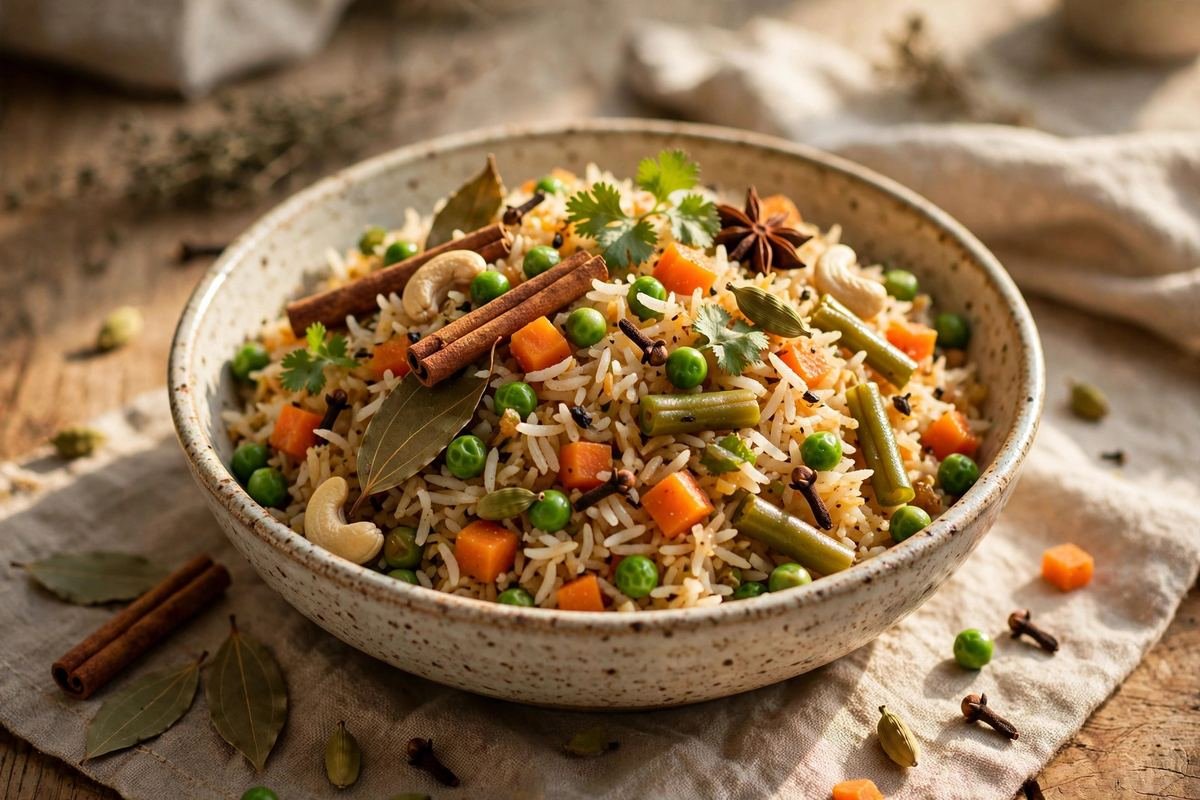
One pot, thirty minutes, endless comfort. Fluffy basmati tossed with colourful vegetables and whole spices makes this the easiest impressive rice dish you will cook.
Ingredients
- 2 cups (400g) basmati rice, rinsed and soaked 20 minutes, then drained
- 3.5 cups (840ml) hot water
- 2 tbsp ghee or neutral oil
- 1 tsp cumin seeds
- 2 bay leaves
- 4 green cardamom pods, lightly crushed
- 4 cloves
- 1 cinnamon stick (1.5 inches)
- 1 star anise (optional)
- 1 large onion (150g), thinly sliced
- 1 tbsp ginger-garlic paste
- 2 green chillies, slit lengthwise
- 1 cup (150g) carrots, diced small
- 1 cup (120g) green beans, cut into half-inch pieces
- 3/4 cup (100g) green peas
- 1 cup (150g) cauliflower, cut into small florets
- 1 medium potato (150g), peeled and diced small
- 1/2 tsp turmeric powder
- 1 tsp garam masala
- 1.5 tsp salt, plus more to taste
- 2 tbsp fresh coriander leaves, chopped
- 1 tbsp lemon juice
- 2 tbsp fried onions, for garnish (optional)
Instructions
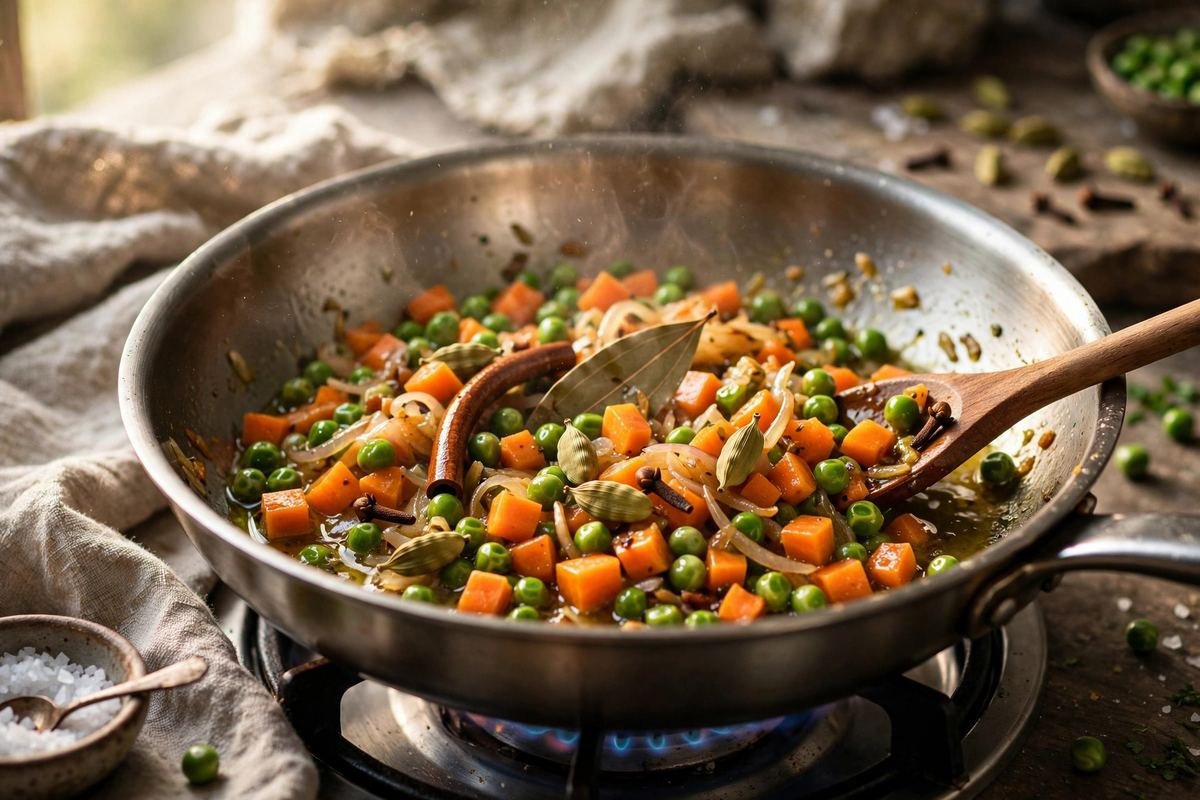
- Bloom the whole spices: Heat the ghee in a heavy-bottomed pot over medium heat until it shimmers. Add the cumin seeds and let them sizzle for 20 seconds until they darken a shade and smell nutty. Add the bay leaves, cardamom, cloves, cinnamon and star anise; stir for 30 seconds until fragrant. Do not let them smoke, burnt spices turn the whole pulao bitter.
- Sauté the aromatics: Add the sliced onion and cook for 4 to 5 minutes, stirring often, until soft and golden at the edges. Stir in the ginger-garlic paste and slit green chillies and cook for 1 minute until the raw smell disappears and the mixture looks glossy.
- Cook the vegetables: Add the diced carrots, beans, cauliflower and potato with the turmeric, garam masala and salt. Stir to coat everything in the spiced ghee and cook for 4 to 5 minutes. The vegetables should look bright and slightly softened at the edges but still firm; they will finish cooking with the rice. Stir in the peas last.
- Add rice and water: Add the drained rice and stir very gently for 1 minute so each grain gets coated in the flavoured fat; you will notice the grains turn slightly translucent at the tips. Pour in the hot water, using hot water keeps the temperature steady so the rice cooks evenly, and bring to a vigorous boil. Taste the water: it should be well salted, slightly saltier than you think necessary.
- Steam on low: Once boiling, reduce the heat to the lowest setting, cover with a tight lid, and cook undisturbed for 15 minutes. Do not lift the lid, the trapped steam is doing the work. After 15 minutes, switch off the heat and let the pot rest, still covered, for 10 minutes.
- Fluff and finish: Remove the lid and let the initial burst of steam escape for a minute. Fluff the rice gently with a fork, lifting from the bottom rather than stirring, which breaks grains. Sprinkle over the lemon juice and coriander, toss lightly, and garnish with fried onions if using. Serve hot.
Tip: Read through the full post below for step-by-step photos, pro tips, variations and FAQs before you start cooking.
Why Vegetable Pulao Deserves a Place in Your Weekly Rotation
Every home cook needs a dish that is greater than the sum of its parts, something that turns a bag of rice and whatever vegetables are wilting in the crisper into dinner in half an hour. For me, that dish is vegetable pulao. It is the quiet workhorse of Indian kitchens: not as theatrical as biryani, not as plain as steamed rice, but sitting in the perfect middle where comfort meets just enough celebration. The technique is beautifully simple. You bloom whole spices in ghee, sauté vegetables with aromatics, add soaked basmati and water, and let one pot do all the work while you set the table.
Pulao has ancient roots. The word comes from the Persian pilaf, and the dish travelled to India with traders and cooks centuries ago, settling into every regional kitchen with local twists. In the north it is fragrant with garam masala and ghee; in the south it might carry curry leaves and coconut. What unites every version is the one-pot philosophy: the rice cooks in flavoured liquid, absorbing the spices as it steams, so every grain carries the taste of the whole dish. That is the fundamental difference from biryani, where components stay layered and distinct. In a pulao, everything melds into harmonious, golden, fluffy comfort.
I make this pulao at least twice a month, and it has rescued more weeknights than I can count. It is the dish I cook when friends drop by unexpectedly, when the fridge is nearly empty, when I want something wholesome without standing over the stove. The vegetables can be whatever you have: peas and carrots from the freezer, a lone capsicum, leftover beans. The method never changes, the result never disappoints. If you are new to Indian cooking, this is the perfect first rice dish to master, because it teaches you the two skills every great rice cook needs: blooming spices in fat, and getting the water ratio exactly right.
Why You’ll Love This Recipe
- True one-pot cooking: Everything happens in a single pot, so dinner is ready in 40 minutes with minimal washing up.
- Weeknight easy, guest worthy: Simple enough for a Tuesday, pretty enough for company with its jewel-like vegetables.
- Endlessly flexible: Use any vegetables you have; the method and timing stay the same.
- Perfect lunchbox food: Packs beautifully, reheats well, and tastes great at room temperature.
- Gentle on beginners: No layering, no sealing, no dum, just straightforward stovetop rice with big flavour.
- Balanced and wholesome: Whole vegetables, aromatic spices and fluffy rice in every satisfying spoonful.
Key Ingredients Explained
Basmati rice is the traditional choice, and for good reason: its long grains stay separate and its aroma is unmatched. You can use any long-grain rice in a pinch, but soak whatever you use for 20 to 30 minutes. Soaking is not optional folklore; it lets the grains hydrate evenly so they cook through without the outside turning to mush. After soaking, drain thoroughly, because water clinging to the rice throws off your measured ratio.
The vegetable mix should be colourful and sturdy. Carrots, green beans, peas, cauliflower and potatoes are the classics, cut into small, even pieces so they finish cooking in the same time as the rice. Dice everything to roughly half-inch pieces, smaller than you would for biryani, because here the vegetables cook only as long as the rice does. Frozen peas and corn are perfectly fine and need no thawing. Avoid watery vegetables like zucchini or tomatoes in large quantities; they release liquid and make the pulao soggy.
Whole spices are the soul of a pulao. Cumin seeds, bay leaves, green cardamom, cloves, cinnamon and a star anise or two bloom in hot ghee, and that flavoured fat coats every grain. Do not substitute ground spices for the whole ones at this stage; ground spices burn in the blooming step and turn bitter. You will add a little garam masala later for depth, but the whole spices do the heavy aromatic lifting. Ghee gives the classic rich flavour, though a neutral oil works if you prefer. Salt generously, the rice absorbs a lot of it, and finish with fresh coriander and a squeeze of lemon to brighten everything.
Equipment You’ll Need
- Heavy-bottomed pot or deep pan with a tight lid: Even heat prevents the bottom from scorching while the top steams.
- Fine-mesh strainer: For rinsing and draining the soaked rice.
- Wooden spoon or spatula: For gentle stirring that does not break the grains.
Ingredients
- 2 cups (400g) basmati rice, rinsed and soaked 20 minutes, then drained
- 3.5 cups (840ml) hot water
- 2 tbsp ghee or neutral oil
- 1 tsp cumin seeds
- 2 bay leaves
- 4 green cardamom pods, lightly crushed
- 4 cloves
- 1 cinnamon stick (1.5 inches)
- 1 star anise (optional)
- 1 large onion (150g), thinly sliced
- 1 tbsp ginger-garlic paste
- 2 green chillies, slit lengthwise
- 1 cup (150g) carrots, diced small
- 1 cup (120g) green beans, cut into half-inch pieces
- 3/4 cup (100g) green peas
- 1 cup (150g) cauliflower, cut into small florets
- 1 medium potato (150g), peeled and diced small
- 1/2 tsp turmeric powder
- 1 tsp garam masala
- 1.5 tsp salt, plus more to taste
- 2 tbsp fresh coriander leaves, chopped
- 1 tbsp lemon juice
- 2 tbsp fried onions, for garnish (optional)
Instructions
- Bloom the whole spices: Heat the ghee in a heavy-bottomed pot over medium heat until it shimmers. Add the cumin seeds and let them sizzle for 20 seconds until they darken a shade and smell nutty. Add the bay leaves, cardamom, cloves, cinnamon and star anise; stir for 30 seconds until fragrant. Do not let them smoke, burnt spices turn the whole pulao bitter.
- Sauté the aromatics: Add the sliced onion and cook for 4 to 5 minutes, stirring often, until soft and golden at the edges. Stir in the ginger-garlic paste and slit green chillies and cook for 1 minute until the raw smell disappears and the mixture looks glossy.
- Cook the vegetables: Add the diced carrots, beans, cauliflower and potato with the turmeric, garam masala and salt. Stir to coat everything in the spiced ghee and cook for 4 to 5 minutes. The vegetables should look bright and slightly softened at the edges but still firm; they will finish cooking with the rice. Stir in the peas last.
- Add rice and water: Add the drained rice and stir very gently for 1 minute so each grain gets coated in the flavoured fat; you will notice the grains turn slightly translucent at the tips. Pour in the hot water, using hot water keeps the temperature steady so the rice cooks evenly, and bring to a vigorous boil. Taste the water: it should be well salted, slightly saltier than you think necessary.
- Steam on low: Once boiling, reduce the heat to the lowest setting, cover with a tight lid, and cook undisturbed for 15 minutes. Do not lift the lid, the trapped steam is doing the work. After 15 minutes, switch off the heat and let the pot rest, still covered, for 10 minutes.
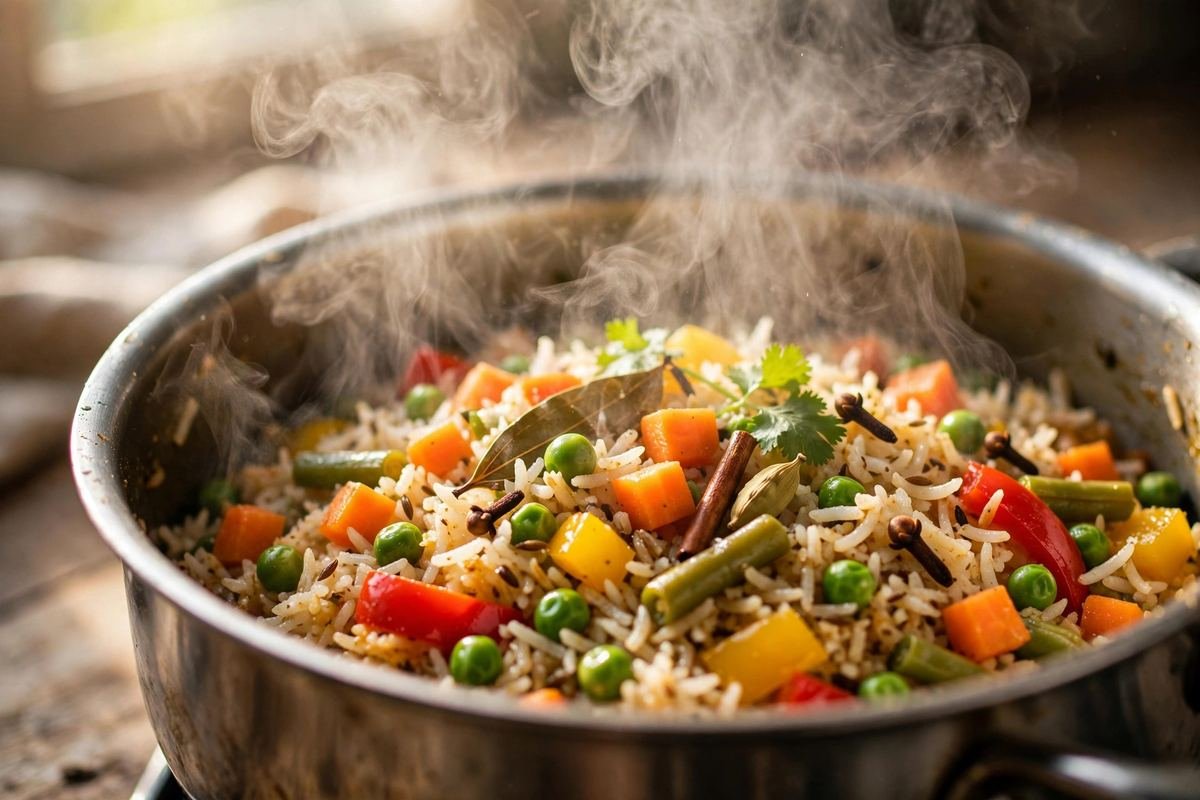
- Fluff and finish: Remove the lid and let the initial burst of steam escape for a minute. Fluff the rice gently with a fork, lifting from the bottom rather than stirring, which breaks grains. Sprinkle over the lemon juice and coriander, toss lightly, and garnish with fried onions if using. Serve hot.
Pro Tips for Perfect Results
- Use the 1:1.75 rice-to-water ratio: For soaked basmati, 1 cup of rice needs 1 and 3/4 cups of water. Too much water gives mush; too little leaves hard cores. Measure, do not eyeball, until you know your pot.
- Always use hot water: Cold water drops the pot temperature and the rice cooks unevenly, with gummy bottoms and firm tops. Keep a kettle of hot water ready before you start.
- Do not skip the rest: The 10-minute covered rest after cooking is when the grains firm up and absorb the last of the steam. Skipping it gives you wet, fragile rice.
- Cut vegetables small and even: Half-inch pieces cook through in the 15-minute steam. Large chunks stay raw in the middle while the rice overcooks around them.
- Toast the rice in ghee: That one minute of gentle stirring coats every grain in spiced fat, which keeps grains separate and adds a nutty depth you cannot get any other way.
- Salt the cooking water properly: Rice absorbs a surprising amount of salt. The water should taste distinctly salty before the lid goes on; you can always adjust at the table, but you cannot season the inside of a grain afterwards.
- Fluff with a fork, never a spoon: A fork lifts and separates; a spoon mashes. Work from the edges toward the centre in gentle lifting motions.
Variations to Try
For a South Indian twist, temper with mustard seeds, curry leaves and a handful of grated coconut, and finish with roasted cashews. A Kashmiri-style pulao adds saffron milk, fried paneer cubes and a sweet-savoury mix of raisins and slivered almonds. If you like heat, stir in a teaspoon of red chilli powder with the turmeric and top with crispy fried green chillies. For extra protein, add a cup of cooked chickpeas or kidney beans along with the vegetables. A mushroom pulao, made by swapping the cauliflower for 200g of sliced button mushrooms added with the onions, is deeply savoury and wonderful. And for a festive touch, layer in some fried onion birista and saffron milk at the end and give it 5 minutes of covered resting, a cheat’s biryani that takes half the effort.
Serving Suggestions
Vegetable pulao is gloriously self-sufficient, but a few sides turn it into a feast. A simple onion-tomato raita or cucumber raita is the classic partner; the cool yoghurt balances the warm spices perfectly. Serve with a side of dal fry or a simple moong dal for extra protein, and some crunchy papad or pickle for contrast. A kachumber salad of diced onion, tomato and cucumber with lemon and chaat masala adds freshness. For a lunchbox, pack the pulao with a small container of raita and a lemon wedge. It also makes a wonderful base for a buddha-bowl-style meal topped with roasted paneer or a fried egg.
Storage and Reheating
Pulao stores like a dream. Cool completely, then refrigerate in an airtight container for up to 4 days; the flavours actually deepen overnight. To reheat, sprinkle a tablespoon of water over the rice and microwave covered for 2 to 3 minutes, fluffing halfway through. On the stovetop, warm in a covered pan over low heat for 6 to 8 minutes. Pulao freezes well for up to 2 months; portion it into meal-sized containers, thaw overnight in the fridge, and reheat as above. Leftover pulao also makes excellent fried rice: toss cold pulao in a hot wok with a little oil, soy sauce and spring onions for a next-day Indo-Chinese twist.
Frequently Asked Questions
Why is my pulao sticky or mushy?
The usual suspects are too much water, skipping the soak, or lifting the lid during steaming. Stick to the 1:1.75 ratio for soaked basmati, always rest the pot covered for 10 minutes after cooking, and resist peeking. Also make sure your vegetables are not watery; pat thawed frozen vegetables dry before adding.
Can I make vegetable pulao in a pressure cooker?
Yes, and it is even faster. Follow the same sautéing steps in the cooker, add rice and water, then pressure cook for exactly 1 whistle on medium heat (about 6 minutes at pressure) and let the pressure release naturally for 10 minutes. Do not cook for 2 whistles or the rice will turn to mush.
Can I make it in an Instant Pot?
Absolutely. Use sauté mode for the spices, onions and vegetables, then add rice and water, seal, and cook on high pressure for 5 minutes with a 10-minute natural release. The texture is excellent and very consistent.
How do I keep the rice grains separate?
Three things: soak the rice, toast it in the spiced ghee before adding water, and do not stir once the lid is on. Stirring releases starch and breaks grains. Fluff only at the very end with a fork.
Is vegetable pulao healthy?
It is a genuinely balanced meal: complex carbs from basmati, fibre and vitamins from the vegetables, and modest fat from ghee. To lighten it further, use 1 tablespoon of oil instead of ghee and load up on extra vegetables. A cup of pulao with raita makes a complete, satisfying lunch.
Can I add paneer to pulao?
Yes, and it is delicious. Pan-fry 150g of paneer cubes until golden and fold them in gently after fluffing the rice, so they do not break during cooking. The paneer soaks up the spiced steam and adds wonderful richness and protein.
Some recipes impress with complexity; this one impresses with reliability. Once you have the ratio and the rhythm in your hands, vegetable pulao becomes one of those dishes you cook without thinking, the way you hum a favourite song. Keep the spices bloomed, the water measured and the lid closed, and dinner will take care of itself. Happy cooking.