Recipe Card
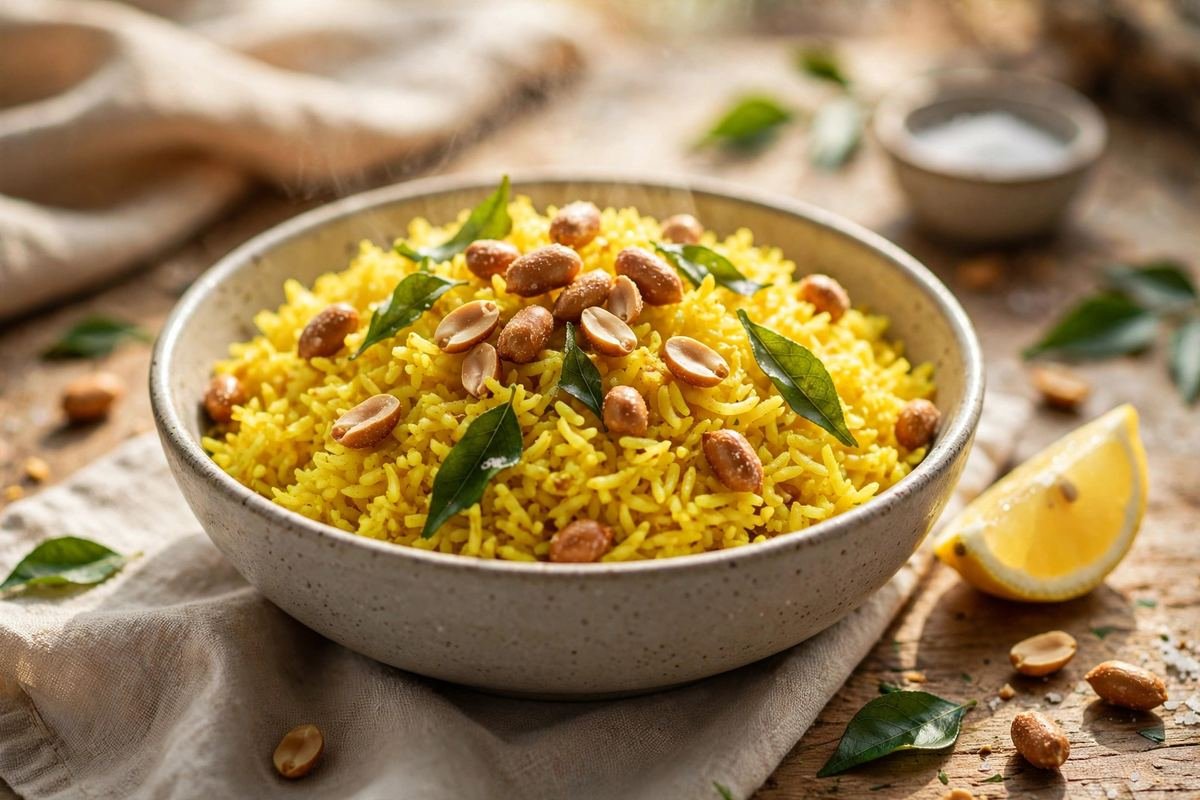
Bright, tangy South Indian lemon rice with crunchy peanuts and a crackling mustard-seed tempering. A 30-minute lunchbox hero that turns day-old rice into something you’ll crave.
Ingredients
- 1 1/2 cups rice (300g), preferably sona masoori or basmati
- 3 cups water (720ml), for cooking the rice
- 3 tbsp sesame oil (45ml), plus 1 tsp for cooling the rice
- 1/3 cup raw peanuts (50g)
- 1 tbsp chana dal (15g), rinsed and patted very dry
- 1 tbsp urad dal (15g), rinsed and patted very dry
- 1 tsp black mustard seeds
- 1/4 tsp asafoetida (hing), optional
- 4 dried red chillies, broken in half
- 2 green chillies, slit lengthwise
- 1-inch piece fresh ginger (15g), finely chopped
- 15–18 fresh curry leaves (2 sprigs)
- 1/2 tsp turmeric powder
- 1 1/4 tsp fine salt, plus more to taste
- 2 large lemons, juiced (about 1/4 cup / 60ml)
- 2 tbsp freshly grated coconut, optional
- 2 tbsp chopped fresh coriander leaves, for garnish
Instructions
- Cook and cool the rice. Rinse the rice in 3 to 4 changes of water until the water runs mostly clear, then cook with the 3 cups of water — either in a rice cooker or in a saucepan brought to a boil, then covered and simmered on low for 12 to 14 minutes until just tender. The grains should be fully cooked but still distinct and firm, not soft and splitting. Immediately spread the rice on a wide plate or tray in a thin layer, drizzle over 1 teaspoon of sesame oil, and gently fluff with a fork to separate the grains. Let it cool completely to room temperature, at least 30 minutes; for best results, refrigerate uncovered for 2 hours or overnight. Cold, firm grains are the secret to non-mushy lemon rice.
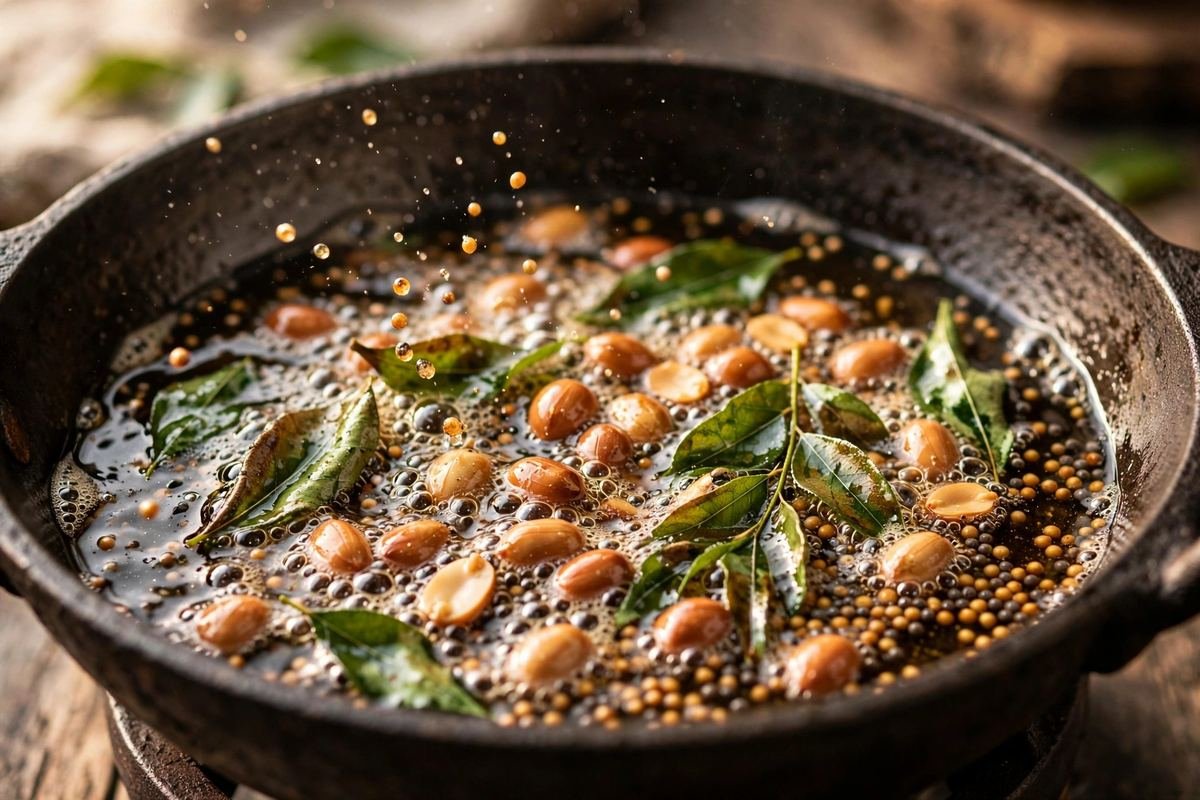
- Heat the oil and roast the peanuts. Set your wide kadai over medium heat and add the 3 tablespoons of sesame oil. When the oil shimmers and a peanut dropped in sizzles gently, add the peanuts and fry, stirring often, for 2 to 3 minutes until they turn a deep golden colour and smell richly toasty. Do not rush this — under-roasted peanuts taste raw and ruin the dish. Scoop them out with a slotted spoon onto a plate and set aside; they go back in at the end so they stay crisp.
- Crisp the dals. In the same hot oil, add the chana dal and urad dal. Fry, stirring constantly, for 60 to 90 seconds until they turn golden-brown and smell nutty. They go from golden to burnt in seconds, so watch them like a hawk and keep them moving. The oil must be properly hot — you want an enthusiastic sizzle on contact — or the dals turn leathery instead of crisp.
- Crackle the mustard seeds. Add the mustard seeds to the oil and wait for them to pop and crackle vigorously, about 20 to 30 seconds. Every seed should pop — grey, silent seeds taste raw and bitter. The moment the crackling subsides, add the asafoetida (if using), the broken dried red chillies, slit green chillies and chopped ginger. Fry 30 seconds until the ginger edges turn golden and the chillies blister.
- Sizzle the curry leaves. Toss in the curry leaves — stand back, they will sputter dramatically — and fry for about 20 seconds until they are crisp, darkened and intensely fragrant. Have the lid ready to partially cover the pan if the sputtering is violent. This 20-second fry is what releases the curry leaves’ essential oils into the fat; pale, limp curry leaves mean under-fried flavour.
- Toss the rice with turmeric and salt. Add the cooled rice to the kadai along with the turmeric and salt. Using a gentle lifting-and-folding motion with your spatula — never mashing or stirring aggressively — toss the rice through the tempered oil for 2 to 3 minutes over medium-low heat until every grain is evenly golden and warmed through. If the rice was refrigerated, give it an extra minute so no cold clumps remain. Taste a grain: it should be seasoned and savoury already, before any lemon.
Tip: Read through the full post below for step-by-step photos, pro tips, variations and FAQs before you start cooking.
The Story Behind Lemon Rice
In Karnataka it is called chitranna, in Tamil Nadu elumichai sadam, and in a million Indian lunchboxes it is simply “the yellow rice that never disappoints.” Lemon rice is one of South India’s great transformer dishes — a humble, almost austere preparation that takes plain cooked rice and, with nothing more than lemon, turmeric and a sizzling tempering, turns it into something bright, crunchy, nutty and deeply satisfying. It is temple food and travel food, picnic food and sick-day food; it shows up in prasadam boxes at festivals and in steel tiffin carriers on overnight trains, because it travels well, keeps well, and tastes good at any temperature.
The dish belongs to the family of kalantha sadam — “mixed rices” — that form the backbone of South Indian home cooking. Long before refrigeration, cooks learned that tossing cooked rice with acidic, well-tempered seasonings kept it safe and delicious for hours: the lemon’s acidity, the turmeric’s antimicrobial reputation and the thorough frying of the tempering all helped the rice stay fresh through a hot day. That practical wisdom became flavour wisdom. Each region left its fingerprint — Karnataka’s chitranna leans on roasted peanuts and a touch of grated coconut, Tamil versions favour sesame oil and curry leaves, and Andhra kitchens are not shy with the green chillies — but the soul of the dish is the same everywhere: sour, salty, crunchy, golden.
What makes lemon rice special is its balance of contrasts. Every forkful should give you soft, separate grains of rice against the deep crunch of peanuts and fried dals, the bright slap of lemon against the earthy warmth of turmeric, the crackle of mustard seeds against the perfume of curry leaves. It is a dish that proves restraint is a flavour: there are no complex spice blends here, no long simmering, just a handful of ingredients treated with respect. This recipe follows the classic Karnataka-style method, with the one rule that matters most — the lemon goes in off the heat, always — and a few small refinements that keep the rice grains separate and glossy rather than mushy and dull.
Why You’ll Love This Recipe
- Ready in 35 minutes: most of that is just the rice cooking — the tempering takes five.
- Lunchbox champion: tastes great at room temperature and stays fresh for hours, no reheating needed.
- Day-old rice rescue: the best lemon rice starts with cold leftover rice, so this is your fridge-cleanout hero.
- Crunch in every bite: roasted peanuts plus crisp-fried chana and urad dals for serious texture.
- Bright, not harsh: the lemon-off-heat method gives clean citrus tang with zero bitterness.
- Naturally vegan and gluten-free: skip the asafoetida or use a gluten-free one, and it suits almost everyone.
- Endlessly packable: pairs with pickle, papad, curd or just a handful of fried appalams.
Key Ingredients Explained
Rice — and why day-old is best: The single biggest factor in great lemon rice is the rice itself. Freshly cooked, steaming rice is too soft and wet; tossed with tempering it clumps and turns mushy. Rice that has been cooked, cooled and refrigerated overnight firms up as the starches retrograde, so each grain stays separate and drinks up the seasoned oil without collapsing. If you must cook fresh, spread the hot rice on a wide plate or tray, drizzle with a teaspoon of sesame oil, and fan it cool for at least 30 minutes. Medium-grain or short-grain rice like sona masoori is traditional, but long-grain basmati works beautifully too — just cook it a touch firmer than usual.
Lemons — fresh, and added off the heat: This is the rule the whole dish hangs on. Lemon juice added to a screaming-hot pan turns bitter as its delicate compounds scorch; stirred through warm (not hot) rice, it stays bright, clean and sunny. Always use fresh lemons — bottled juice has a flat, cooked flavour that no amount of tempering can fix. Roll the lemons firmly on the counter before cutting to release maximum juice, and taste as you go: two lemons is a starting point, not a law.
Peanuts — the crunch backbone: Raw peanuts, roasted golden in the tempering itself, give lemon rice its signature deep crunch and nutty richness. Fry them first in the hot oil before the dals, giving them a full 2 to 3 minutes until they turn golden and smell toasty — pale peanuts taste raw and unpleasant. If anyone in the house has a nut allergy, roasted cashews are the traditional alternative, or simply double the dals.
Chana dal and urad dal — the crisp confetti: These tiny split lentils are not cooked soft here; they are fried in hot oil until golden and crisp, adding a wonderful crackly texture and a toasty, savoury depth. They need to go into properly hot oil or they turn leathery instead of crisp — listen for an enthusiastic sizzle the moment they hit the pan. Rinse and thoroughly dry them first; wet dal spatters violently in hot oil.
Mustard seeds, curry leaves, turmeric: The holy trinity of the South Indian tempering. Mustard seeds must crackle and pop completely — grey, uncrackled seeds are bitter and raw-tasting. Curry leaves go in after the seeds have popped; they will sputter dramatically, so have a lid handy, and fry them until crisp and deeply fragrant, about 20 seconds. Turmeric goes in with the rice rather than the hot oil, where it would scorch — it is what gives lemon rice its glorious golden colour.
Sesame oil (gingelly oil): The traditional cooking fat for lemon rice in Tamil Nadu, and it matters: its deep, nutty aroma is part of the dish’s identity. Use toasted/cold-pressed sesame oil, not the pale refined kind. If you only have neutral oil, the dish still works, but a teaspoon of sesame oil stirred in at the end gets you most of the way there.
Equipment You’ll Need
- Heavy-bottomed saucepan or rice cooker for the rice
- Wide kadai or large frying pan — you need room to toss the rice without crushing it
- Wide plate or tray for cooling the rice
- Wooden spoon or spatula with a flat edge for gentle tossing
- Citrus juicer or reamer, and a small strainer for the lemon juice
- A lid to tame the curry-leaf sputtering
- 1 1/2 cups rice (300g), preferably sona masoori or basmati
- 3 cups water (720ml), for cooking the rice
- 3 tbsp sesame oil (45ml), plus 1 tsp for cooling the rice
- 1/3 cup raw peanuts (50g)
- 1 tbsp chana dal (15g), rinsed and patted very dry
- 1 tbsp urad dal (15g), rinsed and patted very dry
- 1 tsp black mustard seeds
- 1/4 tsp asafoetida (hing), optional
- 4 dried red chillies, broken in half
- 2 green chillies, slit lengthwise
- 1-inch piece fresh ginger (15g), finely chopped
- 15–18 fresh curry leaves (2 sprigs)
- 1/2 tsp turmeric powder
- 1 1/4 tsp fine salt, plus more to taste
- 2 large lemons, juiced (about 1/4 cup / 60ml)
- 2 tbsp freshly grated coconut, optional
- 2 tbsp chopped fresh coriander leaves, for garnish
- Cook and cool the rice. Rinse the rice in 3 to 4 changes of water until the water runs mostly clear, then cook with the 3 cups of water — either in a rice cooker or in a saucepan brought to a boil, then covered and simmered on low for 12 to 14 minutes until just tender. The grains should be fully cooked but still distinct and firm, not soft and splitting. Immediately spread the rice on a wide plate or tray in a thin layer, drizzle over 1 teaspoon of sesame oil, and gently fluff with a fork to separate the grains. Let it cool completely to room temperature, at least 30 minutes; for best results, refrigerate uncovered for 2 hours or overnight. Cold, firm grains are the secret to non-mushy lemon rice.
- Heat the oil and roast the peanuts. Set your wide kadai over medium heat and add the 3 tablespoons of sesame oil. When the oil shimmers and a peanut dropped in sizzles gently, add the peanuts and fry, stirring often, for 2 to 3 minutes until they turn a deep golden colour and smell richly toasty. Do not rush this — under-roasted peanuts taste raw and ruin the dish. Scoop them out with a slotted spoon onto a plate and set aside; they go back in at the end so they stay crisp.
- Crisp the dals. In the same hot oil, add the chana dal and urad dal. Fry, stirring constantly, for 60 to 90 seconds until they turn golden-brown and smell nutty. They go from golden to burnt in seconds, so watch them like a hawk and keep them moving. The oil must be properly hot — you want an enthusiastic sizzle on contact — or the dals turn leathery instead of crisp.
- Crackle the mustard seeds. Add the mustard seeds to the oil and wait for them to pop and crackle vigorously, about 20 to 30 seconds. Every seed should pop — grey, silent seeds taste raw and bitter. The moment the crackling subsides, add the asafoetida (if using), the broken dried red chillies, slit green chillies and chopped ginger. Fry 30 seconds until the ginger edges turn golden and the chillies blister.
- Sizzle the curry leaves. Toss in the curry leaves — stand back, they will sputter dramatically — and fry for about 20 seconds until they are crisp, darkened and intensely fragrant. Have the lid ready to partially cover the pan if the sputtering is violent. This 20-second fry is what releases the curry leaves’ essential oils into the fat; pale, limp curry leaves mean under-fried flavour.
- Toss the rice with turmeric and salt. Add the cooled rice to the kadai along with the turmeric and salt. Using a gentle lifting-and-folding motion with your spatula — never mashing or stirring aggressively — toss the rice through the tempered oil for 2 to 3 minutes over medium-low heat until every grain is evenly golden and warmed through. If the rice was refrigerated, give it an extra minute so no cold clumps remain. Taste a grain: it should be seasoned and savoury already, before any lemon.
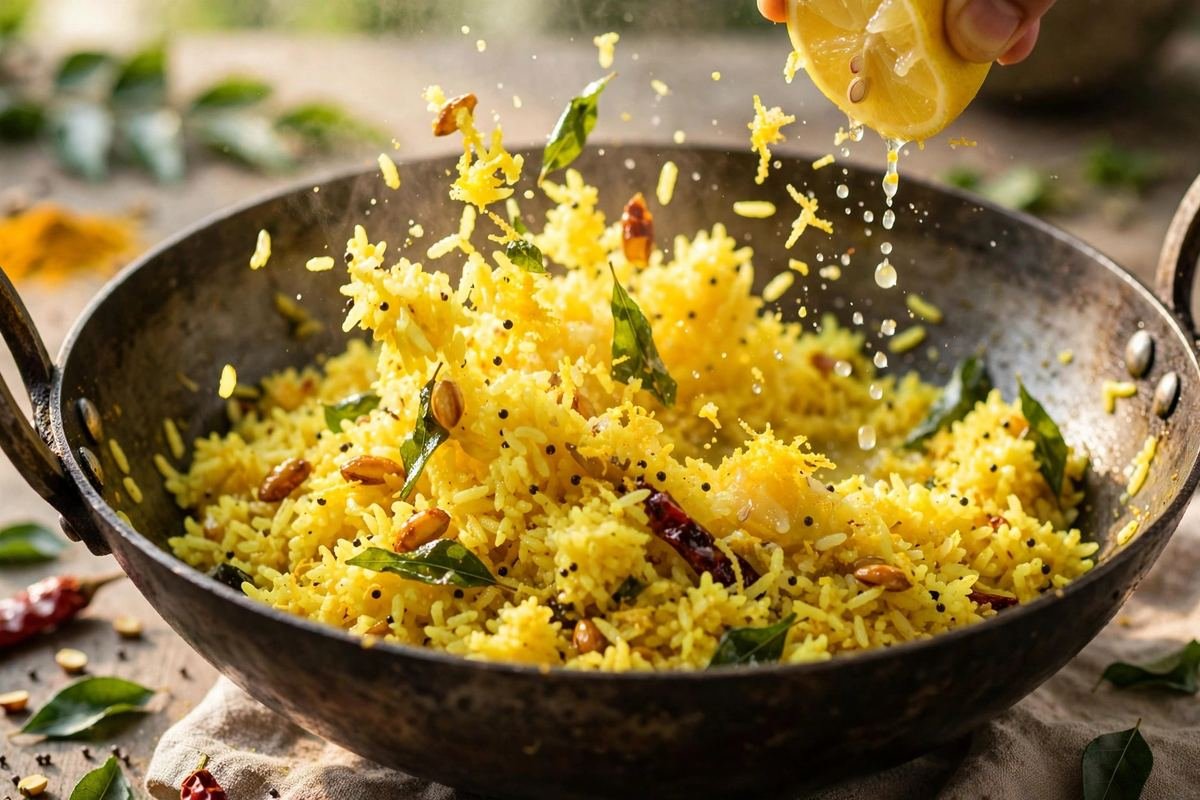
- Take it off the heat — then add the lemon. Remove the kadai from the burner entirely and wait 1 to 2 minutes until the rice is steaming gently rather than fiercely hot. Pour the strained lemon juice evenly over the rice and fold it through gently. This is the critical moment: lemon juice hitting a ripping-hot pan scorches and turns bitter, but on warm rice it stays bright and clean. Taste and adjust — add more lemon juice a teaspoon at a time if you want it tangier, or a pinch more salt if the sourness needs balancing.
- Rest, garnish and serve. Return the reserved roasted peanuts to the pan and fold through, along with the grated coconut if using. Cover and rest for 5 minutes so the flavours settle into the grains. Garnish with chopped coriander, fluff once more with a fork, and serve. Lemon rice is excellent warm, at room temperature, or even cold from the lunchbox — it is one of the rare dishes that asks for nothing and gives back at every temperature.
Pro Tips for Perfect Results
- Cold rice is non-negotiable. If your lemon rice ever turned mushy, this was why. Cook the rice ahead, cool it spread out on a tray, and refrigerate if you can. Firm, separate grains drink up the tempering; soft warm grains collapse into it.
- Lemon goes in off the heat. Say it like a mantra. Hot pan plus lemon juice equals bitterness. Pull the kadai off the burner, let the furious steaming subside, then add the juice.
- Strain your lemon juice. Seeds are bitter little surprises and pith makes the rice taste harsh. A quick pour through a small strainer takes ten seconds and saves the dish.
- Fry the peanuts first, return them last. Peanuts fried in the tempering and left in while you toss the rice go soft from the steam. Scooping them out and folding them back at the end keeps every one crisp.
- Season before the lemon, balance after. Salt the rice with the turmeric first, then add lemon, then taste and adjust. Salt and acid balance each other — the final seasoning only makes sense once both are in.
- Keep the dals moving. Chana and urad dal cross from golden to burnt in under 30 seconds. Stir constantly, and if your stove runs hot, pull the pan off the heat for a few seconds rather than risking it.
- Do not skimp on the oil. Three tablespoons may look like a lot, but every grain needs a glossy coat to carry the turmeric and tempering flavours. Dry, pale lemon rice is under-oiled lemon rice.
- Fresh curry leaves matter. Dried curry leaves are a shadow of the fresh ones — brittle, dusty, almost flavourless. If you cannot find fresh, skip them rather than substituting dried; the dish survives, but fresh leaves make it sing.
Variations to Try
Pulihora (Andhra-style): add 1 tablespoon of tamarind pulp soaked in warm water along with the lemon juice, and double the green chillies — tangier, hotter, and deeply traditional.
Coconut lemon rice: increase the grated coconut to 1/3 cup and add it with the rice so it toasts lightly in the tempering — a Karnataka tiffin-room favourite.
Vegetable lemon rice: toss in 1 cup of finely diced carrots, green beans and peas, sautéed in the tempering before the rice goes in, for a one-bowl lunch.
Mango lemon rice: in summer, replace half the lemon juice with 1/2 cup of finely diced raw mango for a seasonal, fruity tang.
Orange-sesame twist: finish with 1 teaspoon of toasted sesame seeds and a few drops of orange juice alongside the lemon for a fragrant, modern variation.
Quinoa lemon “rice”: swap the rice for 1 1/2 cups of cooked, cooled quinoa for a protein-rich, gluten-free version — the tempering works identically.
Serving Suggestions
Lemon rice is proudly self-sufficient, but the right accompaniments turn it into a feast. The classic South Indian plate pairs it with curd or raita — the cool creaminess against the tangy rice is one of the great simple contrasts — plus a crisp papad or appalams and a spoon of mango or lime pickle. For a fuller meal, serve alongside coconut chutney and sambar, or with a simple poriyal (stir-fried vegetables with coconut). It is also the ideal partner for curd rice — the two mixed rices side by side are a staple of Tamil wedding meals and temple feasts. Pack it in a steel tiffin with a banana and a small box of mixture (savoury snack mix) and you have the definitive Indian train journey lunch. A glass of buttermilk or panakam (jaggery-pepper cooler) is the traditional drink alongside.
Storage and Reheating
Lemon rice keeps exceptionally well, which is exactly why it became a travel classic. Cool completely and refrigerate in an airtight container for up to 3 days — the flavours actually deepen overnight. It is delicious eaten cold or at room temperature straight from the fridge; if you prefer it warm, sprinkle a teaspoon of water over it and microwave covered for 90 seconds, or warm gently in a pan. The peanuts will soften slightly on storage; revive the crunch by scattering a few freshly roasted peanuts over the top when serving. Do not freeze lemon rice — the grains turn mealy and the lemon flavour dulls. For meal prep, cook a big batch of rice on Sunday, refrigerate, and temper fresh portions through the week; the tempering itself takes five minutes, so a fresh batch is never more than ten minutes away.
Frequently Asked Questions
Why did my lemon rice turn bitter?
Nine times out of ten, the lemon juice hit a too-hot pan. The juice must go in after the kadai comes off the heat, when the rice is warm but no longer fiercely steaming. The other culprits are lemon seeds or pith in the juice (always strain it) and scorched turmeric — which is why turmeric goes in with the rice, not into the screaming-hot tempering oil.
Can I use freshly cooked rice?
You can, but you must cool it properly first. Spread the hot rice on a wide tray, drizzle with a teaspoon of sesame oil, fluff with a fork and fan it for at least 30 minutes until completely cool. Even then, day-old refrigerated rice gives a noticeably better, more separate-grained result.
Is lemon rice the same as chitranna?
Chitranna is the Karnataka name for the same family of dish, and in practice the terms are used interchangeably. Purists will tell you classic chitranna often includes roasted peanuts and grated coconut and is mixed with the tempering while the rice is still slightly warm, but the bright lemon-tangy rice you know and love is the same soul.
My mustard seeds never pop. What is wrong?
The oil is not hot enough, or the seeds are old. Test the oil with a single seed first — it should begin to dance and pop within seconds. Old mustard seeds lose their volatile oils and pop weakly; buy them in small quantities and store airtight. And never add the dals or leaves before the seeds have finished crackling, or the steam keeps them from popping.
Can I make it without peanuts for a school lunchbox?
Absolutely. Double the chana and urad dals for crunch, or add roasted cashews if tree nuts are fine and only peanuts are the issue. Many schools are nut-free, and the dal-only version is completely traditional — plenty of Tamil home versions skip peanuts entirely.
How do I scale this for a party?
It scales beautifully. The ratio holds up to a triple batch in a very wide kadai or a large stockpot — just make sure you have room to toss without crushing the grains. Temper in two batches if your pan is crowded, since overcrowding steams the dals instead of crisping them. Lemon juice scales linearly; add it gradually and taste.
Lemon rice is proof that the simplest dishes are often the hardest to perfect and the easiest to love. It asks for nothing fancy — yesterday’s rice, a lemon, a handful of pantry spices — and returns a lunchbox that makes coworkers jealous and kids actually finish their tiffins. Master the two rules — cold rice, lemon off the heat — and this bright golden rice will become one of your most-reached-for recipes, the one you make when the fridge looks empty and dinner still needs to happen.