
Recipe Card
Delicate pleated momos stuffed with a juicy cabbage-carrot filling, steamed until translucent and served with fiery red chutney. This recipe covers the dough, the filling, three pleating styles, and foolproof steaming.
Ingredients
- 2 cups maida (all-purpose flour, about 250g), plus extra for dusting
- 1 tsp oil, for the dough, plus more for greasing
- 1/2 tsp salt, for the dough
- 3/4 cup water, approximately, for kneading (add gradually)
- 2 cups finely chopped cabbage (about 200g)
- 1 medium carrot, finely grated (about 3/4 cup)
- 4 spring onions, finely chopped (whites and greens)
- 1 tbsp finely minced ginger
- 1 tbsp finely minced garlic (5-6 cloves)
- 2 green chillies, finely chopped (optional)
- 1 tbsp soy sauce
- 1 tsp white pepper powder
- 1/2 tsp sugar
- 1 tbsp oil, for the filling
- Salt to taste for the filling (remember the cabbage was salted and squeezed)
- 1 tbsp finely chopped coriander (optional)
- 8-10 dried red chillies (mix of Kashmiri for colour and hot variety for heat), stems removed
- 6-7 garlic cloves
- 1-inch piece of ginger, roughly chopped
- 1 medium tomato, roughly chopped
- 1 tbsp white vinegar
- 1 tsp sugar
- 3/4 tsp salt, or to taste
- 2-3 tbsp water, for grinding
Instructions
- Make and rest the dough. In a large bowl, mix the maida, salt, and 1 teaspoon of oil. Add water a little at a time, kneading as you go, until you have a firm, smooth dough — it should feel like stiff play-dough, not soft like roti dough. Knead vigorously for 5 to 7 minutes until completely smooth and elastic. Cover with a damp cloth and rest for at least 30 minutes (up to 2 hours is fine). This rest is non-negotiable: it relaxes the gluten so the wrappers roll thin without shrinking back.
- Prepare the chutney first. Soak the dried red chillies in hot water for 20 to 30 minutes until completely soft and pliable. Drain and add to a mixer jar with the garlic, ginger, tomato, vinegar, sugar, and salt. Grind to a thick, slightly coarse paste, adding water a tablespoon at a time — the chutney should be spoonable but not runny, with a little texture. Taste and adjust: more salt, a pinch more sugar if it is too sharp, or another soaked chilli if you want more fire. Set aside; the flavours meld and improve as it sits.
- Make the juicy filling. Toss the chopped cabbage with 1 teaspoon of salt and let it sit for 10 minutes — you will see water pooling at the bottom of the bowl. Now squeeze the cabbage firmly, handful by handful, wringing out as much liquid as you possibly can; this is the single most important step for a non-soggy momo. Combine the squeezed cabbage with the grated carrot, spring onions, ginger, garlic, green chillies, soy sauce, white pepper, sugar, oil, and coriander. Mix well and taste — it should be boldly seasoned, almost too salty on its own, because the bland wrapper will balance it. Do not add extra salt until you have tasted, since the cabbage was already salted.
- Roll thin, even wrappers. Divide the rested dough into small balls, about the size of a large marble (roughly 15g each). Working with a few at a time and keeping the rest covered with the damp cloth, roll each ball into a 3 to 3.5-inch circle on a lightly floured surface. Aim for wrappers that are thin at the edges and very slightly thicker in the centre — the centre bears the weight of the filling. If the edges are too thick, they will be doughy and unpleasant after steaming; if the centre is too thin, the filling may burst through. Keep rolled wrappers under the damp cloth; even a few minutes of air exposure makes them dry and unsealable.
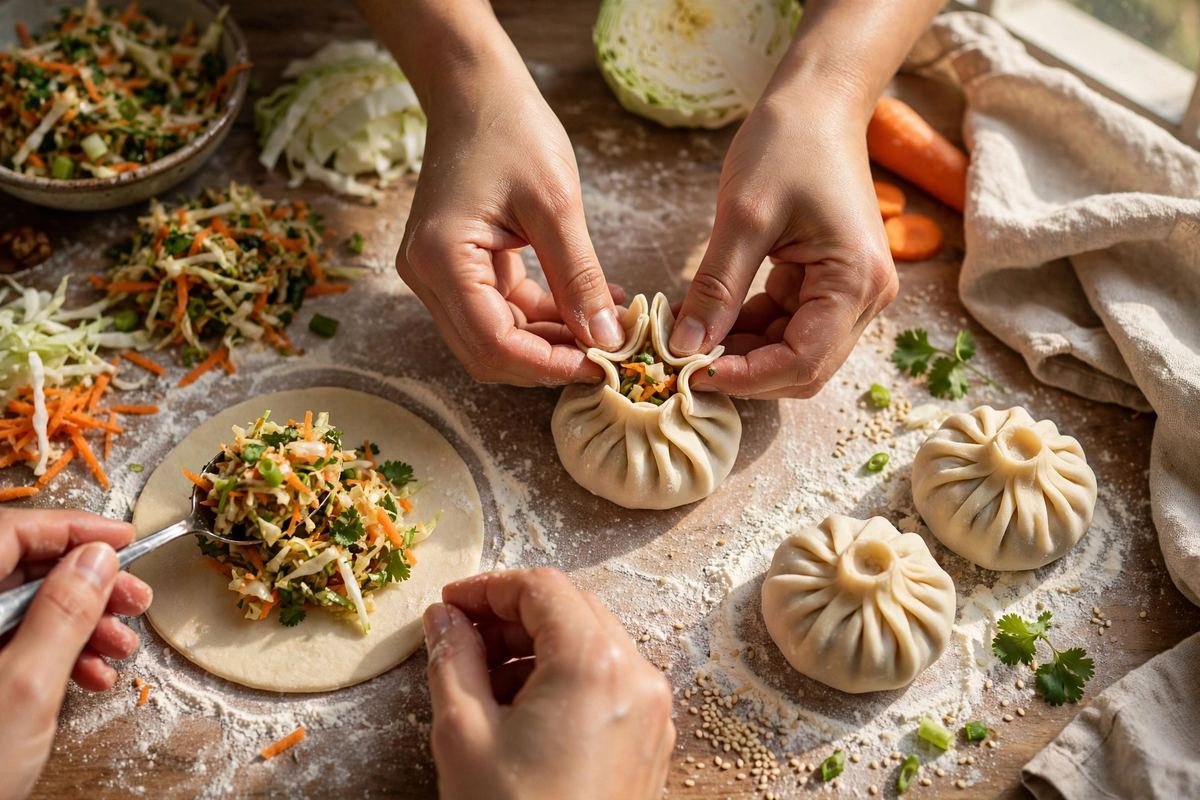
- Fill and pleat. Place a wrapper in your palm and spoon 1 to 1 1/2 teaspoons of filling into the centre — do not overfill; an overstuffed momo will not seal. Moisten the edge of the wrapper with a fingertip dipped in water. For the beginner half-moon: fold the wrapper in half over the filling, press the edges together firmly, then crimp with a fork for a secure seal. For the classic round pleat: hold the filled wrapper in one hand and, starting at one point, make small overlapping folds around the edge with your other hand, gathering the wrapper up and around the filling, then twist and pinch the top closed. For the potli (money bag): gather all the edges up around the filling like a pouch and pinch firmly at the neck. Whichever style you choose, the seal must be airtight — press firmly and check for gaps, because steam will find any weak spot.
- Set up the steamer. Bring water to a rolling boil in your steamer pot — the steam must be vigorous before the momos go in, or they will sit in lukewarm humidity and turn soggy. Line your steamer tray with parchment paper (poke a few holes for steam circulation), lightly greased cabbage leaves, or a well-oiled plate. Arrange the momos at least an inch apart; they puff slightly as they cook and will stick to each other if crowded. Brush or spray the tops very lightly with oil for a glossy finish.
- Steam until translucent. Place the tray over the boiling water, cover with a tight lid, and steam on high heat for 10 to 12 minutes. The momos are done when the wrappers turn slightly translucent and look glossy, and the skin feels firm and non-doughy to a gentle touch — cut one open to check that the filling is steaming hot and cooked through. Do not lift the lid repeatedly; every peek drops the temperature and adds minutes. If steaming in batches, keep the waiting pleated momos covered with the damp cloth so they do not dry out.
- Serve immediately with chutney. Transfer the steaming momos to a serving plate — a slotted spoon or spatula works best, as they are delicate when hot. Serve within minutes, with generous bowls of the red chutney for dipping and perhaps a small dish of soy-vinegar dip on the side. Momos are at their peak in the first ten minutes: the wrapper is tender, the filling is juicy, and the steam still rises when you bite in. Encourage everyone to dip boldly — a momo without chutney is only half the experience.
Tip: Read through the full post below for step-by-step photos, pro tips, variations and FAQs before you start cooking.
There is a quiet theatre to eating momos. You pick one up — carefully, because it is hot — dip it generously in that fierce red chutney, and take a bite that releases a puff of steam and a spoonful of juicy, gingery filling. It is one of India’s great street-food rituals, repeated millions of times a day from Delhi’s momo carts to the hillside stalls of Darjeeling and Gangtok. And yet, for all their ubiquity, homemade momos remain a frontier many cooks never cross, intimidated by the pleating. This recipe is here to change that: the dough is simple, the filling is forgiving, and the pleating — with a little practice — becomes meditative rather than maddening.
Momos travelled to India with Tibetan and Nepali communities, settling first in the Himalayan regions and then conquering the entire country over the last three decades. The Indian street version evolved its own character: a slightly thicker wrapper than the Tibetan original (sturdier for cart cooking), a filling heavy on cabbage and carrot with ginger and spring onions, and above all that blazing red chutney — a blend of dried red chillies, garlic, and tomato that is as essential to the experience as the dumpling itself. In Delhi alone, momo carts number in the thousands, and the steamed veg momo remains the undisputed king of the menu.
What makes this recipe special is its completeness. You get a dough formula that rolls thin without tearing, a filling that stays juicy instead of turning watery, step-by-step guidance for three pleating styles (including a foolproof beginner fold), steaming technique that prevents sticking and sogginess, and the red chutney recipe that ties it all together. Make a batch on a lazy Sunday, rope in family members for the pleating assembly line, and you will understand why momo-making is as much a social event as a cooking project.
Why You’ll Love This Recipe
- Truly juicy filling — the cabbage-squeezing technique and the right fat balance keep the filling moist, never watery or dry.
- Tender, translucent wrappers — a simple dough with the right rest time rolls thin and steams to a delicate, slightly chewy bite.
- Three pleating styles — from a beginner-friendly half-moon to the classic round pleat, with clear guidance for each.
- Fiery red chutney included — the complete momo experience, chutney and all, in one recipe.
- Healthier than fried snacks — steamed, vegetable-packed, and light, yet completely satisfying.
- Freezer-friendly — pleat a big batch, freeze uncooked, and steam from frozen whenever the craving strikes.
Key Ingredients Explained
The dough is deceptively simple: maida (all-purpose flour), a pinch of salt, a teaspoon of oil, and water. But two details matter enormously. First, the dough must be firm and smooth, not soft — softer than a poori dough would be ideal is too soft; you want something closer to a stiff play-dough that holds pleats without stretching thin and tearing. Second, it needs a 30-minute rest under a damp cloth, which relaxes the gluten so the wrappers roll out thin and even without springing back. Skip the rest and you will fight the dough the whole way.
The filling is where juiciness is won or lost. Cabbage is the base — finely chopped or grated, then salted and squeezed to remove excess water. This step is critical: unsqueezed cabbage releases its water during steaming, turning the filling soggy and sometimes bursting the wrapper. Carrots add sweetness and colour, grated fine. Spring onions (both whites and greens) bring sharp freshness, while ginger and garlic, finely minced, give the filling its characteristic warmth. A little oil in the filling — just a tablespoon — coats the vegetables and keeps them succulent, mimicking the juiciness that meat fillings get from fat. Soy sauce adds savoury depth, white pepper its gentle heat, and a pinch of sugar balances everything.
For the red chutney, dried red chillies (the wrinkled Kashmiri or Byadgi kind for colour plus a few hot Guntur or Bedgi chillies for fire) are soaked until soft, then ground with garlic, ginger, tomato, vinegar, and a little sugar and salt. Soaking the chillies is essential — it tames their raw harshness and gives the chutney a smooth, rounded heat. The tomato adds body and a touch of sweetness that balances the fire. This chutney keeps for a week in the fridge and is worth making in a double batch.
Equipment You’ll Need
- A steamer — a bamboo steamer, an idli stand, or any large pot with a steamer insert all work. Even a metal colander set over a pot of boiling water will do in a pinch.
- Parchment paper, cabbage leaves, or a greased plate — to line the steamer so the momos do not stick.
- A rolling pin and a round cutter — a 3 to 3.5-inch cutter (or the rim of a steel glass) for uniform wrappers.
- A damp kitchen towel — to keep rolled wrappers and the resting dough from drying out; dry wrappers crack and will not seal.
- A small bowl of water — for moistening wrapper edges before sealing.
- A mixer grinder or blender — for the chutney.
- 2 cups maida (all-purpose flour, about 250g), plus extra for dusting
- 1 tsp oil, for the dough, plus more for greasing
- 1/2 tsp salt, for the dough
- 3/4 cup water, approximately, for kneading (add gradually)
- 2 cups finely chopped cabbage (about 200g)
- 1 medium carrot, finely grated (about 3/4 cup)
- 4 spring onions, finely chopped (whites and greens)
- 1 tbsp finely minced ginger
- 1 tbsp finely minced garlic (5-6 cloves)
- 2 green chillies, finely chopped (optional)
- 1 tbsp soy sauce
- 1 tsp white pepper powder
- 1/2 tsp sugar
- 1 tbsp oil, for the filling
- Salt to taste for the filling (remember the cabbage was salted and squeezed)
- 1 tbsp finely chopped coriander (optional)
For the spicy red chutney:
- 8-10 dried red chillies (mix of Kashmiri for colour and hot variety for heat), stems removed
- 6-7 garlic cloves
- 1-inch piece of ginger, roughly chopped
- 1 medium tomato, roughly chopped
- 1 tbsp white vinegar
- 1 tsp sugar
- 3/4 tsp salt, or to taste
- 2-3 tbsp water, for grinding
- Make and rest the dough. In a large bowl, mix the maida, salt, and 1 teaspoon of oil. Add water a little at a time, kneading as you go, until you have a firm, smooth dough — it should feel like stiff play-dough, not soft like roti dough. Knead vigorously for 5 to 7 minutes until completely smooth and elastic. Cover with a damp cloth and rest for at least 30 minutes (up to 2 hours is fine). This rest is non-negotiable: it relaxes the gluten so the wrappers roll thin without shrinking back.
- Prepare the chutney first. Soak the dried red chillies in hot water for 20 to 30 minutes until completely soft and pliable. Drain and add to a mixer jar with the garlic, ginger, tomato, vinegar, sugar, and salt. Grind to a thick, slightly coarse paste, adding water a tablespoon at a time — the chutney should be spoonable but not runny, with a little texture. Taste and adjust: more salt, a pinch more sugar if it is too sharp, or another soaked chilli if you want more fire. Set aside; the flavours meld and improve as it sits.
- Make the juicy filling. Toss the chopped cabbage with 1 teaspoon of salt and let it sit for 10 minutes — you will see water pooling at the bottom of the bowl. Now squeeze the cabbage firmly, handful by handful, wringing out as much liquid as you possibly can; this is the single most important step for a non-soggy momo. Combine the squeezed cabbage with the grated carrot, spring onions, ginger, garlic, green chillies, soy sauce, white pepper, sugar, oil, and coriander. Mix well and taste — it should be boldly seasoned, almost too salty on its own, because the bland wrapper will balance it. Do not add extra salt until you have tasted, since the cabbage was already salted.
- Roll thin, even wrappers. Divide the rested dough into small balls, about the size of a large marble (roughly 15g each). Working with a few at a time and keeping the rest covered with the damp cloth, roll each ball into a 3 to 3.5-inch circle on a lightly floured surface. Aim for wrappers that are thin at the edges and very slightly thicker in the centre — the centre bears the weight of the filling. If the edges are too thick, they will be doughy and unpleasant after steaming; if the centre is too thin, the filling may burst through. Keep rolled wrappers under the damp cloth; even a few minutes of air exposure makes them dry and unsealable.
- Fill and pleat. Place a wrapper in your palm and spoon 1 to 1 1/2 teaspoons of filling into the centre — do not overfill; an overstuffed momo will not seal. Moisten the edge of the wrapper with a fingertip dipped in water. For the beginner half-moon: fold the wrapper in half over the filling, press the edges together firmly, then crimp with a fork for a secure seal. For the classic round pleat: hold the filled wrapper in one hand and, starting at one point, make small overlapping folds around the edge with your other hand, gathering the wrapper up and around the filling, then twist and pinch the top closed. For the potli (money bag): gather all the edges up around the filling like a pouch and pinch firmly at the neck. Whichever style you choose, the seal must be airtight — press firmly and check for gaps, because steam will find any weak spot.
- Set up the steamer. Bring water to a rolling boil in your steamer pot — the steam must be vigorous before the momos go in, or they will sit in lukewarm humidity and turn soggy. Line your steamer tray with parchment paper (poke a few holes for steam circulation), lightly greased cabbage leaves, or a well-oiled plate. Arrange the momos at least an inch apart; they puff slightly as they cook and will stick to each other if crowded. Brush or spray the tops very lightly with oil for a glossy finish.
- Steam until translucent. Place the tray over the boiling water, cover with a tight lid, and steam on high heat for 10 to 12 minutes. The momos are done when the wrappers turn slightly translucent and look glossy, and the skin feels firm and non-doughy to a gentle touch — cut one open to check that the filling is steaming hot and cooked through. Do not lift the lid repeatedly; every peek drops the temperature and adds minutes. If steaming in batches, keep the waiting pleated momos covered with the damp cloth so they do not dry out.
- Serve immediately with chutney. Transfer the steaming momos to a serving plate — a slotted spoon or spatula works best, as they are delicate when hot. Serve within minutes, with generous bowls of the red chutney for dipping and perhaps a small dish of soy-vinegar dip on the side. Momos are at their peak in the first ten minutes: the wrapper is tender, the filling is juicy, and the steam still rises when you bite in. Encourage everyone to dip boldly — a momo without chutney is only half the experience.
Pro Tips for Perfect Results
- Squeeze the cabbage ruthlessly. Watery filling is the number one momo failure. Salt, rest, and wring the cabbage until barely any liquid comes out.
- Firm dough, thin edges. A stiff dough holds pleats; thin edges steam tender instead of doughy. Roll the edges thinner than the centre.
- Never overfill. One to one-and-a-half teaspoons of filling per momo. Overfilled momos burst, leak, and refuse to seal.
- Keep everything covered. Rested dough, rolled wrappers, and waiting pleated momos all dry out in minutes. The damp cloth is your constant companion.
- Steam only over a full boil. Lukewarm steam makes soggy momos. Wait for vigorous boiling before the tray goes in, and do not peek.
- Space them out. Momos puff as they cook. An inch of space prevents the heartbreak of fused-together dumplings.
- Season the filling boldly. The wrapper is bland by design, so the filling needs to be punchy — taste it raw (it is all vegetables) and adjust before pleating.

Variations to Try
Fried Momos: Steam the momos first, then shallow-fry or deep-fry until golden and crisp. The contrast of the crunchy exterior and juicy interior is irresistible — toss the fried momos in a little schezwan sauce for a street-style treat.
Tandoori Momos: Marinate steamed momos in a spiced hung-curd mixture (curd, tandoori masala, Kashmiri chilli powder, ginger-garlic paste) for 30 minutes, then char in a hot oven or tandoor until smoky at the edges. A Delhi street-cart legend.
Jhol Momos: Serve steamed momos in a bowl of thin, tangy sesame-soy soup (jhol) — the Nepali way. The soup soaks into the dumplings and the whole bowl becomes greater than the sum of its parts.
Cheese Corn Momos: Add 1/2 cup of grated cheese and 1/2 cup of corn kernels to the filling for a kid-friendly version that oozes delightfully when bitten.
Whole Wheat Momos: Replace half the maida with whole wheat flour for a nuttier, more wholesome wrapper. The dough will be slightly less elastic, so roll a touch thicker and pleat gently.
Open-Faced “Flower” Momos: Instead of sealing fully, pleat the wrapper into an open cup shape with the filling visible on top — pretty, easier for beginners, and they steam beautifully.
Serving Suggestions
Steamed veg momos need little beyond the red chutney, but a small spread elevates them into a feast. Offer two dips: the fiery red chutney and a milder soy-vinegar-sesame dip for the heat-shy. A hot, clear soup — like a simple vegetable or sweet corn soup — makes a wonderful accompaniment on a cold evening. For a full Indo-Chinese platter, serve momos alongside chilli paneer and veg fried rice, and watch the table go quiet. At parties, set up a momo bar: steamed momos kept warm in the steamer, bowls of chutney, chopped spring onions, and toasted sesame seeds for garnishing. And for drinks, hot masala chai is the classic Himalayan pairing — the spices in the chai echo the ginger in the filling beautifully.
Storage and Reheating
Uncooked momos freeze brilliantly, which makes them perfect for batch cooking. Arrange pleated momos in a single layer on a floured tray, freeze until solid (2 to 3 hours), then transfer to a freezer bag — they keep for up to 1 month. Steam directly from frozen, adding 3 to 4 extra minutes to the steaming time; do not thaw first, or they will stick and go soggy. Cooked momos keep in the refrigerator for up to 1 day in an airtight container, but the wrappers firm up and lose their delicacy. To reheat, re-steam for 4 to 5 minutes until heated through — the microwave makes them rubbery, so avoid it. The red chutney keeps in a sealed jar in the refrigerator for up to a week and its flavour actually improves after a day.
Frequently Asked Questions
Why did my momos stick to the steamer?
The tray was not lined or greased, or the momos were placed too close together. Always line with parchment (with steam holes poked in), greased cabbage leaves, or a well-oiled plate, leave an inch of space between momos, and brush the tops lightly with oil.
My momos burst open while steaming. What went wrong?
Usually overfilling, a weak seal, or watery filling. Use less filling, press the seal firmly and check for gaps, and make sure you squeezed the cabbage dry. Rolling the wrapper too thin in the centre can also cause bursting.
Can I make momos without a steamer?
Yes. Use an idli stand in a large pot, a metal colander set over boiling water with a lid on top, or even a heatproof plate balanced on a small bowl inside a covered wok. Any setup that holds the momos above vigorously boiling water under a tight lid will work.
Why is my filling dry instead of juicy?
Either the vegetables were over-squeezed along with too little oil, or the momos were over-steamed. Do not skip the tablespoon of oil in the filling — it is what keeps the vegetables succulent — and steam just until the wrappers turn translucent, not beyond.
Can I prepare momos ahead for a party?
Pleat them up to a day ahead and refrigerate on a floured tray covered with a damp cloth, or freeze for longer storage. The chutney can be made 3 to 4 days ahead. Steam in batches as guests arrive so every serving is fresh and hot.
How do I make the chutney less spicy?
Use only Kashmiri or Byadgi dried chillies (which are mild and mainly add colour), remove all the seeds before soaking, and increase the tomato by half. You will get the gorgeous red colour and garlicky flavour with gentle warmth instead of fire.
Making momos at home is one of those kitchen projects that sounds harder than it is — and the first time you lift the steamer lid to a tray of glistening, translucent dumplings you pleated yourself, you will wonder why you waited so long. Gather people around the table for the pleating, argue good-naturedly about whose look the prettiest, and eat them too hot, dipped too generously, with chutney on your fingers. That is the real momo experience, and now it lives in your kitchen.