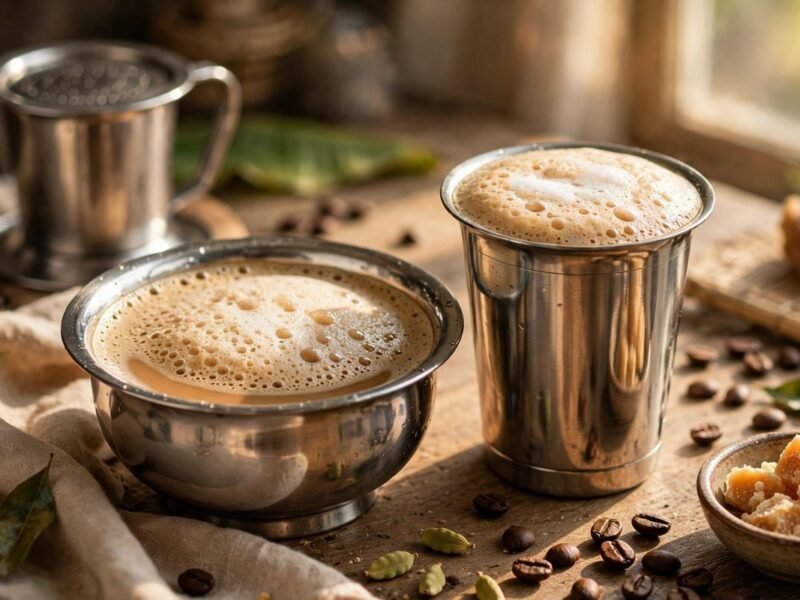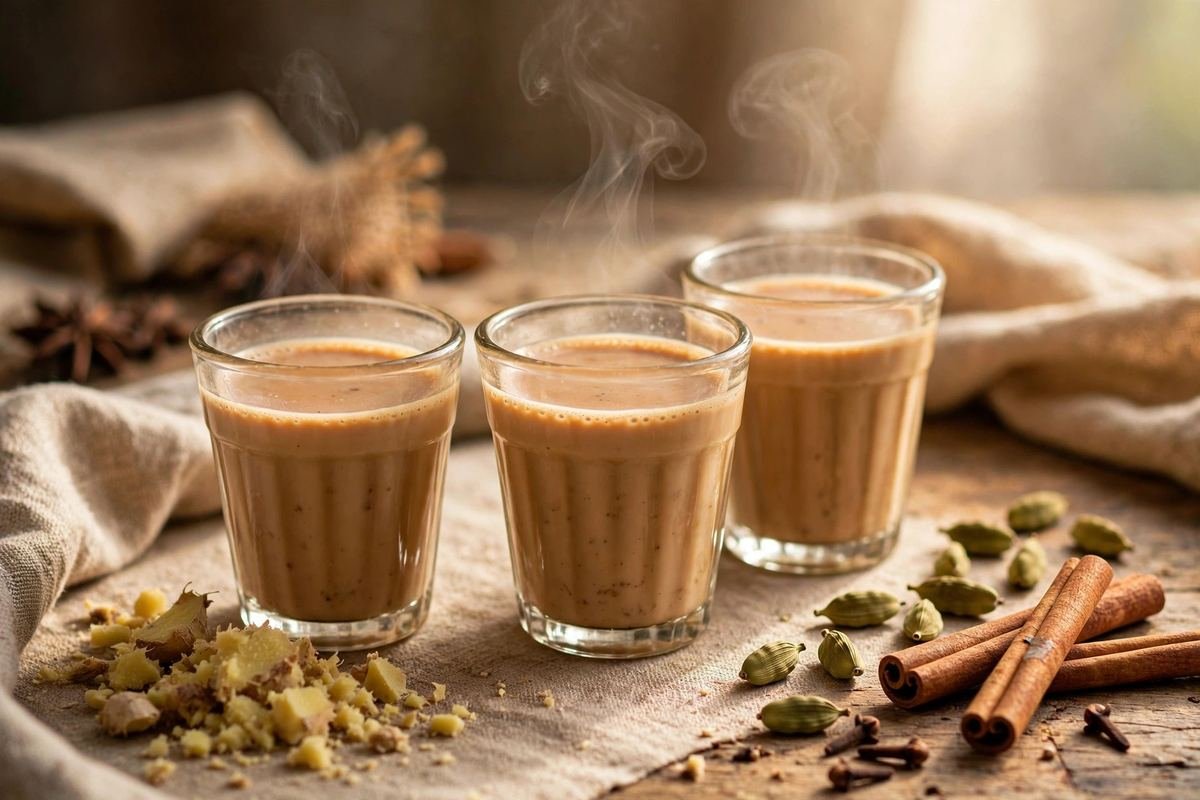
Recipe Card
Fragrant crushed spices, fresh ginger, strong Assam tea, and creamy milk simmered together — the real homemade masala chai, just like the best tapri on the street.
Ingredients
- 2 cups (500 ml) water
- 2 cups (500 ml) whole full-cream milk
- 5 tsp Assam CTC tea leaves (about 1 tsp per cup plus 1 for the pot)
- 1 inch (2.5 cm) fresh ginger, peeled and crushed
- 4 green cardamom pods, lightly crushed
- 1 small cinnamon stick (about 1 inch), broken into pieces
- 3 whole cloves
- 4–5 black peppercorns, lightly crushed
- 4–5 tsp sugar (or to taste; jaggery works too)
Instructions
- Crush the spices fresh. Place the cardamom pods, cinnamon pieces, cloves, and peppercorns in a mortar and pestle and pound to a coarse crush — you want broken pieces, not fine powder, so the flavour releases slowly during simmering. Peel the ginger and crush it with the flat of a knife or grate it coarsely. The aroma that rises when you crush fresh spices is your first sign that this chai will be exceptional; pre-ground spices never smell like this.
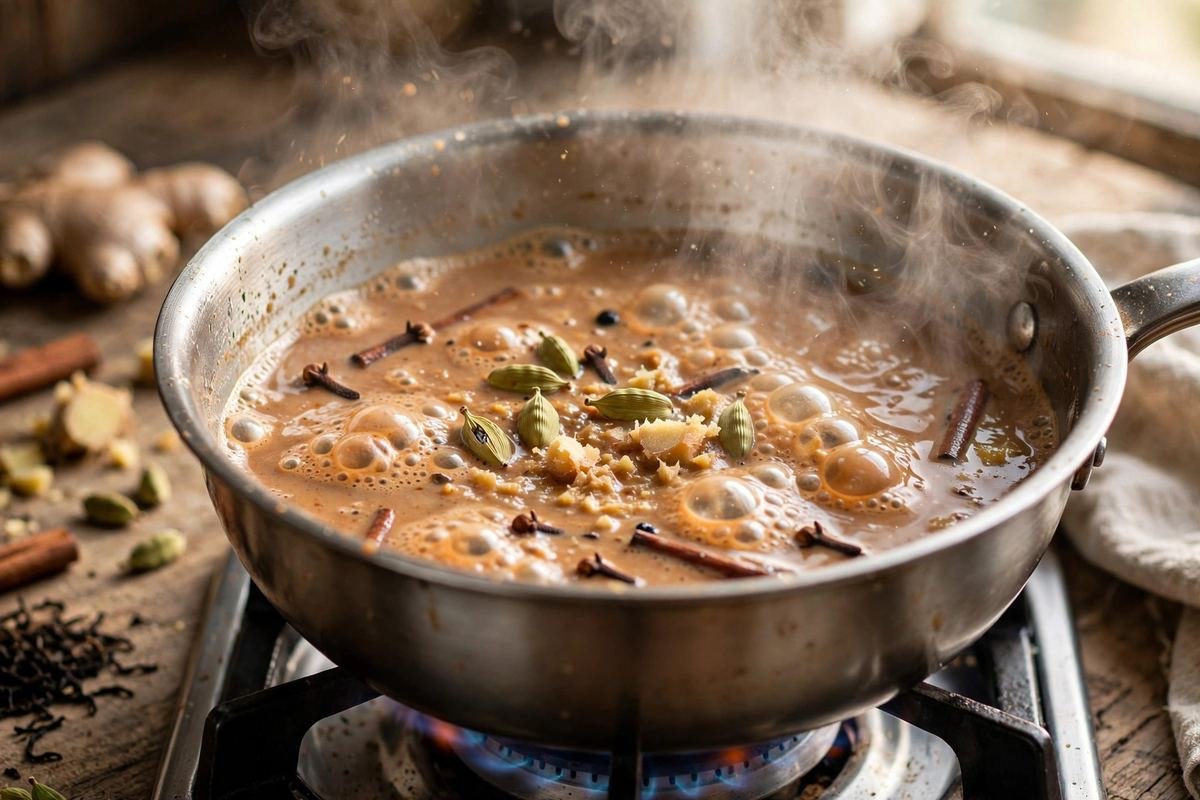
- Simmer the spices in water. Pour the 2 cups of water into your heavy-bottomed saucepan and add all the crushed spices and ginger. Bring to a rolling boil over medium-high heat, then reduce to a lively simmer for 3 to 4 minutes. The water should turn faintly golden and smell intensely fragrant — this step builds the spiced base so the tea and milk later have something to marry into, rather than floating on top of bland liquid.
- Add the tea and boil hard. Add the CTC tea leaves and the sugar to the spiced water. Let it come to a strong, rolling boil and cook for 2 minutes, watching the colour deepen to a rich reddish-brown. The surface will foam up — lift the pan off the heat for a few seconds if it threatens to boil over, then return it. This hard boil extracts the tea’s full strength and begins caramelising the sugar slightly, which is part of chai’s signature depth.
- Add the milk and bring to the boil twice. Pour in the milk and stir. Bring the chai back up to a full rolling boil — it will rise dramatically, so stay close and lift the pan the moment it crests. Let it settle for a few seconds, then return to the heat and bring to a second full boil. This double-boil (some chaiwalas do three) is the heart of the technique: it cooks the milk, melds the spices and tea into one unified flavour, and develops the creamy body that defines great chai. The final colour should be a warm, opaque caramel-brown.
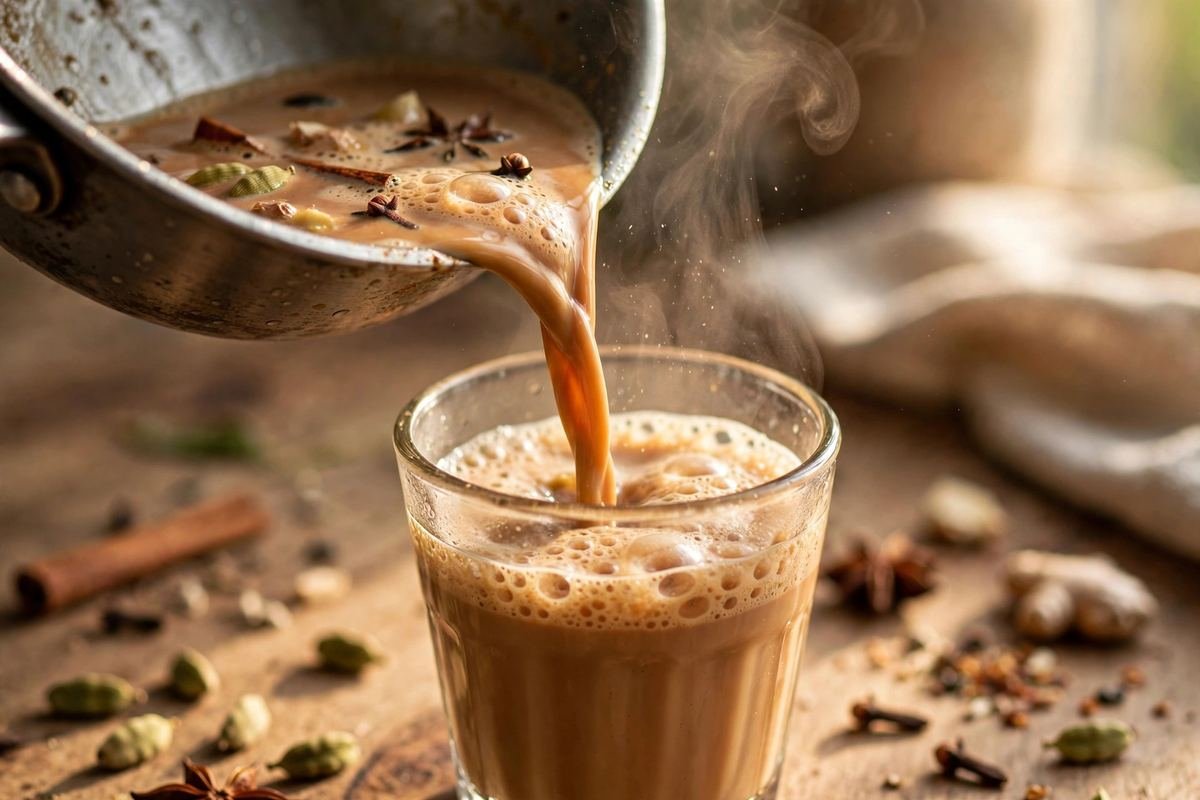
- Rest, strain, and pour from a height. Take the pan off the heat and let the chai rest for 1 minute — this settles the leaves and lets the flavour round out. Strain through a fine-mesh strainer into cups or kulhads. For the classic frothy top, pour from a height of 8 to 10 inches in a thin stream, or pour the chai back and forth between two vessels once or twice (“pulling” the chai). Serve immediately, steaming hot.
Tip: Read through the full post below for step-by-step photos, pro tips, variations and FAQs before you start cooking.
Ask an Indian what they miss most about home, and before they mention any dish, they will probably say chai. Not tea — chai. The distinction matters. Tea is a beverage; chai is a ritual, a pause button, a social contract, the first thing offered to a guest and the last thing discussed before a decision is made. And masala chai — tea brewed strong with crushed whole spices, fresh ginger, and milk — is the version that has travelled the world, turning up in cafés from Seattle to Sydney, though rarely tasting quite like the cup your friend’s mother makes.
The story of masala chai is more tangled than most people realise. Tea drinking in India was popularised under British colonial rule, when the Assam tea industry needed a domestic market and began pushing chai to Indian workers — often with lots of milk and sugar to stretch the expensive leaves. But Indians made it entirely their own, adding the spice-blending instincts of Ayurveda and the home kitchen: ginger for warmth, cardamom for fragrance, cloves and cinnamon for depth, black pepper for a gentle kick. The street-side tapri and the railway-station chaiwala perfected the art of the “cutting chai” — a small, strong glass, boiled hard, poured from a height to create froth — and the office worker’s 4 pm chai break became as institutional as any ritual in the country.
What separates real masala chai from the pale, teabag-in-hot-milk imitations is method. The spices must be crushed fresh and simmered so their oils release into the water before the tea goes in. The tea itself must be strong — Assam CTC granules, the small dark pellets that brew into a deep red liquor, are the classic choice because they stand up to milk and spice without disappearing. And the whole thing must actually boil, ideally more than once, because chai that has merely been steeped tastes thin and apologetic, while chai that has been boiled tastes bold and complete. The traditional “cutting” pour — lifting the vessel high and pouring in a thin stream — cools it slightly and builds a beautiful frothy top.
This recipe gives you the genuine article: whole spices crushed moments before brewing, fresh ginger, proper CTC tea, full-cream milk, and the double-boil technique that makes the flavours marry. It makes four generous cups, takes under half an hour, and will ruin café chai for you forever — in the best way.
Why You’ll Love This Recipe
- Authentic tapri-style flavour — whole crushed spices and a proper boil, not a spice-flavoured teabag.
- Fully customisable — adjust the spice blend, sweetness, milkiness, and strength to your exact taste.
- Ready in 25 minutes — from whole spices to steaming cups in less time than a coffee run.
- Cheaper and better than café chai — a fraction of the price with ten times the aroma.
- Comfort in a cup — ginger, cardamom, and cloves are genuinely warming and soothing, especially in monsoon and winter.
- Scales effortlessly — double or triple the recipe for guests; chai loves a crowd.
Key Ingredients Explained
The tea matters more than anything else. For authentic masala chai, you want Assam CTC tea — those small, dark, granular pellets (CTC stands for crush-tear-curl) that brew into a strong, malty, deep-red liquor. CTC is what every chaiwala uses because it releases flavour fast and stands up boldly to milk and spices. Regular leaf tea or teabags will give you a thinner, more delicate brew that gets lost. Use about one teaspoon of CTC per cup plus one extra for the pot, and buy it fresh — stale tea makes flat chai no matter how good your spices are.
The spice blend is where your personal signature lives. Green cardamom is non-negotiable — its sweet, floral aroma is the backbone of masala chai. Fresh ginger, crushed or grated, adds heat and brightness that dried ginger powder cannot match; use a good 1-inch piece. Cinnamon (a small stick or piece of bark) brings sweet warmth, cloves add pungent depth (go easy — two or three is plenty), and a few black peppercorns give a subtle back-of-the-throat warmth that makes the chai feel alive. Some families add fennel seeds for a sweet, almost floral note, star anise for liquorice depth, or a grating of nutmeg. Crush everything coarsely just before brewing — in a mortar and pestle ideally — because pre-ground spice powders taste dusty and one-dimensional in chai.
Milk should be full-cream whole milk for the classic rich, creamy body. The traditional ratio is roughly half water, half milk, though many homes go heavier on milk for a creamier cup. Toned milk works but gives a lighter result; avoid skimmed milk, which makes watery chai. For a dairy-free version, oat milk is the best substitute — it is creamy and does not split — while almond milk works but tastes noticeably nuttier.
Sugar is traditional — chai is meant to be sweet enough to balance the tannins of strong tea and the heat of the spices. Add it during the boil so it dissolves fully and its sweetness integrates; stirring sugar into the cup afterwards never tastes quite the same. Jaggery is a wonderful alternative with a deeper, almost caramel flavour, though it will darken the chai. Start with the recipe’s amount and adjust — chai sweetness is deeply personal, and there is no wrong answer.
Equipment You’ll Need
- A heavy-bottomed saucepan or traditional chai tapeli (2-litre capacity for 4 cups)
- A mortar and pestle for crushing spices (or the flat of a knife and a chopping board)
- A fine-mesh strainer (chai channi)
- Measuring spoons and cups
- Heatproof cups, glasses, or traditional clay kulhads for serving
- 2 cups (500 ml) water
- 2 cups (500 ml) whole full-cream milk
- 5 tsp Assam CTC tea leaves (about 1 tsp per cup plus 1 for the pot)
- 1 inch (2.5 cm) fresh ginger, peeled and crushed
- 4 green cardamom pods, lightly crushed
- 1 small cinnamon stick (about 1 inch), broken into pieces
- 3 whole cloves
- 4–5 black peppercorns, lightly crushed
- 4–5 tsp sugar (or to taste; jaggery works too)
- Crush the spices fresh. Place the cardamom pods, cinnamon pieces, cloves, and peppercorns in a mortar and pestle and pound to a coarse crush — you want broken pieces, not fine powder, so the flavour releases slowly during simmering. Peel the ginger and crush it with the flat of a knife or grate it coarsely. The aroma that rises when you crush fresh spices is your first sign that this chai will be exceptional; pre-ground spices never smell like this.
- Simmer the spices in water. Pour the 2 cups of water into your heavy-bottomed saucepan and add all the crushed spices and ginger. Bring to a rolling boil over medium-high heat, then reduce to a lively simmer for 3 to 4 minutes. The water should turn faintly golden and smell intensely fragrant — this step builds the spiced base so the tea and milk later have something to marry into, rather than floating on top of bland liquid.
- Add the tea and boil hard. Add the CTC tea leaves and the sugar to the spiced water. Let it come to a strong, rolling boil and cook for 2 minutes, watching the colour deepen to a rich reddish-brown. The surface will foam up — lift the pan off the heat for a few seconds if it threatens to boil over, then return it. This hard boil extracts the tea’s full strength and begins caramelising the sugar slightly, which is part of chai’s signature depth.
- Add the milk and bring to the boil twice. Pour in the milk and stir. Bring the chai back up to a full rolling boil — it will rise dramatically, so stay close and lift the pan the moment it crests. Let it settle for a few seconds, then return to the heat and bring to a second full boil. This double-boil (some chaiwalas do three) is the heart of the technique: it cooks the milk, melds the spices and tea into one unified flavour, and develops the creamy body that defines great chai. The final colour should be a warm, opaque caramel-brown.
- Rest, strain, and pour from a height. Take the pan off the heat and let the chai rest for 1 minute — this settles the leaves and lets the flavour round out. Strain through a fine-mesh strainer into cups or kulhads. For the classic frothy top, pour from a height of 8 to 10 inches in a thin stream, or pour the chai back and forth between two vessels once or twice (“pulling” the chai). Serve immediately, steaming hot.
Pro Tips for Perfect Results
- Always crush spices fresh. This is the single biggest upgrade you can make. Whole spices pounded seconds before brewing release volatile oils that pre-ground masala lost months ago.
- Use CTC, not teabags. Teabags are designed for gentle steeping; chai needs the aggressive extraction that only granular CTC tea provides. The difference in body is dramatic.
- Boil, don’t just steep. Timid chai is thin chai. The rolling boils — of the spiced water, of the tea, and twice of the milk — are what build strength and that characteristic cooked-milk richness.
- Watch the pot like a hawk after adding milk. Milk chai boils over in seconds and the mess is legendary. Stay at the stove, hand on the handle, ready to lift.
- Add sugar during brewing, not after. Sugar boiled with the tea integrates completely and its sweetness rounds the tannins. Sugar stirred into the cup sits on top of the flavour instead of inside it.
- Taste and calibrate your spice ratio. Love ginger heat? Double it. Sensitive to cloves? Use one. After two or three batches you will have your personal house blend — write it down.
- Serve immediately. Chai waits for no one. It is at its peak in the first five minutes: hottest, frothiest, most aromatic. Reheated chai tastes flat and tired.
Variations to Try
Cutting Chai: Halve the milk for a stronger, more intense brew served in small glasses — the Mumbai tapri classic. Adrak Elaichi Chai: Skip the cinnamon, cloves, and pepper; double the ginger and cardamom for a cleaner, brighter cup. Chocolate Chai: Whisk a tablespoon of cocoa powder in with the tea for a mocha-like winter warmer. Kesar Chai: Add a pinch of saffron bloomed in warm milk for a luxurious festive version. Tulsi Chai: Add a handful of fresh holy basil leaves with the spices — soothing and beloved during cold season. Iced Masala Chai: Brew double-strength with half the milk, cool, and pour over ice, topping with cold milk. Vegan Chai: Use oat milk and jaggery; add the oat milk gently at the end and avoid the hardest boils to prevent splitting.
Serving Suggestions
Chai is rarely served alone — it arrives with something to nibble. The classics are parle-style glucose biscuits dunked until just short of collapse, rusk (twice-baked tea toast), samosa or pakoras on rainy days, and bun maska (soft bun with butter) in Mumbai’s Irani cafés. For guests, serve in clay kulhads if you can find them — they keep the chai hot, add an earthy aroma, and look beautiful. Morning chai pairs with breakfast; 4 pm chai is practically a constitutional right and goes with whatever snack is at hand. And there is no wrong time for a small cutting chai after dinner with family, talking late into the evening.
Storage and Make-Ahead
Freshly brewed chai is best consumed immediately, but life happens. You can brew a large batch, cool it quickly, and refrigerate it in a sealed bottle for up to 24 hours; reheat gently on the stove (never microwave on high — it scalds the milk) and expect a slightly less vibrant cup. For a smarter make-ahead, prepare a chai concentrate: simmer the spices, tea, and sugar in water only (no milk), strain, and refrigerate for up to 4 days. When you want chai, heat equal parts concentrate and fresh milk together with one good boil. This gives you near-fresh flavour in five minutes. Do not store chai with milk in it for more than a day, and never leave brewed chai at room temperature for more than two hours.
Frequently Asked Questions
Can I use teabags instead of CTC tea?
You can, but the result will be noticeably thinner. If teabags are all you have, use 4 to 5 strong Assam or English Breakfast bags for this quantity, squeeze them well, and give the brew an extra minute of hard boiling. But CTC tea is inexpensive and widely available — it is worth buying a packet for chai alone.
Why did my chai split or curdle?
Curdling usually happens with very fresh ginger added directly to boiling milk in large quantities, or with acidic additions like lemongrass. The recipe’s method — simmering ginger in water first, then adding milk — minimises this. If using plant milks, add them at the end over gentler heat. A tiny pinch of baking soda in the water (a traditional halwai trick) can also stabilise the milk.
How do I make chai less milky / more milky?
The 1:1 water-to-milk ratio here is a balanced middle. For stronger, more tea-forward chai, use 3 cups water to 1 cup milk. For creamy, mellow chai, reverse it. Keep the tea and spice quantities the same and just shift the liquid ratio — the technique does not change.
Can I make masala chai without sugar?
Yes. Brew it exactly the same way and simply omit the sweetener, or serve sugar on the side. The spices carry plenty of flavour. A small piece of jaggery on the side, the old-fashioned way, lets each drinker sweeten to taste.
What is the difference between masala chai and cutting chai?
Cutting chai is a style of serving, not a different recipe — it is masala chai brewed stronger with less milk, served in a small glass (“cutting” = half measure, from the Mumbai mills where workers split one full glass between two people to save money). The brew method is the same; the ratio and portion are what change.
Can I grind a big batch of chai masala in advance?
You can, and many families do — blend crushed cardamom, cinnamon, cloves, pepper, and dried ginger, and store airtight for up to a month. It will be good, but never quite as vivid as spices crushed fresh per batch. A good compromise: keep a premix for busy weekdays and crush fresh on slow weekends.
There is a reason the phrase “chai pe milte hain” — let’s meet over chai — can resolve arguments, seal friendships, and start love stories. A proper cup of masala chai is never just a drink; it is an invitation to slow down for ten minutes. Master this recipe, find your personal spice balance, and you will always have something wonderful to offer anyone who walks through your door.