Recipe Card
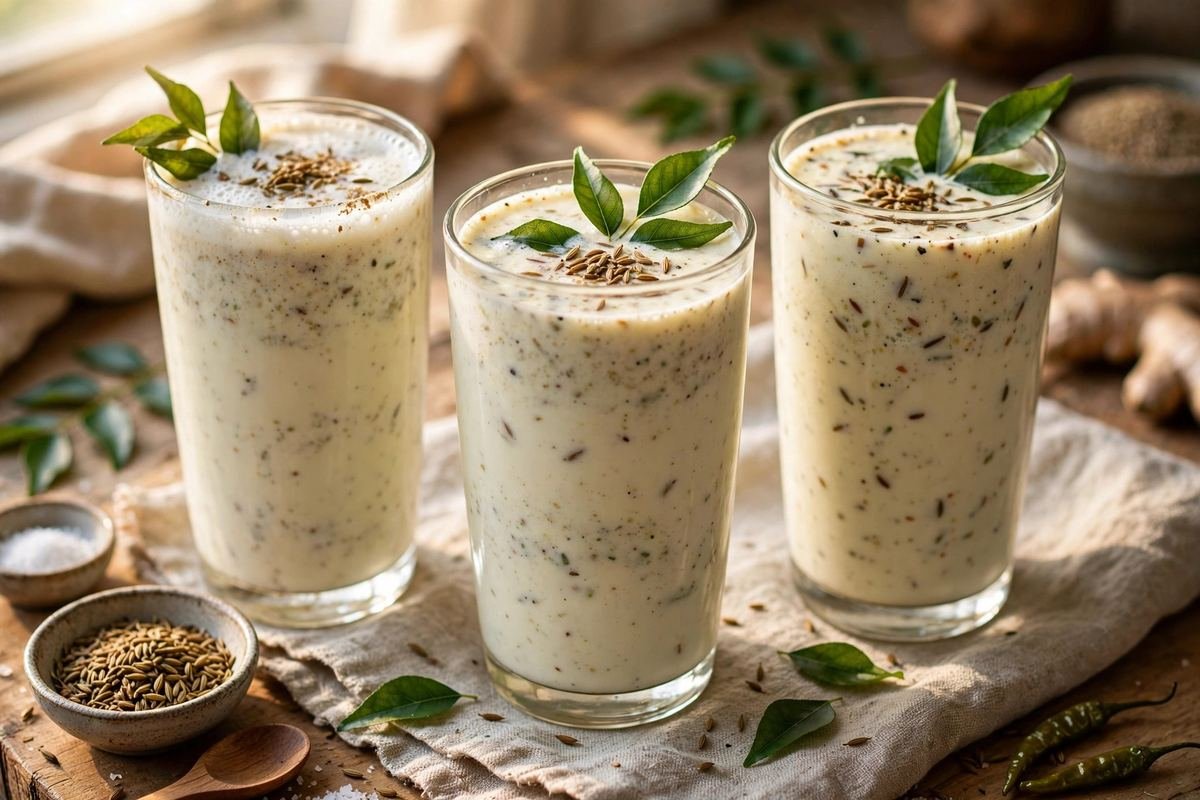
This masala chaas is the real deal — thin, tangy buttermilk whisked with roasted cumin, curry leaves, ginger, and green chilli. Cooling, digestive, and ready in 10 minutes flat.
Ingredients
- 2 cups (480 g) fresh plain curd (yogurt), not sour
- 3 cups (720 ml) chilled water
- 1 tsp cumin seeds, dry-roasted and coarsely ground
- ¾ tsp black salt (kala namak), plus more to taste
- 1 inch (2.5 cm) fresh ginger, peeled and finely grated
- 1 small green chilli, finely chopped (adjust to heat preference)
- 8 to 10 fresh curry leaves, finely chopped, plus a few whole for tempering
- 2 tbsp fresh coriander leaves, finely chopped
- ½ tsp mustard seeds
- 1 tsp oil (mustard oil or neutral oil)
- 1 dried red chilli (optional, for the tadka)
- Ice cubes, to serve
Instructions
- Roast and grind the cumin. Place the cumin seeds in a small dry pan over medium heat. Toast for 2 to 3 minutes, shaking the pan frequently, until the seeds darken one shade and release a deep, nutty aroma — you will know it is ready when the smell hits you from a foot away. Tip them onto a plate to stop the cooking, let them cool for a minute, then grind to a coarse powder using a spice grinder or mortar and pestle. Set aside. Freshly roasted cumin is the single biggest flavour upgrade in this recipe, so do not skip this.
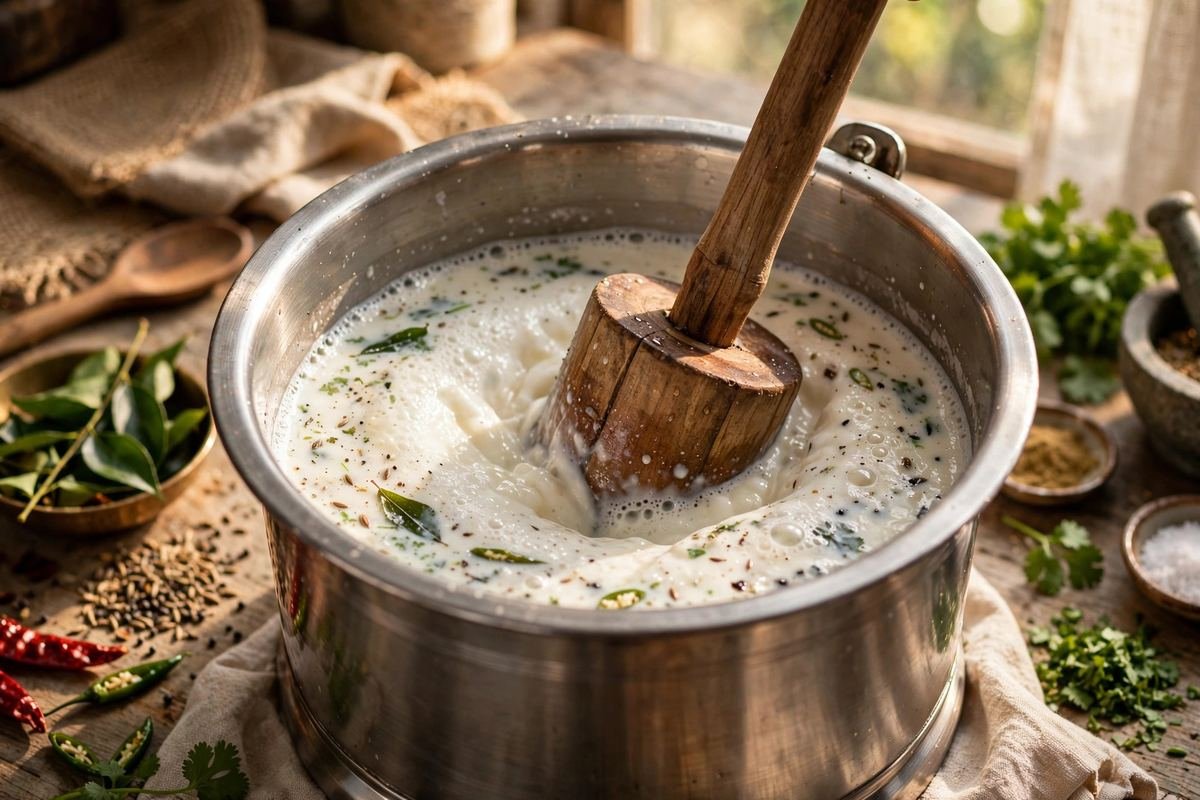
- Whisk the base. Put the curd into a large bowl or jug and whisk it smooth first, breaking up any lumps — this takes about 30 seconds with a wire whisk. Then add the chilled water and whisk vigorously for a full minute until the mixture is uniformly thin, frothy on top, and completely lump-free. The consistency should be like thin cream: pourable, not spoonable. If you prefer it thinner, add another half cup of water. Taste the base now — it should be mildly tangy. If your curd was on the sour side, add a tiny pinch of sugar (about ¼ teaspoon) to balance it.
- Add the masalas. Stir in the roasted cumin powder, black salt, grated ginger, chopped green chilli, chopped curry leaves, and half the coriander leaves. Whisk everything together well and taste. This is your moment to adjust: more black salt for tang, more cumin for smokiness, more chilli for heat. The flavour should be bold — remember it will mellow slightly once chilled and poured over ice. Let the chaas rest for 10 minutes at this stage if you have the time; the spices bloom and meld beautifully.
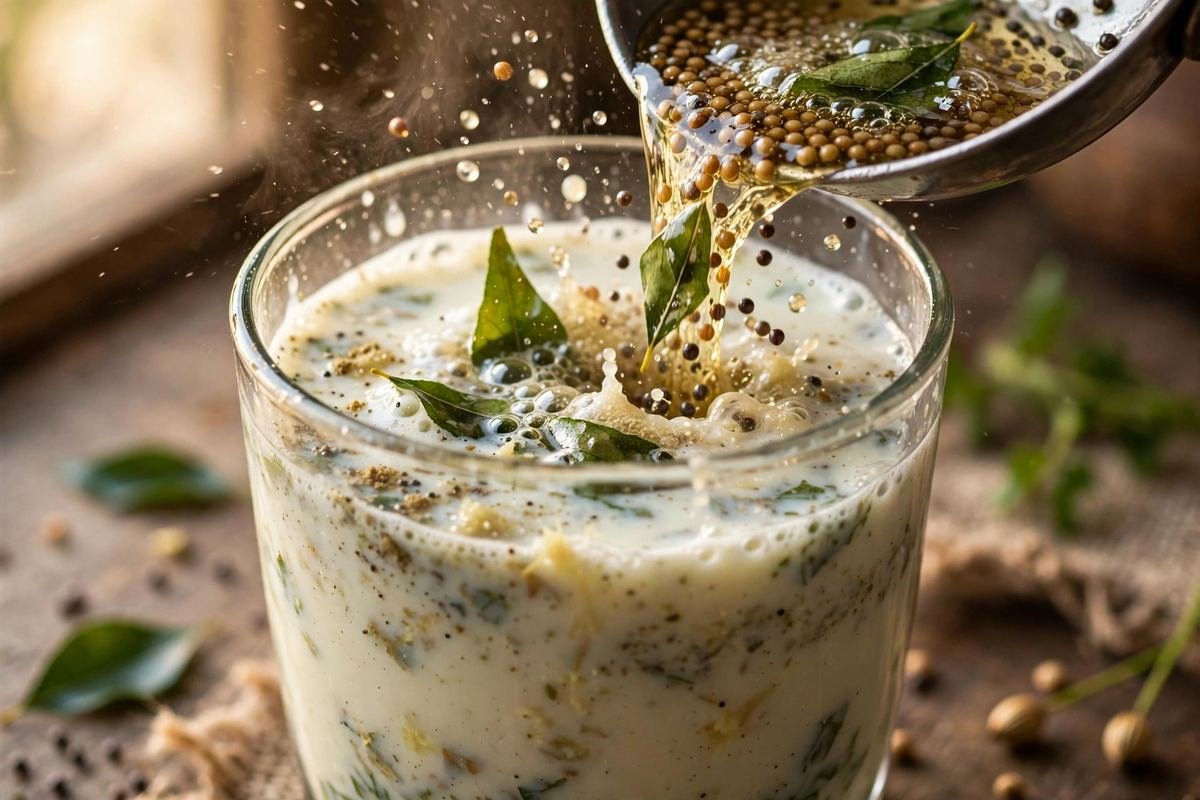
- Make the tadka. Heat the oil in a small pan or tadka ladle over medium-high heat until it shimmers. Add the mustard seeds and wait for them to splutter and pop — this takes 20 to 30 seconds, and you will hear them crackling. Immediately add the whole curry leaves (stand back, they will sputter in the hot oil) and the dried red chilli if using. Fry for just 10 to 15 seconds until the curry leaves turn crisp and glossy and the chilli darkens slightly. Take it off the heat instantly — burnt curry leaves taste bitter.
- Finish and serve. Pour the hot tadka directly into the chaas — you will hear a satisfying sizzle — and stir it through. Garnish with the remaining coriander leaves and a light dusting of extra roasted cumin on top. Fill tall glasses with ice cubes, pour the chaas over, and serve immediately while it is cold and the tadka aroma is still rising off the top. Four generous glasses, gone in minutes.
Tip: Read through the full post below for step-by-step photos, pro tips, variations and FAQs before you start cooking.
If India had an official summer drink, it would be chaas. Not the thick, sweet lassi of Punjab — though we love that too — but its leaner, spicier cousin: a glass of thin, salty buttermilk, cloudy-white and beaded with condensation, that goes down in about four gulps and immediately makes a 42-degree afternoon feel survivable. Ask any grandmother in Rajasthan, Gujarat, or Maharashtra and she will tell you chaas is not a beverage, it is medicine — for heat, for heavy meals, for sluggish digestion, for crankiness. And she is not wrong.
Chaas, also called buttermilk or moru in the south, is one of the oldest drinks in Indian food culture. It goes back to the days when every household churned its own butter from curd, and the thin liquid left behind — naturally probiotic, lightly tangy — was drunk fresh rather than wasted. The Ayurvedic texts praise takra, as it was called, as a digestive and a coolant, something to be sipped after meals rather than with them. Over the centuries, each region dressed it up in its own way: the south tempers it with mustard seeds and curry leaves, Gujarat sweetens it slightly, and the north — particularly Rajasthan and Punjab — turns it into masala chaas, pounded with roasted cumin, black salt, ginger, and green chilli until it is savoury, punchy, and deeply refreshing.
What makes a great masala chaas is balance. The base should be thin enough to drink like water but creamy enough to feel nourishing. The curd should be fresh and mildly sour — not the aggressively sour stuff at the back of the fridge. And the spice mix should wake up your palate without setting your mouth on fire. The roasted cumin is non-negotiable: raw cumin tastes grassy and flat, but cumin toasted until dark and nutty, then ground fresh, gives chaas its signature smoky warmth. Black salt (kala namak) adds that faintly eggy, mineral tang that regular salt cannot replicate. And the tempering of curry leaves and mustard seeds crackled in hot oil at the end? That is what separates homemade chaas from the flat, bottled kind.
This recipe makes four tall glasses, because chaas is one of those things where one glass is never enough. It takes ten minutes, no cooking to speak of beyond a quick tadka, and the result is the kind of drink people ask you for the recipe of. Let us make it properly.
Why You’ll Love This Recipe
- Ready in 10 minutes — no cooking, just whisking and a 2-minute tempering
- Naturally cooling and digestive — thin buttermilk with ginger, cumin, and curry leaves is genuinely good for the gut
- Light and low-calorie — about 45 calories a glass, and far more hydrating than any soft drink
- Restaurant-style flavour — the tadka of curry leaves and mustard seeds gives it that dhaba touch
- Easy to scale — double or triple it for parties; it only gets better as it sits
- Kid-friendly adjustable — skip or reduce the green chilli and it becomes a mild, tasty drink children enjoy
Key Ingredients Explained
The soul of chaas is the curd, so start with good dahi. You want fresh, thick, homemade-style curd that is pleasantly tangy but not sour. Over-soured curd will make the chaas sharp and unpleasant no matter how much spice you add — if your curd has turned too sour, whisk in a little extra water and a pinch of sugar to round it off, or better yet, set a fresh batch. Full-fat curd gives a creamier chaas; low-fat works too but tastes thinner. Some people make chaas from leftover whey after making paneer, which is wonderfully light and traditional — if you have it, use it.
Roasted cumin powder is the signature spice, and it must be roasted fresh. Take whole cumin seeds, dry-roast them in a hot pan for 2 to 3 minutes until they turn a shade darker and smell intensely nutty, then cool and grind them to a coarse powder. Pre-ground roasted cumin from a jar is a pale shadow of the fresh stuff — it loses its volatile oils within days. This one small step is the difference between good chaas and unforgettable chaas.
Black salt, or kala namak, is the second non-negotiable. It has a distinctive sulphurous, mineral flavour that gives chaas its characteristic tang — regular table salt tastes flat by comparison. If you absolutely cannot find it, use sea salt plus a tiny squeeze of lemon, but try to get kala namak; it is available in every Indian grocery store. Fresh ginger, grated fine, adds warmth and aids digestion. Green chilli brings heat — use one small chilli for gentle warmth, two for a proper kick. Fresh curry leaves, both whisked in and crackled in the tadka, give an aroma that dried leaves simply cannot. And a handful of fresh coriander leaves adds colour and freshness at the end.
Equipment You’ll Need
- Large mixing bowl or jug
- Whisk, hand blender, or traditional wooden churner (mathani)
- Small pan or tadka ladle for tempering
- Fine grater for ginger
- Serving glasses
- 2 cups (480 g) fresh plain curd (yogurt), not sour
- 3 cups (720 ml) chilled water
- 1 tsp cumin seeds, dry-roasted and coarsely ground
- ¾ tsp black salt (kala namak), plus more to taste
- 1 inch (2.5 cm) fresh ginger, peeled and finely grated
- 1 small green chilli, finely chopped (adjust to heat preference)
- 8 to 10 fresh curry leaves, finely chopped, plus a few whole for tempering
- 2 tbsp fresh coriander leaves, finely chopped
- ½ tsp mustard seeds
- 1 tsp oil (mustard oil or neutral oil)
- 1 dried red chilli (optional, for the tadka)
- Ice cubes, to serve
- Roast and grind the cumin. Place the cumin seeds in a small dry pan over medium heat. Toast for 2 to 3 minutes, shaking the pan frequently, until the seeds darken one shade and release a deep, nutty aroma — you will know it is ready when the smell hits you from a foot away. Tip them onto a plate to stop the cooking, let them cool for a minute, then grind to a coarse powder using a spice grinder or mortar and pestle. Set aside. Freshly roasted cumin is the single biggest flavour upgrade in this recipe, so do not skip this.
- Whisk the base. Put the curd into a large bowl or jug and whisk it smooth first, breaking up any lumps — this takes about 30 seconds with a wire whisk. Then add the chilled water and whisk vigorously for a full minute until the mixture is uniformly thin, frothy on top, and completely lump-free. The consistency should be like thin cream: pourable, not spoonable. If you prefer it thinner, add another half cup of water. Taste the base now — it should be mildly tangy. If your curd was on the sour side, add a tiny pinch of sugar (about ¼ teaspoon) to balance it.
- Add the masalas. Stir in the roasted cumin powder, black salt, grated ginger, chopped green chilli, chopped curry leaves, and half the coriander leaves. Whisk everything together well and taste. This is your moment to adjust: more black salt for tang, more cumin for smokiness, more chilli for heat. The flavour should be bold — remember it will mellow slightly once chilled and poured over ice. Let the chaas rest for 10 minutes at this stage if you have the time; the spices bloom and meld beautifully.
- Make the tadka. Heat the oil in a small pan or tadka ladle over medium-high heat until it shimmers. Add the mustard seeds and wait for them to splutter and pop — this takes 20 to 30 seconds, and you will hear them crackling. Immediately add the whole curry leaves (stand back, they will sputter in the hot oil) and the dried red chilli if using. Fry for just 10 to 15 seconds until the curry leaves turn crisp and glossy and the chilli darkens slightly. Take it off the heat instantly — burnt curry leaves taste bitter.
- Finish and serve. Pour the hot tadka directly into the chaas — you will hear a satisfying sizzle — and stir it through. Garnish with the remaining coriander leaves and a light dusting of extra roasted cumin on top. Fill tall glasses with ice cubes, pour the chaas over, and serve immediately while it is cold and the tadka aroma is still rising off the top. Four generous glasses, gone in minutes.
Pro Tips for Perfect Results
- Use fresh, mild curd. This is the golden rule. Sour curd makes sour chaas, and no amount of spice fixes it. Set your curd the previous evening in warm weather, or buy fresh the same day.
- Always roast cumin fresh. Pre-ground cumin powder, even the roasted kind from a jar, fades within days. Two minutes in a dry pan gives you ten times the flavour.
- Whisk, do not just stir. A full minute of vigorous whisking aerates the chaas and gives it that light, frothy top. A hand blender for 20 seconds works brilliantly too.
- Chill everything. Chaas is at its best ice-cold. Use chilled water, chill the glasses if you can, and serve over plenty of ice.
- Season boldly, then rest. The flavours mellow as the chaas sits, so season it a touch stronger than you think it needs, then let it rest 10 minutes before the final taste.
- Do not burn the tadka. Curry leaves go from crisp to bitter in seconds. Have the chaas bowl ready beside the stove so you can pour the tadka in the moment it is done.
- Thin is right. If your chaas coats a spoon like lassi, it is too thick. Real chaas should pour like flavoured water with body — thin enough to gulp.
Variations to Try
The chaas family is large and every region has its favourite. Pudina chaas adds a handful of fresh mint leaves, whisked in for a bright, cooling twist that is wonderful in peak summer. South Indian moru skips the North Indian spices and tempers the buttermilk with mustard seeds, curry leaves, grated coconut, and sometimes a shallot — thinner, milder, and equally delicious. For a smoky dhaba-style chaas, hold a piece of live charcoal with tongs, place it in a small steel bowl set inside the chaas vessel, drizzle a few drops of ghee on it, and cover for 2 minutes — the smoke infuses the whole batch. Beetroot chaas, with a little boiled beetroot blended in, turns a stunning pink and is a hit with kids. And for a sweet-salty Gujarati style, add a teaspoon of sugar and a pinch of roasted cumin — no chilli, no tadka.
Serving Suggestions
Masala chaas is the classic accompaniment to a heavy North Indian meal — it cuts through the richness of dal makhani, butter paneer, chole, or a full thali like nothing else. It is also the traditional partner for parathas: aloo paratha and a tall glass of chaas is one of life’s great breakfast pairings. Serve it as a welcome drink when guests arrive in summer, poured over lots of ice with a curry-leaf garnish — it is far more refreshing than any aerated drink. It also works beautifully alongside biryani, where its cool tang balances the heat of the rice. And honestly? A glass of chaas on its own at 4 pm, when the afternoon slump hits, is one of the simplest pleasures there is.
Storage and Make-Ahead
Masala chaas keeps well in the refrigerator for up to 2 days in a sealed jug or bottle — in fact, the flavours meld and improve after a few hours. Give it a good shake or whisk before serving, as the spices settle. Add the tadka fresh just before serving if you want the full aromatic effect, though stirring it in ahead still tastes good. Do not freeze chaas; the curd splits and turns grainy on thawing. If you want to prep ahead for a party, whisk the spiced base the night before, refrigerate, and do the tadka and garnish right before guests arrive.
Frequently Asked Questions
What is the difference between chaas and lassi?
Chaas is thin, savoury, and spiced — made by whisking curd with plenty of water until it is drinkable like a thin soup. Lassi is thick, creamy, and often sweet, made with much less water and sometimes fruit or malai on top. Chaas is the everyday coolant; lassi is the indulgent treat. This recipe is firmly in the chaas camp.
Can I make chaas with store-bought yogurt?
Yes, plain unsweetened yogurt works fine — just whisk it well with water. Greek yogurt is too thick and tangy on its own; if that is all you have, thin it with extra water (about 2 cups water per cup of Greek yogurt) and go easy on the black salt until you taste it. Fresh dahi from an Indian store is the closest to homemade.
My chaas tastes bland. What went wrong?
Almost always it is one of three things: the cumin was not freshly roasted, there is not enough black salt, or the curd was too mild and watery. Fix it by adding another half teaspoon of fresh roasted cumin, a pinch more black salt, and letting it rest 10 minutes. Taste again — chaas should taste bold and punchy, not subtle.
Is masala chaas healthy?
Genuinely, yes. It is low in calories, rich in probiotics from the live curd cultures, hydrating, and the spices — cumin, ginger, curry leaves — are all traditionally valued for digestion. It is also naturally low in fat if you use low-fat curd. Just go easy on the salt if you are watching sodium.
Can I skip the tadka?
You can, and the chaas will still taste good — many home versions skip it on busy days. But the tadka is what gives this recipe its restaurant-style aroma and that gorgeous sizzle when it hits the cold chaas. If you are short on time, at least crush a few curry leaves between your palms and stir them in raw; you will get some of the aroma without the extra pan.
How do I make it less spicy for kids?
Simply leave out the green chilli and the dried red chilli, and use just a pinch of ginger. The roasted cumin and black salt alone make a mild, tasty chaas that most children love. You can always add chilli to the adults’ glasses afterwards.
That is masala chaas — ten minutes, one bowl, and a drink that has been cooling Indian summers for centuries. Make a jug, pour it tall over ice, and listen for that tadka sizzle. Your afternoons are about to get a whole lot better.