Recipe Card
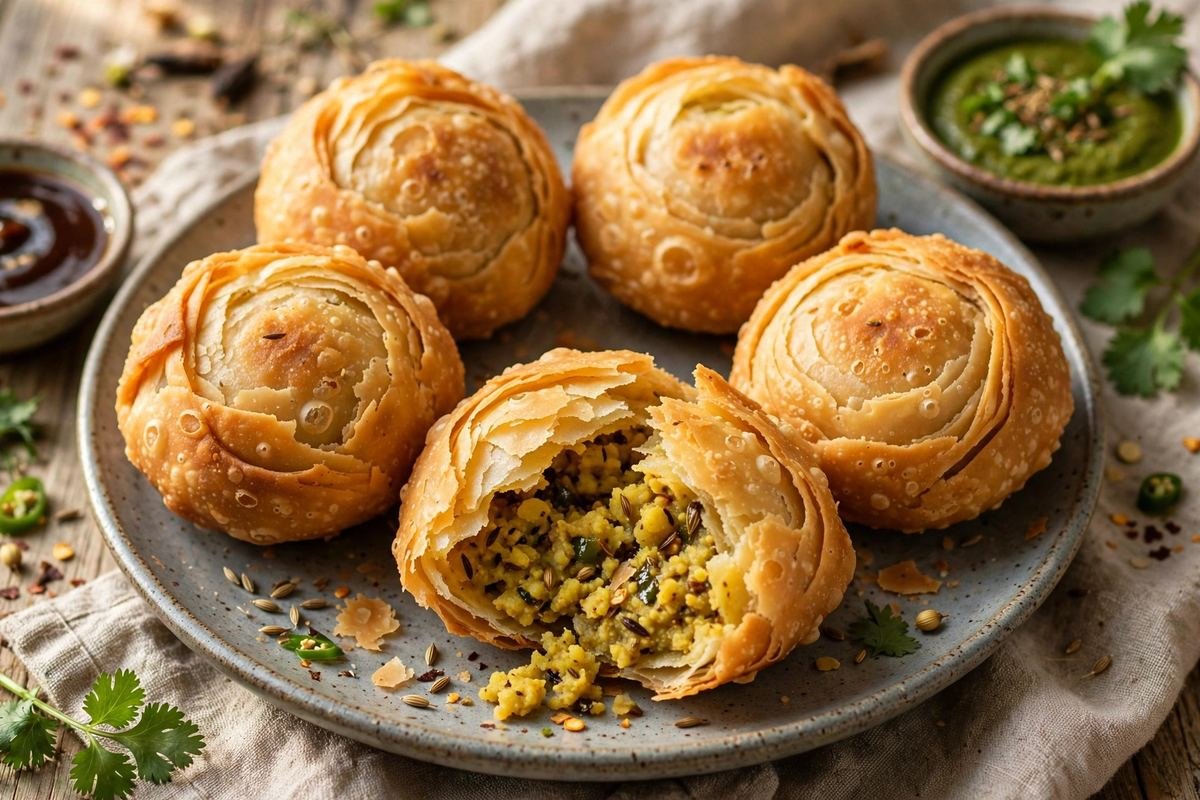
Shatteringly flaky khasta kachori with a spiced moong dal filling, fried low and slow halwai-style. The secret is generous moyan and patience — worth every minute.
Ingredients
- 2 cups (250g) maida (all-purpose flour)
- ¼ cup (60ml) oil or ghee, for moyan, plus more oil for deep-frying
- ½ tsp salt
- ½ tsp ajwain (carom seeds)
- ½ cup (120ml) lukewarm water, approximately
- ¾ cup (150g) moong dal (split yellow), soaked 3–4 hours and drained completely
- 3 tbsp oil
- 1 tsp saunf (fennel seeds), coarsely crushed
- 1 tsp coriander seeds, coarsely crushed
- ½ tsp cumin seeds
- ½ tsp kalonji (nigella seeds)
- ¼ tsp hing (asafoetida)
- 1 tbsp besan (chickpea flour)
- 1 tsp amchur (dry mango powder)
- 1 tsp red chili powder
- ½ tsp turmeric powder
- ½ tsp garam masala
- 1 tsp salt (adjust to taste)
- 1 tbsp finely chopped coriander leaves (optional)
Instructions
- Prepare the dal. Drain the soaked moong dal completely — spread it on a kitchen towel for 15–20 minutes to remove surface moisture. Grind in a mixer to a coarse, semolina-like texture with no added water, pulsing and scraping down. It should look like coarse sand with some larger bits, never a paste. Set aside.
- Make the pastry dough. In a large bowl, combine the maida, salt, and ajwain. Pour in the ¼ cup oil or ghee and rub it into the flour with your fingertips for 2–3 minutes until the mixture resembles breadcrumbs. Do the fist test: squeeze a handful — it should hold together in a firm clump. If it crumbles, work in another tablespoon of fat. Add lukewarm water a little at a time and bring together into a stiff, firm dough — noticeably firmer than chapati dough. Knead for 4–5 minutes until smooth. Cover with a damp cloth and rest for 30 minutes. A stiff dough is critical: soft dough absorbs oil and turns leathery instead of flaky.
- Cook the filling. Heat 3 tablespoons oil in a pan over medium heat. Add the cumin, kalonji, and hing; let them sizzle for 15 seconds. Add the crushed fennel and coriander seeds and sauté for 30 seconds until fragrant. Add the coarse ground dal and sauté, stirring frequently, for 8–10 minutes until the dal turns golden, smells nutty and roasted, and feels completely dry and crumbly. Stir in the besan and roast 2 more minutes. Add the amchur, red chili, turmeric, garam masala, and salt; mix well and cook 1 minute more. Taste — it should be boldly spiced, tangy, and savory. Cool completely before filling. Warm filling melts the pastry fat and ruins flakiness.
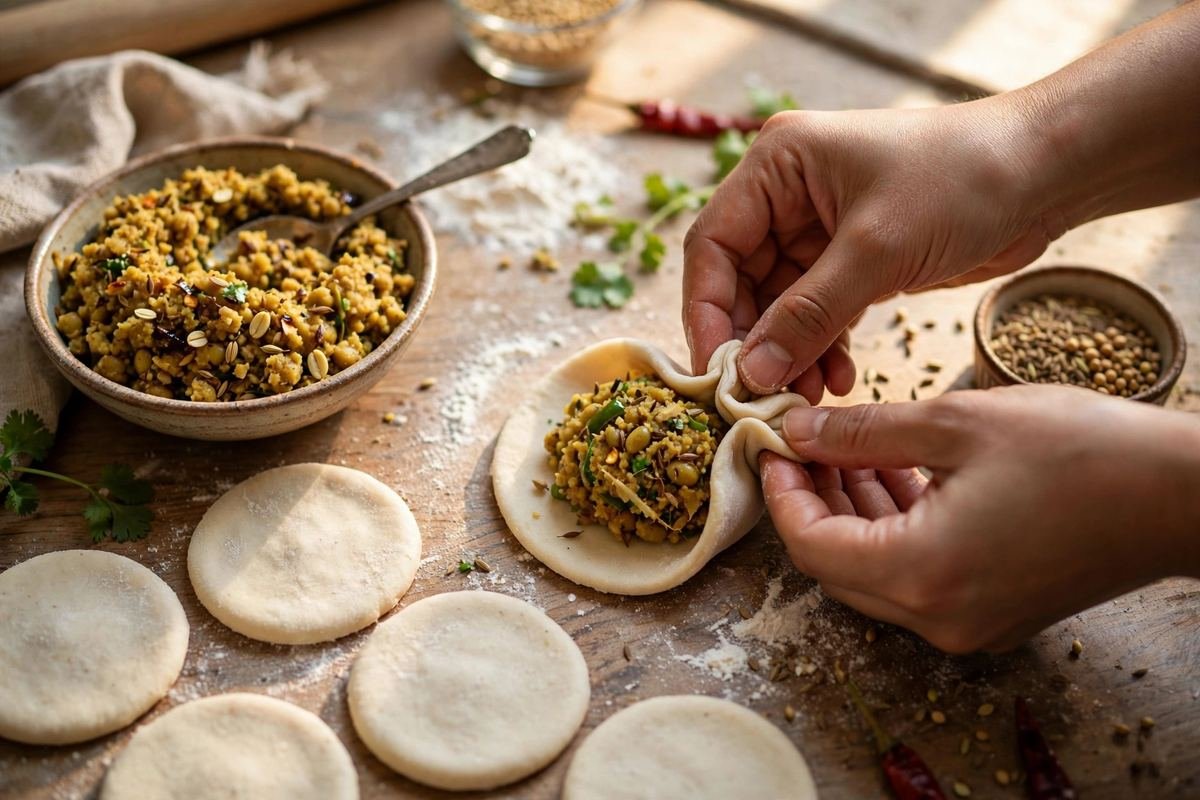
- Shape the kachoris. Divide the rested dough into 12 equal balls. Working with one at a time (keep the rest covered), flatten a ball into a 3-inch disc, keeping the center slightly thicker and the edges thinner — use your thumbs to press the edges out. Place 1½–2 teaspoons of the cooled filling in the center. Now gather the edges up and around the filling like a little purse, pinching firmly to seal, then twist off or press flat any excess dough at the top. Flip seam-side down and gently flatten with your palm into a 2.5–3 inch disc, about ¾ inch thick. Do not use a rolling pin — pressing by hand keeps the layers intact and avoids thinning the seal, which causes bursting.
- Rest the shaped kachoris. Let the filled kachoris rest for 10 minutes while the oil heats. This relaxes the dough so it doesn’t shrink and crack in the fryer.
- Heat oil low and slow. Pour oil 2–3 inches deep into the kadhai and heat over low-medium to 130–140°C (265–285°F) — much cooler than typical deep-frying. Test: drop in a tiny piece of dough; it should sink, then rise slowly with gentle, lazy bubbles. Vigorous bubbling means the oil is too hot — cool it down before proceeding.
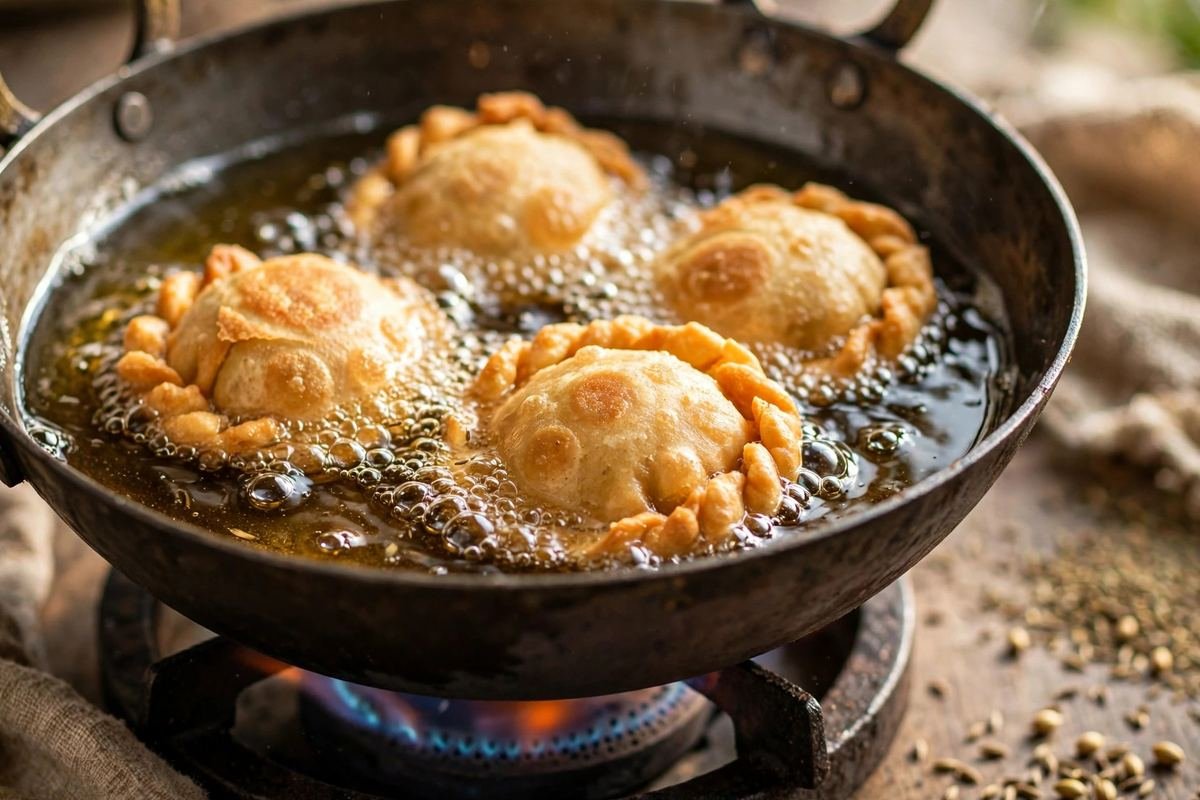
- Fry patiently. Slide in 4–5 kachoris (don’t crowd). They will sink, then slowly rise as the pastry sets. Fry for 12–15 minutes, turning every 2–3 minutes, maintaining that low temperature. The kachoris will gradually turn from pale to light gold to a deep, even golden-brown, and the surface will develop tiny blisters — the hallmark of a khasta crust. Rushing this step is the only real way to fail: high heat browns the outside while the inside stays raw and doughy.
- Drain and cool. Lift out with a slotted spoon, drain for a few seconds, and cool on a wire rack — not paper towels, which trap steam and soften the crust. The kachoris continue to crisp as they cool. Listen for the crackle when you break the first one: that’s khasta.
- Repeat and serve. Let the oil return to 130–140°C between batches (it creeps up while you work). Serve warm or at room temperature with tamarind chutney and green chutney.
Tip: Read through the full post below for step-by-step photos, pro tips, variations and FAQs before you start cooking.
The Flakiest Thing to Ever Come Out of a Kadhai
Say the word khasta to anyone who grew up in North India and watch their eyes light up. Khasta means crisp, flaky, shattering — the quality of a pastry that breaks into a hundred delicate layers at the touch of a tooth. And there is no khasta more legendary than the kachori: a golden, deep-fried shell of wheat flour pastry wrapped around a spicy, savory filling of moong dal, fried so slowly and patiently that the crust turns into something between a cookie and a dream. Break one open and it crackles audibly; inside, the coarse, crumbly dal filling — perfumed with fennel, coriander, and amchur — waits like treasure.
Kachori’s roots run deep through Rajasthan and Uttar Pradesh, where halwais (traditional sweet-and-snack makers) have been frying them for centuries. The Jodhpur kachori stuffed with onion, the Kota kachori, the Ujjain aloo kachori — every region has its champion, but the moong dal kachori is the undisputed classic, the one that shows up at Diwali, at weddings, in tiffin boxes on long train journeys (it keeps for days, which is no accident), and at every respectable namkeen shop in the country. It is festival food, travel food, and comfort food in a single flaky package.
The two pillars of khasta kachori are moyan and patience. Moyan is the fat rubbed into the flour before water is added — and for kachori, it must be generous, roughly a quarter of the flour’s weight in oil or ghee. This fat coats the flour particles and inhibits gluten formation, which is precisely what creates short, flaky layers instead of chewy bread. Skimp on moyan and you get a hard, bready shell; get it right and the crust shatters. Patience is the second pillar: kachoris must be fried on low heat, slowly, for 12–15 minutes, so the thick pastry cooks through to the center and the layers set crisp. Rush them on high heat and you get a browned outside with a raw, doughy inside — the classic home-kachori failure.
This recipe gives you the halwai method, adapted for home kitchens: a properly short pastry, a dry, coarsely ground moong dal filling that won’t make the shell soggy, the sealing technique that prevents bursting, and the low-and-slow fry that produces that signature blistered, layered crust. It takes time — there is no way around that — but the first crackling bite will explain exactly why.
Why You’ll Love This Recipe
- Genuinely khasta — the generous moyan ratio gives a shattering, layered crust like the halwai’s
- Dry, flavorful filling — coarsely ground moong dal with fennel and amchur, never soggy
- Keeps for days — stays crisp for 4–5 days at room temperature, perfect for festivals and travel
- Freezer-friendly — shape and freeze; fry fresh whenever the craving strikes
- The full technique, explained — sealing, low-slow frying, and every visual cue, demystified
Key Ingredients Explained
The pastry uses maida (refined flour) — this is not the place for whole wheat, which makes a denser, less flaky shell. Maida’s lower protein and finer milling give the tenderest, most layered result. The moyan — oil or ghee rubbed into the flour — should be about ¼ cup per 2 cups of flour. Test it the halwai way: squeeze a handful of the rubbed mixture; it should hold together in a clump (mutthi bandhna). If it crumbles apart, add more fat. Ghee gives a richer flavor; oil gives a slightly crisper shell. Many halwais use a mix.
The filling starts with moong dal (split yellow moong), soaked for 3–4 hours and then ground coarse without water — this is essential. Wet-ground dal makes a paste that steams the shell from inside and turns the filling gummy. Coarse-ground dal, sautéed in oil with spices until completely dry and crumbly, gives the classic texture: separate, nutty granules that stay put. Some recipes use urad dal or a moong-urad mix; moong alone is the most traditional for khasta kachori.
The spice blend is what makes the filling sing: saunf (fennel seeds) coarsely crushed is the signature note — sweet, aromatic, unmistakably kachori. Coriander seeds crushed coarse, cumin, kalonji (nigella) for its oniony bite, ajwain, amchur for tang, red chili powder for heat, and a pinch of hing bloomed in the oil for depth. A spoon of besan roasted with the dal absorbs any last moisture and binds the filling. Salt generously — the filling must taste bold, as the bland pastry shell needs a punchy center.
Equipment You’ll Need
- A mixer-grinder for the coarse dal grind
- A large mixing bowl for the dough
- A rolling pin and board
- A deep, heavy kadhai for frying
- A slotted spoon
- A kitchen thermometer (very helpful for the low-temp fry)
- A wire rack for cooling
- 2 cups (250g) maida (all-purpose flour)
- ¼ cup (60ml) oil or ghee, for moyan, plus more oil for deep-frying
- ½ tsp salt
- ½ tsp ajwain (carom seeds)
- ½ cup (120ml) lukewarm water, approximately
For the moong dal filling:
- ¾ cup (150g) moong dal (split yellow), soaked 3–4 hours and drained completely
- 3 tbsp oil
- 1 tsp saunf (fennel seeds), coarsely crushed
- 1 tsp coriander seeds, coarsely crushed
- ½ tsp cumin seeds
- ½ tsp kalonji (nigella seeds)
- ¼ tsp hing (asafoetida)
- 1 tbsp besan (chickpea flour)
- 1 tsp amchur (dry mango powder)
- 1 tsp red chili powder
- ½ tsp turmeric powder
- ½ tsp garam masala
- 1 tsp salt (adjust to taste)
- 1 tbsp finely chopped coriander leaves (optional)
- Prepare the dal. Drain the soaked moong dal completely — spread it on a kitchen towel for 15–20 minutes to remove surface moisture. Grind in a mixer to a coarse, semolina-like texture with no added water, pulsing and scraping down. It should look like coarse sand with some larger bits, never a paste. Set aside.
- Make the pastry dough. In a large bowl, combine the maida, salt, and ajwain. Pour in the ¼ cup oil or ghee and rub it into the flour with your fingertips for 2–3 minutes until the mixture resembles breadcrumbs. Do the fist test: squeeze a handful — it should hold together in a firm clump. If it crumbles, work in another tablespoon of fat. Add lukewarm water a little at a time and bring together into a stiff, firm dough — noticeably firmer than chapati dough. Knead for 4–5 minutes until smooth. Cover with a damp cloth and rest for 30 minutes. A stiff dough is critical: soft dough absorbs oil and turns leathery instead of flaky.
- Cook the filling. Heat 3 tablespoons oil in a pan over medium heat. Add the cumin, kalonji, and hing; let them sizzle for 15 seconds. Add the crushed fennel and coriander seeds and sauté for 30 seconds until fragrant. Add the coarse ground dal and sauté, stirring frequently, for 8–10 minutes until the dal turns golden, smells nutty and roasted, and feels completely dry and crumbly. Stir in the besan and roast 2 more minutes. Add the amchur, red chili, turmeric, garam masala, and salt; mix well and cook 1 minute more. Taste — it should be boldly spiced, tangy, and savory. Cool completely before filling. Warm filling melts the pastry fat and ruins flakiness.
- Shape the kachoris. Divide the rested dough into 12 equal balls. Working with one at a time (keep the rest covered), flatten a ball into a 3-inch disc, keeping the center slightly thicker and the edges thinner — use your thumbs to press the edges out. Place 1½–2 teaspoons of the cooled filling in the center. Now gather the edges up and around the filling like a little purse, pinching firmly to seal, then twist off or press flat any excess dough at the top. Flip seam-side down and gently flatten with your palm into a 2.5–3 inch disc, about ¾ inch thick. Do not use a rolling pin — pressing by hand keeps the layers intact and avoids thinning the seal, which causes bursting.
- Rest the shaped kachoris. Let the filled kachoris rest for 10 minutes while the oil heats. This relaxes the dough so it doesn’t shrink and crack in the fryer.
- Heat oil low and slow. Pour oil 2–3 inches deep into the kadhai and heat over low-medium to 130–140°C (265–285°F) — much cooler than typical deep-frying. Test: drop in a tiny piece of dough; it should sink, then rise slowly with gentle, lazy bubbles. Vigorous bubbling means the oil is too hot — cool it down before proceeding.
- Fry patiently. Slide in 4–5 kachoris (don’t crowd). They will sink, then slowly rise as the pastry sets. Fry for 12–15 minutes, turning every 2–3 minutes, maintaining that low temperature. The kachoris will gradually turn from pale to light gold to a deep, even golden-brown, and the surface will develop tiny blisters — the hallmark of a khasta crust. Rushing this step is the only real way to fail: high heat browns the outside while the inside stays raw and doughy.
- Drain and cool. Lift out with a slotted spoon, drain for a few seconds, and cool on a wire rack — not paper towels, which trap steam and soften the crust. The kachoris continue to crisp as they cool. Listen for the crackle when you break the first one: that’s khasta.
- Repeat and serve. Let the oil return to 130–140°C between batches (it creeps up while you work). Serve warm or at room temperature with tamarind chutney and green chutney.
Pro Tips for Perfect Results
- Moyan is everything. A quarter cup of fat per 2 cups flour, and the fist-clump test. Generous moyan = shattering layers; stingy moyan = hard shell.
- Keep the dough stiff. Firm dough resists oil absorption and fries flaky. If your dough feels soft like chapati dough, you’ve added too much water.
- Grind the dal coarse and dry. No water in the grinder, and sauté until every granule is roasted and crumbly. Wet filling = soggy kachori.
- Cool the filling completely. Even slightly warm filling melts the pastry’s fat layers before frying, killing flakiness.
- Seal like you mean it. Pinch the gathered edges firmly with no gaps. A weak seal bursts in the oil and the filling escapes.
- Low and slow is law. 130–140°C for 12–15 minutes. This is non-negotiable — it’s what cooks the thick pastry through and sets the layers.
- Don’t crowd the kadhai. Four to five at a time. Crowding drops the oil temperature and the kachoris absorb grease instead of crisping.
- Cool on a rack. Air circulation underneath finishes the crisping. Stacking hot kachoris steams them soft.
Variations to Try
Pyaz kachori (Jodhpur style): replace the dal with a filling of finely chopped onions sautéed with the same spices until jammy — sweet, spicy, and iconic. Aloo kachori: fill with spiced mashed potato (like samosa filling) for a softer-centered version. Dry fruits kachori: the royal Rajasthani version with chopped cashews, raisins, and coconut in a sweet-spicy masala. Mini cocktail kachoris: make them 1.5 inches wide for party finger food — reduce frying time to 8–10 minutes. Baked kachori: brush shaped kachoris with oil and bake at 180°C for 25–30 minutes, flipping once — flaky-ish and far lighter, though never quite as shattering as fried. Sattu kachori (Bihari style): fill with roasted sattu mixed with mustard oil, ajwain, and pickle masala — rustic and intensely flavorful.
Serving Suggestions
Khasta kachori is traditionally served at room temperature with imli (tamarind) chutney and green chutney — the sweet-sour chutneys against the savory, flaky pastry is the classic pairing. For the full chaat experience, make kachori chaat: crush a kachori on a plate, top with yogurt, both chutneys, chopped onions, sev, and pomegranate — it’s magnificent. Serve with aloo ki sabzi (the thin, soupy potato curry of UP) for the legendary kachori-sabzi breakfast of Varanasi and Agra. Kachoris are also festival and travel royalty — pack them for Diwali gifting, train journeys, or picnics, where their 4–5 day shelf life shines. And of course, hot masala chai alongside is never wrong.
Storage and Reheating
This is where kachori truly excels: stored in an airtight container at room temperature, khasta kachoris stay crisp for 4–5 days — the low moisture content is natural preservation. Do not refrigerate; the cold dulls the crust and the filling. To refresh day-old kachoris, warm in a 180°C oven for 5–7 minutes — they come back crackling. The microwave makes them chewy; avoid it. Unfried shaped kachoris freeze beautifully for up to a month: freeze solid on a tray, bag them, and fry directly from frozen at 130°C, adding 3–4 extra minutes. The cooked dal filling alone keeps refrigerated for 3 days, so you can prep it ahead and assemble fresh.
Frequently Asked Questions
Why did my kachoris burst open while frying?
Three usual causes: a weak seal (pinch the gathered dough firmly with no gaps), air trapped inside with the filling (press gently to expel air before sealing), or oil that’s too hot (violent bubbling forces weak seals open). Seal well, fry low.
Why is my kachori hard instead of flaky?
Not enough moyan is the prime suspect — do the fist-clump test and be generous. Second suspect: dough too soft (it should be stiff), or frying temperature too high, which sets the crust hard before the layers can form.
Can I use whole wheat flour instead of maida?
You can, but it won’t be khasta in the true sense — whole wheat makes a denser, chewier, more bread-like shell. For the authentic shattering halwai texture, maida is essential. A 50-50 blend is a compromise some home cooks accept.
How do I know the oil is at the right low temperature?
A thermometer reading 130–140°C is ideal. Without one, the dough test: a small piece should sink, then rise slowly with gentle, lazy bubbles over 5–6 seconds. If it sizzles violently and browns in under a minute, the oil is far too hot — take it off the heat for a few minutes.
Can I prepare kachoris ahead for a party?
Yes — two ways. Fry them fully a day ahead; they keep perfectly at room temperature and need no reheating (or a quick oven refresh). Or shape and freeze them raw, then fry from frozen on the day. Both methods serve a crowd with zero last-minute stress.
Why is my filling soggy / why did the shell go soft?
The filling wasn’t cooked dry enough, or it was filled while warm. The dal must be sautéed until completely dry and crumbly, and cooled fully before it meets the pastry. Any residual moisture steams the shell from within.
Khasta kachori is a slow food in the truest sense — slow rubbed pastry, slow roasted filling, slow patient frying — and it rewards every unhurried minute with interest. When you break one open and hear that crackle, when the fennel-scented dal crumbles against the shattering shell, you’ll understand why halwais have guarded this craft for generations. Make a big batch. Share some. Keep the rest for yourself — you’ll have earned them.

Hi, I’m Ananya! I’m a home cook from Mumbai who believes the best food is made slowly and shared generously. I test every recipe in my own kitchen — usually with my mother’s old kadai and a strong cup of masala chai nearby — so you can cook with total confidence. When I’m not developing recipes, I’m out hunting down street food or trying to perfect my dosa flip.