Recipe Card
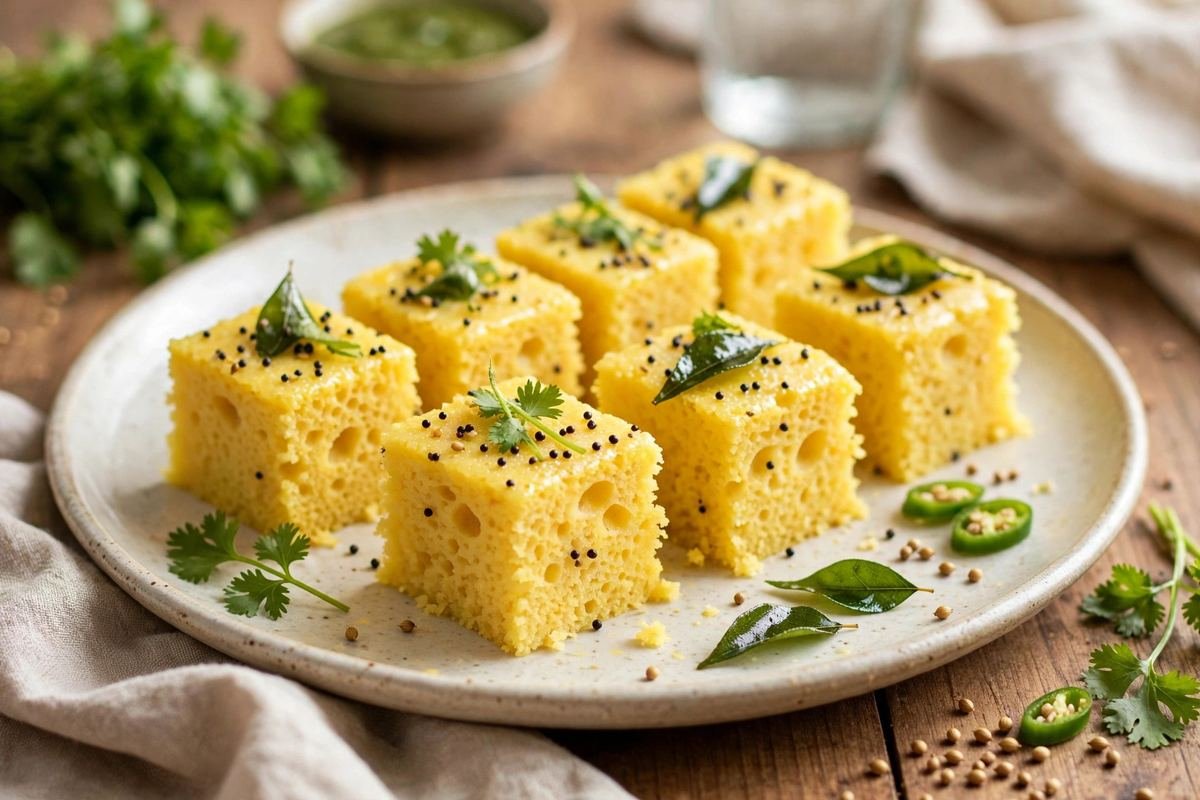
Pillowy-soft khaman dhokla with a tangy-sweet tempering of mustard seeds and sesame. This foolproof steamed chickpea-flour cake rises tall and spongy every time.
Ingredients
- 1 cup (120g) besan (chickpea flour), sifted
- 1 tbsp fine sooji/rava (optional, for structure)
- ¾ cup (180ml) water, plus more as needed
- 2 tbsp sugar
- 1 tbsp lemon juice (or ½ tsp citric acid dissolved in 1 tbsp water)
- ¾ tsp salt
- ¼ tsp turmeric powder
- 1 tbsp oil, plus more for greasing
- 1 tsp eno fruit salt (plain), OR 1 tsp baking soda + 1 tsp citric acid
- 2 tbsp oil
- 1 tsp mustard seeds
- 1 tsp sesame seeds
- 1 pinch hing (asafoetida)
- 8–10 curry leaves
- 2 green chilies, slit lengthwise
- ½ cup (120ml) water
- 1 tsp sugar
- 1 tsp lemon juice
- 2 tbsp chopped coriander leaves, for garnish
- 2 tbsp grated fresh coconut, for garnish (optional)
Instructions
- Set up the steamer first. Fill your steamer pot with 2–3 inches of water, place the trivet or stand inside, and bring to a rolling boil over high heat with the lid on. Grease your cake tin or thali generously with oil. Everything must be ready before you add the leavening — once eno goes in, there is no pausing.
- Make the batter. In a large bowl, whisk together the sifted besan, sooji (if using), sugar, salt, and turmeric. Add the water gradually, whisking to a smooth, pourable batter with no lumps — it should coat the back of a spoon and flow in a ribbon, roughly the consistency of pancake batter. Whisk in the lemon juice and the tablespoon of oil. Let the batter rest for 10 minutes; this hydrates the besan fully and gives a finer crumb.
- Add leavening and steam immediately. Sprinkle the eno (or baking soda + citric acid) evenly over the batter. Pour a teaspoon of water over it to activate, then whisk briskly for exactly 10–15 seconds — no more. The batter will froth, lighten, and visibly swell. Immediately pour into the greased tin, smooth the top, and place in the steamer. Cover with the lid (wrap the lid in a kitchen towel to stop condensation dripping onto the surface) and steam on high for 15–18 minutes. Do not open the lid for the first 12 minutes.
- Test for doneness. After 15 minutes, insert a toothpick or knife into the center — it should come out clean, and the top should spring back when lightly pressed. The khaman will have risen to nearly double its original height with a smooth, slightly domed top. If the toothpick shows wet batter, steam for 3–5 more minutes.
- Cool slightly, then unmold. Let the tin cool for 5 minutes — this firms the crumb so it releases cleanly. Run a knife around the edges and invert onto a serving plate, then flip right-side up. Cut into squares or diamonds with a sharp knife (a sawing motion tears less than pressing straight down).
- Prepare the tempering. Heat the 2 tablespoons of oil in a tadka pan over medium heat. Add the mustard seeds and wait for them to crackle and pop — about 20–30 seconds. Add the hing, sesame seeds, curry leaves (stand back, they splutter), and slit green chilies; sauté for 30 seconds until the sesame turns light golden and the curry leaves crisp.
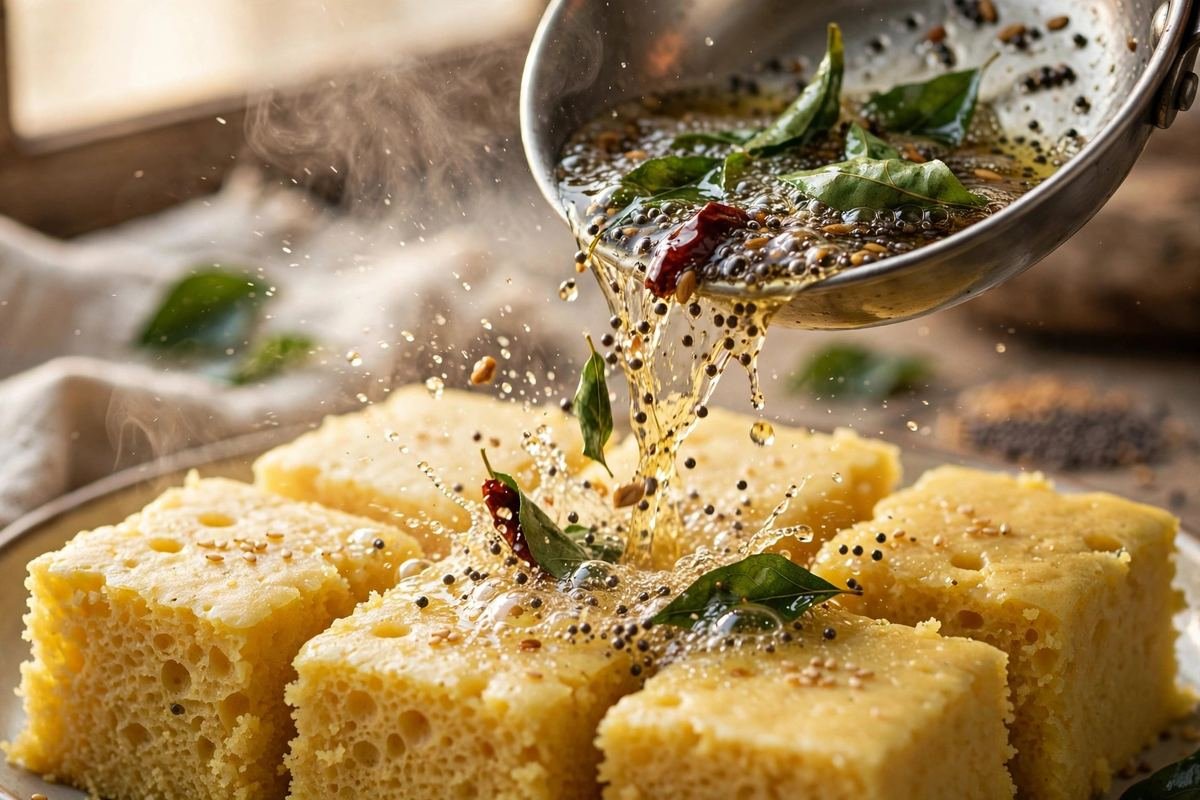
- Make the sweet water. Carefully pour the half cup of water into the tadka pan (it will hiss dramatically), add the sugar and lemon juice, and bring to a boil. Let it bubble for a minute until the sugar dissolves completely.
- Pour and soak. While the khaman is still warm, slowly and evenly pour the hot tempered water all over the cut pieces, letting it seep into the cuts and soak into the sponge. You’ll see the khaman drink it up — this is what keeps every piece moist and glossy. Garnish generously with chopped coriander and grated coconut.
- Rest and serve. Let the khaman rest for 10 minutes so the tempering fully absorbs, then serve at room temperature or lightly warm. Khaman is traditionally served at room temperature, not piping hot.
Tip: Read through the full post below for step-by-step photos, pro tips, variations and FAQs before you start cooking.
Gujarat’s Gift to the World: The Spongy Wonder Called Khaman
Every region of India has a dish it would defend in a friendly argument, and for Gujarat, that dish is dhokla. But here is a distinction worth making, because Gujaratis themselves are particular about it: khaman is the soft, spongy, instantly-made steamed cake of chickpea flour that most of India calls dhokla, while traditional dhokla proper is a fermented batter of rice and lentils, denser and tangier, closer to idli’s rustic cousin. What we are making here — and what ninety-nine percent of people mean when they say dhokla — is khaman: sunshine-yellow, feather-light, sweet-tangy, and crowned with a sizzling tempering of mustard seeds, sesame, and curry leaves.
Khaman’s genius is that it tastes like celebration but eats like health food. It is steamed, not fried. Its base is protein-rich chickpea flour. A serving delivers the satisfaction of cake with a fraction of the guilt — which is exactly why it has traveled from Gujarati home kitchens to office canteens, railway platforms, and mithai shops across the country. The texture is the whole point: when khaman is right, it is a sponge in the most literal sense, full of tiny air pockets that soak up the sweet-tangy tempering poured over it. Press a piece with your finger and it springs back. Tear it and it pulls apart in soft, airy layers.
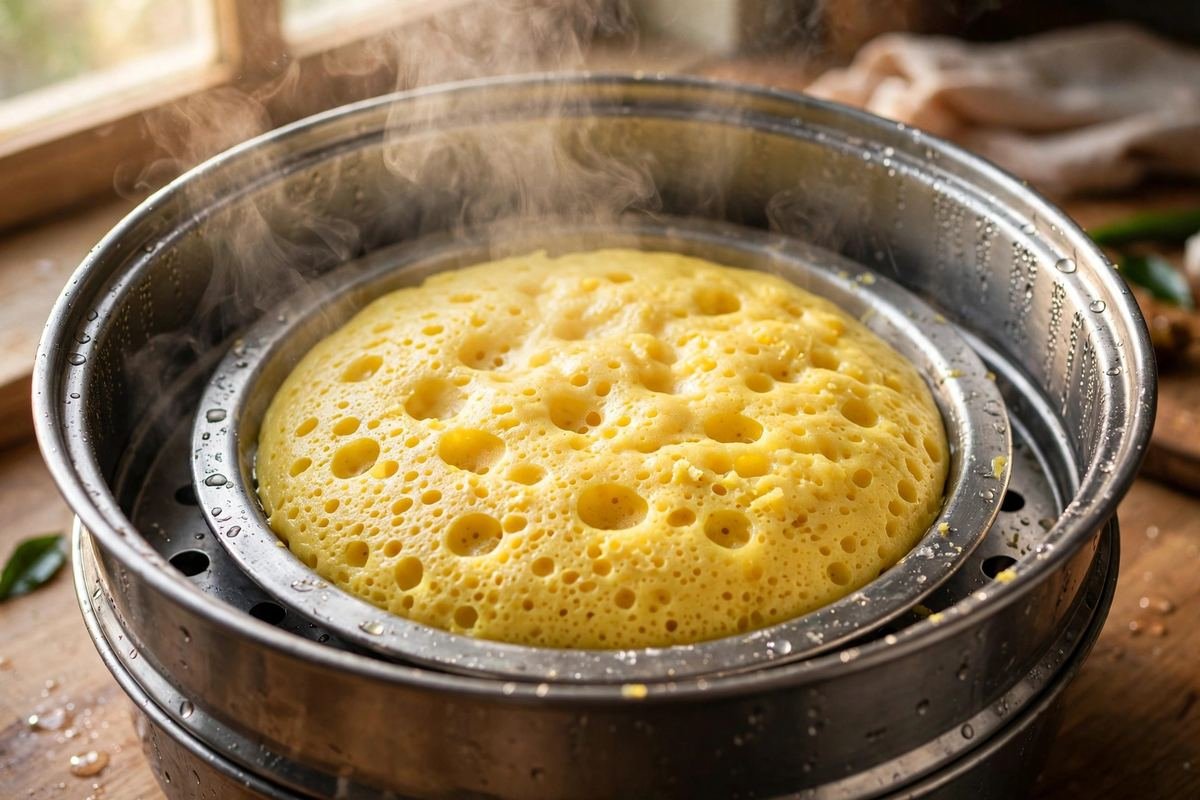
The leavening is where the science — and the drama — lives. Traditional khaman uses eno fruit salt, added at the very last second before steaming, which reacts with the batter’s acidity to produce a furious burst of carbon dioxide. You stir it in, watch the batter froth and swell, and get it into the steamer within seconds. That urgency is not theater; the gas starts escaping immediately, and every minute you delay is height you lose. The alternative leavening — baking soda plus citric acid or lemon — works on the same principle and is what we will use if eno is not available. Either way, the rule is iron: leavening goes in last, and the batter hits the steam immediately.
This recipe gives you the full Gujarati treatment: a batter balanced between sweet, sour, and salty (the holy trinity of Gujarati cooking), a tall even rise, and the classic tempering — or vaghar — of mustard seeds crackling in oil with sesame, green chilies, curry leaves, and a sweetened water poured over the whole thing so every bite glistens. Follow the timings, respect the steam, and you will unmold a khaman so spongy your family will think you bought it from the mithai shop.
Why You’ll Love This Recipe
- Foolproof spongy rise — the last-minute leavening technique guarantees a tall, airy crumb
- Steamed, not fried — all the satisfaction of a snack cake with minimal oil
- Ready in 45 minutes — no fermentation, no overnight wait, unlike traditional dhokla
- Sweet-sour-salty balance — the authentic Gujarati flavor trinity in every bite
- Perfect for crowds — one batch makes a full thali-sized platter; it scales beautifully
Key Ingredients Explained
Besan (chickpea flour) is the entire structure of khaman, so quality matters enormously. Use fresh, finely milled besan — coarse or stale besan gives a gritty, dense crumb and sometimes a bitter aftertaste. Sift it before measuring to remove lumps; lumps in the batter become dense spots in the steamed cake. Some cooks add a tablespoon of sooji (fine semolina) for a slightly firmer, more sliceable texture, but purists keep it all-besan for maximum softness.
The flavor base is sugar and lemon juice (or citric acid). Gujarati khaman is unapologetically sweet-sour — about 2 tablespoons of sugar and the juice of a lemon per cup of besan is the classic ratio. The acidity does double duty: it flavors the cake and it reacts with the leavening to create the rise. Salt balances the sweetness; without enough salt, khaman tastes flatly sugary. A pinch of turmeric gives the signature golden color — just a pinch, or the flavor turns earthy.
For leavening, eno fruit salt (plain, unflavored) is the traditional choice — one sachet (about 1 teaspoon) per cup of besan. If you cannot find eno, substitute 1 teaspoon baking soda plus 1 teaspoon citric acid (or 2 teaspoons lemon juice), though the rise is slightly less dramatic. The tempering needs mustard seeds, sesame seeds, slit green chilies, curry leaves, and hing (asafoetida) — this vaghar is non-negotiable for authentic flavor. Finally, the tempered water — about half a cup of water with a teaspoon of sugar and a squeeze of lemon, heated with the tempering — is poured over the steamed khaman and absorbed like a sponge, which is what keeps it moist for hours.
Equipment You’ll Need
- A steamer — a large pot with a steamer insert, an idli steamer, or a deep kadhai with a trivet and lid all work
- A 7 or 8-inch round cake tin, thali, or steel plate with at least 2-inch sides, greased
- A whisk for a lump-free batter
- A small tadka pan for the tempering
- A toothpick or knife to test doneness
- 1 cup (120g) besan (chickpea flour), sifted
- 1 tbsp fine sooji/rava (optional, for structure)
- ¾ cup (180ml) water, plus more as needed
- 2 tbsp sugar
- 1 tbsp lemon juice (or ½ tsp citric acid dissolved in 1 tbsp water)
- ¾ tsp salt
- ¼ tsp turmeric powder
- 1 tbsp oil, plus more for greasing
- 1 tsp eno fruit salt (plain), OR 1 tsp baking soda + 1 tsp citric acid
For the tempering:
- 2 tbsp oil
- 1 tsp mustard seeds
- 1 tsp sesame seeds
- 1 pinch hing (asafoetida)
- 8–10 curry leaves
- 2 green chilies, slit lengthwise
- ½ cup (120ml) water
- 1 tsp sugar
- 1 tsp lemon juice
- 2 tbsp chopped coriander leaves, for garnish
- 2 tbsp grated fresh coconut, for garnish (optional)
- Set up the steamer first. Fill your steamer pot with 2–3 inches of water, place the trivet or stand inside, and bring to a rolling boil over high heat with the lid on. Grease your cake tin or thali generously with oil. Everything must be ready before you add the leavening — once eno goes in, there is no pausing.
- Make the batter. In a large bowl, whisk together the sifted besan, sooji (if using), sugar, salt, and turmeric. Add the water gradually, whisking to a smooth, pourable batter with no lumps — it should coat the back of a spoon and flow in a ribbon, roughly the consistency of pancake batter. Whisk in the lemon juice and the tablespoon of oil. Let the batter rest for 10 minutes; this hydrates the besan fully and gives a finer crumb.
- Add leavening and steam immediately. Sprinkle the eno (or baking soda + citric acid) evenly over the batter. Pour a teaspoon of water over it to activate, then whisk briskly for exactly 10–15 seconds — no more. The batter will froth, lighten, and visibly swell. Immediately pour into the greased tin, smooth the top, and place in the steamer. Cover with the lid (wrap the lid in a kitchen towel to stop condensation dripping onto the surface) and steam on high for 15–18 minutes. Do not open the lid for the first 12 minutes.
- Test for doneness. After 15 minutes, insert a toothpick or knife into the center — it should come out clean, and the top should spring back when lightly pressed. The khaman will have risen to nearly double its original height with a smooth, slightly domed top. If the toothpick shows wet batter, steam for 3–5 more minutes.
- Cool slightly, then unmold. Let the tin cool for 5 minutes — this firms the crumb so it releases cleanly. Run a knife around the edges and invert onto a serving plate, then flip right-side up. Cut into squares or diamonds with a sharp knife (a sawing motion tears less than pressing straight down).
- Prepare the tempering. Heat the 2 tablespoons of oil in a tadka pan over medium heat. Add the mustard seeds and wait for them to crackle and pop — about 20–30 seconds. Add the hing, sesame seeds, curry leaves (stand back, they splutter), and slit green chilies; sauté for 30 seconds until the sesame turns light golden and the curry leaves crisp.
- Make the sweet water. Carefully pour the half cup of water into the tadka pan (it will hiss dramatically), add the sugar and lemon juice, and bring to a boil. Let it bubble for a minute until the sugar dissolves completely.
- Pour and soak. While the khaman is still warm, slowly and evenly pour the hot tempered water all over the cut pieces, letting it seep into the cuts and soak into the sponge. You’ll see the khaman drink it up — this is what keeps every piece moist and glossy. Garnish generously with chopped coriander and grated coconut.
- Rest and serve. Let the khaman rest for 10 minutes so the tempering fully absorbs, then serve at room temperature or lightly warm. Khaman is traditionally served at room temperature, not piping hot.
Pro Tips for Perfect Results
- Steamer must be at full boil before the batter goes in. Lukewarm steam gives a dense, sad khaman. Get it roaring first.
- Eno goes in last, batter steams within seconds. Whisk 10–15 seconds max after adding it, then pour and cover. Delay deflates the rise.
- Don’t over-whisk after adding leavening. You’re distributing it, not developing anything — 15 seconds is plenty.
- Wrap the steamer lid in a towel. Condensation dripping onto the surface creates soggy dents. A kitchen towel tucked over the lid absorbs it.
- Don’t peek early. Opening the lid in the first 12 minutes drops the temperature and can collapse the rise.
- Sift the besan. Lumps in the batter become hard little pebbles in the finished cake. Sifting takes a minute and changes everything.
- Balance sweet, sour, and salt. Taste the raw batter (before leavening) — it should taste distinctly sweet-sour-salty. Steaming mutes flavors slightly, so be bold.
- Pour the tempering over warm khaman. A warm sponge absorbs the sweet water far better than a cold one.
Variations to Try
Rava dhokla: replace half the besan with fine sooji for a firmer, grainier texture — great for those who find pure khaman too soft. Palak khaman: blend a handful of spinach into the batter water for a green, iron-rich version that kids love. Corn khaman: fold sweet corn kernels into the batter for pops of sweetness. Sandwich dhokla: steam a thin layer, spread green chutney over it, pour a second thin layer on top, and steam again — the layered Gujarati party showpiece. Microwave khaman: pour the leavened batter into a greased microwave-safe dish and cook on high for 3–4 minutes for single-serve emergencies (the texture is slightly denser but genuinely good). Amiri khaman: the Surat specialty — crumble steamed khaman, toss with pomegranate seeds, sev, and extra tempering for a chaat-like dish.
Serving Suggestions
Khaman is traditionally a breakfast or evening snack, served at room temperature with green chutney and sometimes a drizzle of garlic chutney for heat. It pairs beautifully with masala chai — the sweet-sour sponge against tannic tea is a classic Gujarati combination. For a fuller spread, serve alongside fafda and jalebi (the iconic Gujarati Sunday breakfast trio), or with khandvi and patra for a steamed-snacks platter. Crumbled khaman makes an excellent chaat base: top with yogurt, tamarind chutney, sev, and pomegranate. It also travels well, making it ideal for tiffin boxes, picnics, and potlucks — it holds at room temperature for hours without losing charm.
Storage and Reheating
Khaman keeps at room temperature for up to 24 hours in an airtight container — the tempered water keeps it moist. Refrigerate for up to 3 days, but always bring it back to room temperature before serving; cold khaman tastes dense and dull. To revive refrigerated khaman, sprinkle with a little water, cover, and steam for 3–4 minutes or microwave for 30–45 seconds — it springs back remarkably well. You can freeze steamed (untempered) khaman for up to a month; thaw, steam briefly, then apply fresh tempering. Avoid storing the batter — once leavening is added it must be steamed immediately, and unleavened batter ferments unpredictably.
Frequently Asked Questions
Why didn’t my khaman rise / why is it dense?
The classic culprits: old or inactive eno (test it — it should fizz violently in water), delay between adding leavening and steaming, steamer not at full boil, or opening the lid too early. Also check your besan isn’t stale. Fix the timing chain and the rise follows.
Can I make khaman without eno?
Yes — use 1 teaspoon baking soda plus 1 teaspoon citric acid (or 2 teaspoons lemon juice) per cup of besan. Add them exactly as you would eno: last, with a splash of water, whisk briefly, steam immediately. The rise is slightly less lofty but still properly spongy.
Why is my khaman bitter?
Usually too much baking soda, or turmeric over-measured. Stick to the quantities given, and if using the soda-citric substitute, measure carefully — excess soda is the most common cause of bitterness and a soapy aftertaste.
What’s the difference between khaman and dhokla?
Khaman is the instant, chickpea-flour, sweet-sour steamed cake (no fermentation). True dhokla is made from a fermented batter of rice and chana dal, is whiter, denser, and tangier, and takes hours of fermentation. Outside Gujarat the names are used interchangeably, but Gujaratis know the difference.
Can I make khaman in the microwave?
Yes for small batches. Grease a microwave-safe bowl, pour in the leavened batter, and microwave on high for 3–4 minutes until set. The crumb is a touch denser and you miss the tall rise, but the flavor is right and it’s ready in minutes.
Why pour sweetened water over the khaman?
The sponge absorbs it, which does three things: keeps the khaman moist for hours, carries the tempering flavors into every bite, and reinforces the sweet-sour balance. Skipping it gives you dry khaman that stales within an hour. Don’t skip it.
Khaman is proof that the simplest techniques — steam, chickpea flour, and perfect timing — can produce something that feels like magic. Master the last-minute leavening, respect the sweet-sour-salty balance, and be generous with that crackling tempering, and you’ll have a recipe that earns a permanent place in your snack rotation. Make it once for the novelty; you’ll make it forever for the cravings.