Recipe Card
Golden, shatteringly crisp dosas with a spiced potato filling, coconut chutney and sambar. Learn the fermentation secrets for perfect dosa batter at home.
Ingredients
- 3 cups parboiled idli rice
- 1 cup whole urad dal (skinned black gram)
- 1 tsp fenugreek (methi) seeds
- 1/2 cup thick poha (flattened rice), rinsed
- 1.5 tsp salt, or to taste
- Water as needed for soaking and grinding
- 4 large potatoes (about 600g), boiled, peeled, and roughly mashed
- 2 tbsp oil
- 1 tsp mustard seeds
- 1 tsp urad dal
- 1 tsp chana dal
- 10-12 curry leaves
- 2 green chillies, finely chopped
- 1 tbsp fresh ginger, finely grated
- 1 large onion, finely chopped
- 1/2 tsp turmeric powder
- 1 tsp salt, or to taste
- 2 tbsp fresh coriander leaves, chopped
- 1 tbsp lemon juice
- 1 cup fresh or frozen grated coconut
- 2 tbsp roasted chana dal (dalia)
- 2 green chillies
- 1/2 inch ginger piece
- 1/2 tsp salt
- 1/2 cup water, plus more as needed
- 1 tsp oil, 1/2 tsp mustard seeds, 5 curry leaves, and 1 dried red chilli for tempering
Instructions
- Soak the rice and dal. Rinse the idli rice, urad dal, and fenugreek seeds separately until the water runs clear. Soak the rice and fenugreek together in plenty of water for 5-6 hours, and soak the urad dal separately for 4-5 hours. Soaking separately matters because dal and rice need different grinding times. Rinse the poha and soak it for 15 minutes just before grinding.
- Grind to a fluffy batter. Drain the urad dal and grind it first with about 1 cup of cold water, added a tablespoon at a time, for 8-10 minutes until it turns pale, fluffy, and almost mousse-like; properly ground dal should feel light and airy, not gritty. Transfer to your fermentation bowl. Then grind the drained rice with the soaked poha and about 1.5 cups of water to a slightly coarse, semolina-like texture; a little graininess is correct for dosa and gives the crisp lacy texture. Mix both batters together with your clean hands for 2 minutes; the warmth and microbes from your hands genuinely help kickstart fermentation.
- Ferment overnight. Cover the bowl loosely and leave in a warm spot for 8-12 hours. In summer, 8 hours on the counter is plenty; in winter, place the bowl inside the oven with just the light on, which holds a steady 28-30C. The batter is ready when it has risen to nearly double, smells pleasantly sour like yoghurt, and is full of tiny bubbles. Stir in the salt only now, and thin with a little water to a pourable consistency that coats the back of a spoon.
- Make the potato palya. Heat 2 tbsp oil in a pan over medium heat. Add the mustard seeds and let them splutter, then add the urad dal and chana dal and fry until golden, about 1 minute. Add curry leaves, green chillies, and ginger, saute 30 seconds, then add the onion and cook 4-5 minutes until soft and translucent. Stir in the turmeric and salt, add the mashed potatoes and 1/4 cup water, and mix well. Cook 3-4 minutes until everything is heated through and holds together softly. Finish with lemon juice and coriander, and keep warm.
- Blend the chutney. Grind the coconut, roasted chana dal, green chillies, ginger, salt, and water to a smooth, thick chutney. Heat 1 tsp oil in a small tadka pan, splutter the mustard seeds, add curry leaves and the dried red chilli, and pour this tempering over the chutney. Stir and set aside.
- Heat the tawa correctly. This step makes or breaks your dosa. Heat your tawa over medium-high until a drop of water dances and evaporates in 2-3 seconds. Then reduce to medium, sprinkle a few drops of water, and wipe the surface with a halved onion or a damp cloth; this cools it slightly and seasons it. The tawa should be hot enough to sizzle the batter on contact but not so hot that the batter sets before you can spread it.
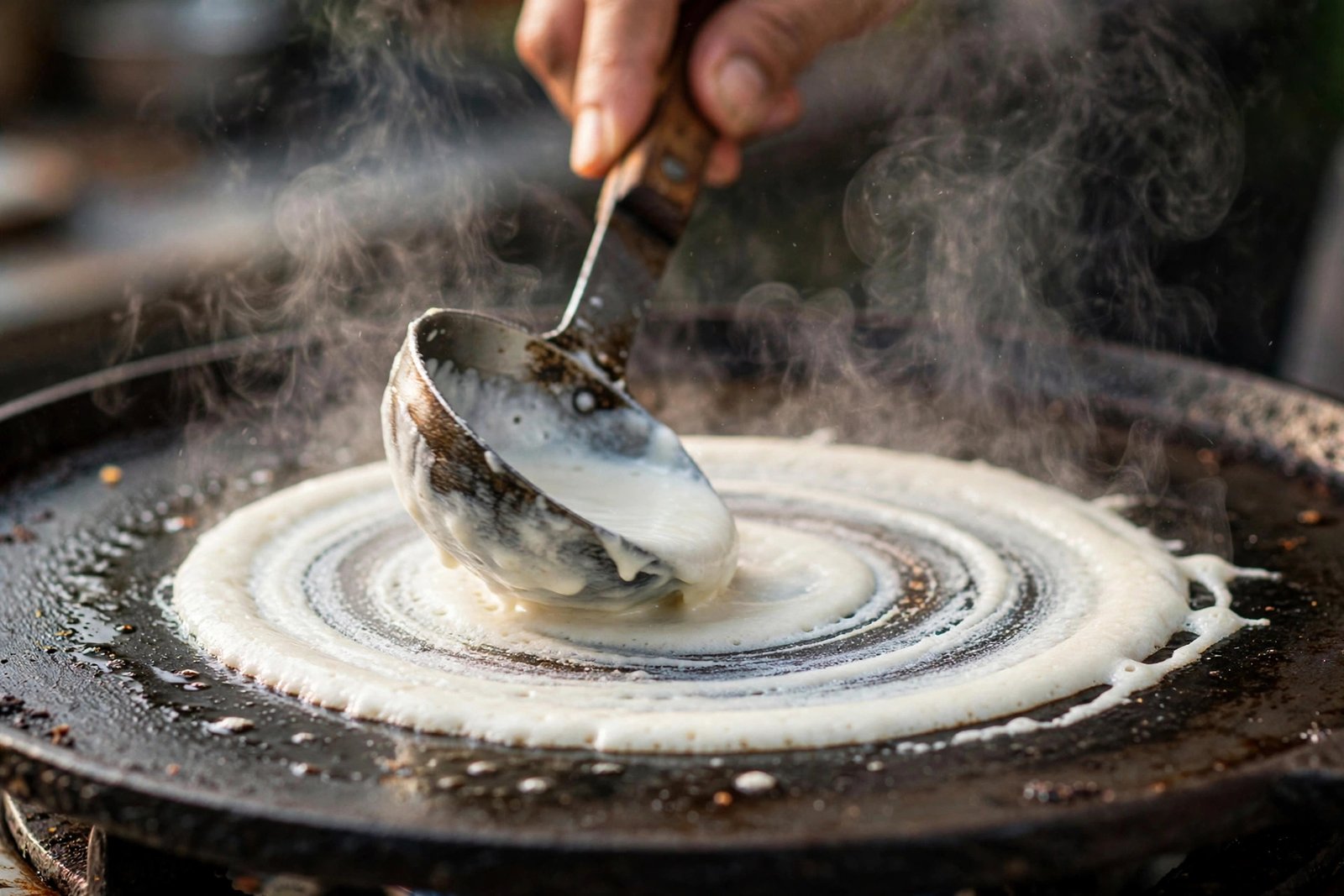
- Spread and cook the dosa. Pour a ladleful of batter (about 1/3 cup) in the centre of the tawa. Using the back of the ladle, spread it outward in a continuous spiral with light pressure, working quickly from centre to edge to make a thin, even circle about 10 inches across. Drizzle 1 teaspoon of oil or ghee around the edges. Cook for 2-3 minutes until the surface looks dry, the edges lift away from the tawa, and the underside is deep golden brown and crisp. For masala dosa, spread 2-3 tablespoons of potato palya over one half, fold the dosa over it, and slide onto a plate. Serve immediately with chutney and sambar.
Tip: Read through the full post below for step-by-step photos, pro tips, variations and FAQs before you start cooking.
Introduction
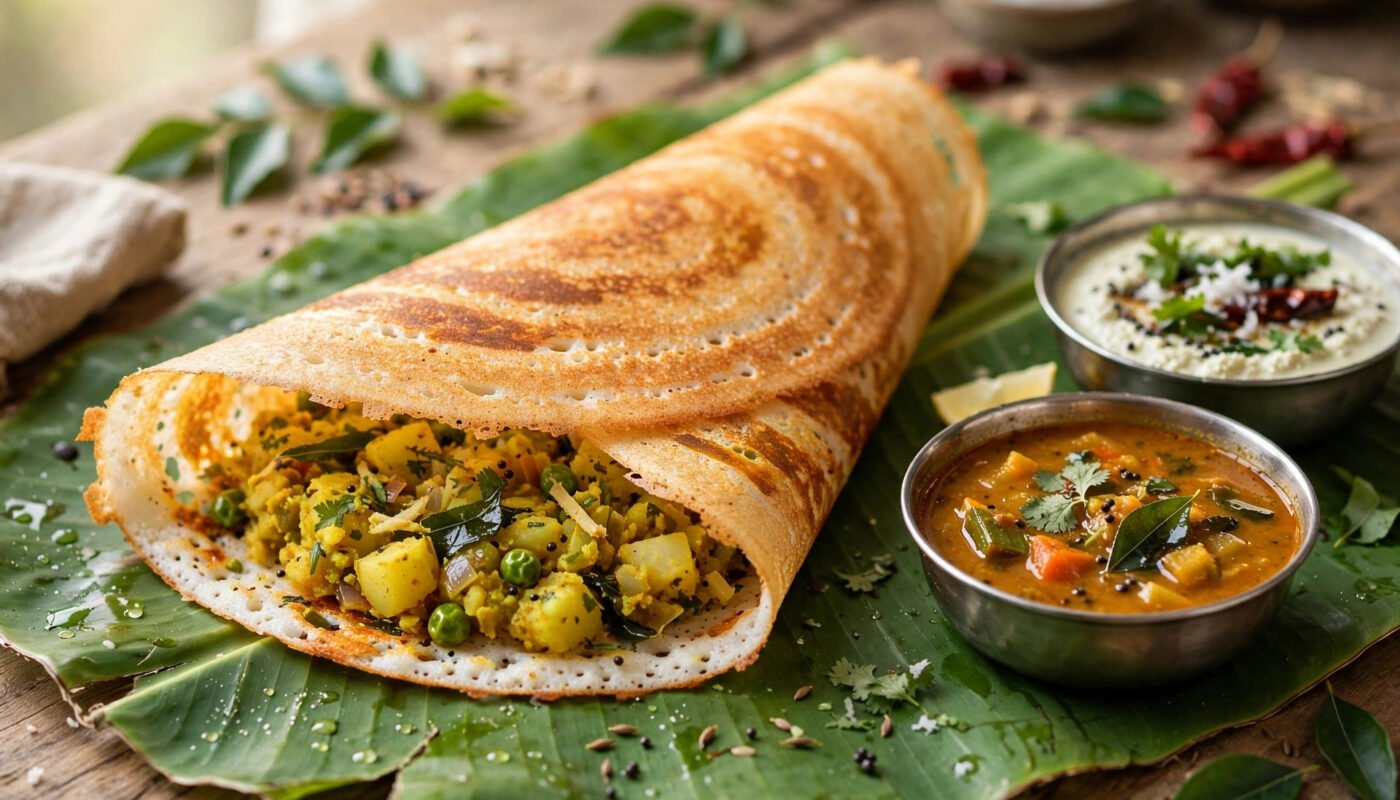
The masala dosa is South India’s gift to the world breakfast table, and quite possibly the greatest crepe ever conceived. A thin, golden, shatteringly crisp fermented crepe made from rice and lentils, folded around a warm, turmeric-yellow potato filling, served with coconut chutney and piping-hot sambar: it is a complete sensory experience. The dosa crackles when you tear it, the potato filling is soft and comforting, the chutney is cool and fresh, and the sambar ties everything together with its tangy, lentil-rich depth.
Dosa’s history stretches back centuries in the temple towns of Tamil Nadu and Karnataka, where fermented batters were already a staple of the vegetarian kitchen. The masala version, with its potato palya filling, is said to have been popularised by the Udupi restaurants of Karnataka, which carried it to every corner of India and then the world. What looks simple is actually applied food science: soaking, grinding, and fermenting rice and urad dal creates a batter alive with lactic acid bacteria, which gives the dosa its characteristic tang and its lacy, crisp texture.
Many home cooks are intimidated by dosa, and I understand why. Fermentation feels unpredictable, and spreading the batter takes practice. But here is the truth: once you understand the three variables that matter, batter consistency, fermentation warmth, and pan temperature, dosa becomes one of the most reliable and rewarding things you can cook. This recipe gives you my tested batter ratio, a foolproof fermentation guide for every season, and the classic potato palya exactly as the Udupi masters make it. Your first dosa may be imperfect. Your fifth will be restaurant-worthy.
Why You’ll Love This Recipe
- Shatteringly crisp texture: The right rice-dal ratio and fermentation produce dosas that crackle, not flop.
- Foolproof fermentation guide: Season-by-season tips so your batter rises perfectly in summer and winter.
- Authentic potato palya: The classic turmeric potato filling with mustard seeds, curry leaves, and ginger.
- Complete meal: Includes quick coconut chutney and guidance on sambar pairing.
- Naturally gluten-free and vegan: The dosa itself needs no wheat, dairy, or eggs.
- Batter keeps for days: One batch gives you dosas, uttapam, and paniyaram across the week.
Key Ingredients Explained
The dosa batter has only a handful of ingredients, so quality and ratio are everything. The foundation is parboiled rice (idli rice) and whole urad dal (black gram, skinned) in a roughly 3:1 ratio by volume. Parboiled rice ferments better and gives a crispier dosa than raw rice; if you cannot find idli rice, regular parboiled rice works. The urad dal is what makes the batter fluffy and fermented; it must be fresh, as old dal ferments poorly. A small handful of poha (flattened rice) or cooked rice goes in as my secret weapon: it makes the dosa golden and crisp even if your fermentation is slightly under.
Fenugreek seeds (methi), just a teaspoon, are non-negotiable. They aid fermentation, add the characteristic aroma, and help the dosa brown beautifully. Salt is added only after fermentation, never before, because salt inhibits the wild bacteria you are trying to encourage. For the potato palya, use starchy potatoes that mash easily, and do not skimp on the tempering: mustard seeds that pop, urad dal that turns golden, curry leaves, ginger, and green chillies. Turmeric gives the filling its sunny colour, and a squeeze of lemon at the end wakes everything up. For the chutney, fresh coconut is best, but frozen grated coconut works well; roasted chana dal (dalia) gives the chutney body so it needs less coconut.
Equipment You’ll Need
- Wet grinder or high-powered mixer grinder: For a smooth, fluffy batter; a regular blender works in small batches.
- Large steel or glass bowl: For fermentation, with room for the batter to double.
- Cast-iron dosa tawa or non-stick griddle: A dedicated flat tawa gives the most even browning.
- Ladle with a rounded bottom: For pouring and spreading the batter in spirals.
- Flat spatula: For lifting and folding the crisp dosa.
Ingredients
For the dosa batter (makes 10-12 dosas)
- 3 cups parboiled idli rice
- 1 cup whole urad dal (skinned black gram)
- 1 tsp fenugreek (methi) seeds
- 1/2 cup thick poha (flattened rice), rinsed
- 1.5 tsp salt, or to taste
- Water as needed for soaking and grinding
For the potato palya (filling)
- 4 large potatoes (about 600g), boiled, peeled, and roughly mashed
- 2 tbsp oil
- 1 tsp mustard seeds
- 1 tsp urad dal
- 1 tsp chana dal
- 10-12 curry leaves
- 2 green chillies, finely chopped
- 1 tbsp fresh ginger, finely grated
- 1 large onion, finely chopped
- 1/2 tsp turmeric powder
- 1 tsp salt, or to taste
- 2 tbsp fresh coriander leaves, chopped
- 1 tbsp lemon juice
For the coconut chutney
- 1 cup fresh or frozen grated coconut
- 2 tbsp roasted chana dal (dalia)
- 2 green chillies
- 1/2 inch ginger piece
- 1/2 tsp salt
- 1/2 cup water, plus more as needed
- 1 tsp oil, 1/2 tsp mustard seeds, 5 curry leaves, and 1 dried red chilli for tempering
Instructions
- Soak the rice and dal. Rinse the idli rice, urad dal, and fenugreek seeds separately until the water runs clear. Soak the rice and fenugreek together in plenty of water for 5-6 hours, and soak the urad dal separately for 4-5 hours. Soaking separately matters because dal and rice need different grinding times. Rinse the poha and soak it for 15 minutes just before grinding.
- Grind to a fluffy batter. Drain the urad dal and grind it first with about 1 cup of cold water, added a tablespoon at a time, for 8-10 minutes until it turns pale, fluffy, and almost mousse-like; properly ground dal should feel light and airy, not gritty. Transfer to your fermentation bowl. Then grind the drained rice with the soaked poha and about 1.5 cups of water to a slightly coarse, semolina-like texture; a little graininess is correct for dosa and gives the crisp lacy texture. Mix both batters together with your clean hands for 2 minutes; the warmth and microbes from your hands genuinely help kickstart fermentation.
- Ferment overnight. Cover the bowl loosely and leave in a warm spot for 8-12 hours. In summer, 8 hours on the counter is plenty; in winter, place the bowl inside the oven with just the light on, which holds a steady 28-30C. The batter is ready when it has risen to nearly double, smells pleasantly sour like yoghurt, and is full of tiny bubbles. Stir in the salt only now, and thin with a little water to a pourable consistency that coats the back of a spoon.
- Make the potato palya. Heat 2 tbsp oil in a pan over medium heat. Add the mustard seeds and let them splutter, then add the urad dal and chana dal and fry until golden, about 1 minute. Add curry leaves, green chillies, and ginger, saute 30 seconds, then add the onion and cook 4-5 minutes until soft and translucent. Stir in the turmeric and salt, add the mashed potatoes and 1/4 cup water, and mix well. Cook 3-4 minutes until everything is heated through and holds together softly. Finish with lemon juice and coriander, and keep warm.
- Blend the chutney. Grind the coconut, roasted chana dal, green chillies, ginger, salt, and water to a smooth, thick chutney. Heat 1 tsp oil in a small tadka pan, splutter the mustard seeds, add curry leaves and the dried red chilli, and pour this tempering over the chutney. Stir and set aside.
- Heat the tawa correctly. This step makes or breaks your dosa. Heat your tawa over medium-high until a drop of water dances and evaporates in 2-3 seconds. Then reduce to medium, sprinkle a few drops of water, and wipe the surface with a halved onion or a damp cloth; this cools it slightly and seasons it. The tawa should be hot enough to sizzle the batter on contact but not so hot that the batter sets before you can spread it.
- Spread and cook the dosa. Pour a ladleful of batter (about 1/3 cup) in the centre of the tawa. Using the back of the ladle, spread it outward in a continuous spiral with light pressure, working quickly from centre to edge to make a thin, even circle about 10 inches across. Drizzle 1 teaspoon of oil or ghee around the edges. Cook for 2-3 minutes until the surface looks dry, the edges lift away from the tawa, and the underside is deep golden brown and crisp. For masala dosa, spread 2-3 tablespoons of potato palya over one half, fold the dosa over it, and slide onto a plate. Serve immediately with chutney and sambar.
Pro Tips for Perfect Results
- Grind the dal fluffy, the rice coarse. Airy dal gives lift; slightly grainy rice gives crispness. Reversing the textures gives you soft, pale dosas.
- Salt only after fermentation. Salt slows the bacteria down. Adding it post-ferment is a small detail with a big impact on rise.
- Master tawa temperature. Too hot and the batter seizes before spreading; too cool and the dosa steams instead of crisping. The water-drop test never lies.
- Wipe between dosas. A quick wipe with a damp cloth between each dosa resets the temperature and prevents sticking.
- Do not flip. A proper thin dosa cooks through from the bottom heat alone. Flipping makes it leathery instead of crisp.
- Keep batter consistency pourable. Too thick and the dosa turns out doughy; too thin and it tears. Aim for a ribbon that flows off the ladle.
- Use the batter across the week. Day-one batter makes the crispiest dosas; day-three, tangier batter is perfect for uttapam and paniyaram.
Variations to Try
The dosa family is vast. Mysore masala dosa spreads a fiery red garlic chutney on the dosa before adding the potato filling, for a bold, spicy upgrade. Rava dosa skips fermentation entirely: a thin batter of semolina, rice flour, and maida studded with cumin, pepper, and onions is poured in a lacy web onto a screaming-hot tawa for instant crispness. Onion uttapam uses the same batter poured thick like a pancake and topped with onions, tomatoes, and green chillies. For a protein-packed twist, try pesarattu, the Andhra moong dal dosa, served with ginger chutney. And cheese masala dosa, with a generous grating of cheese melting into the potato filling, is the Mumbai street-style favourite that kids adore.
Serving Suggestions
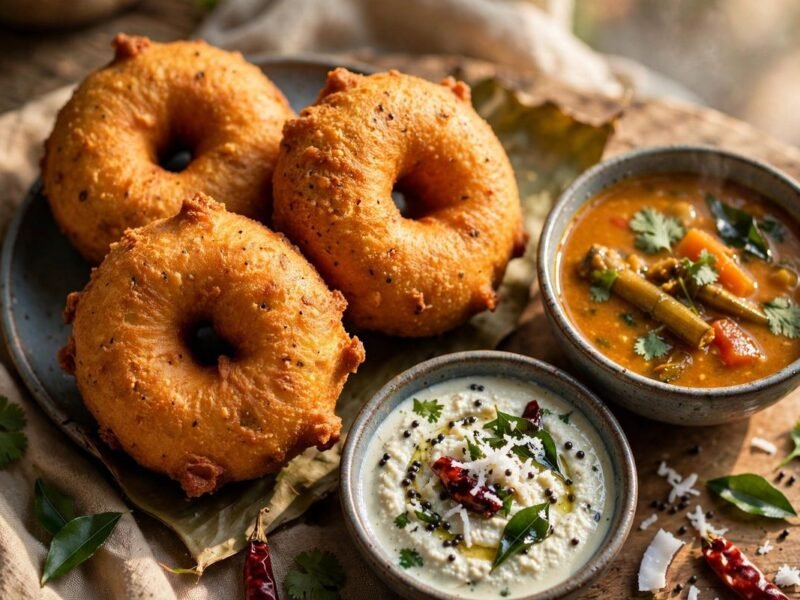
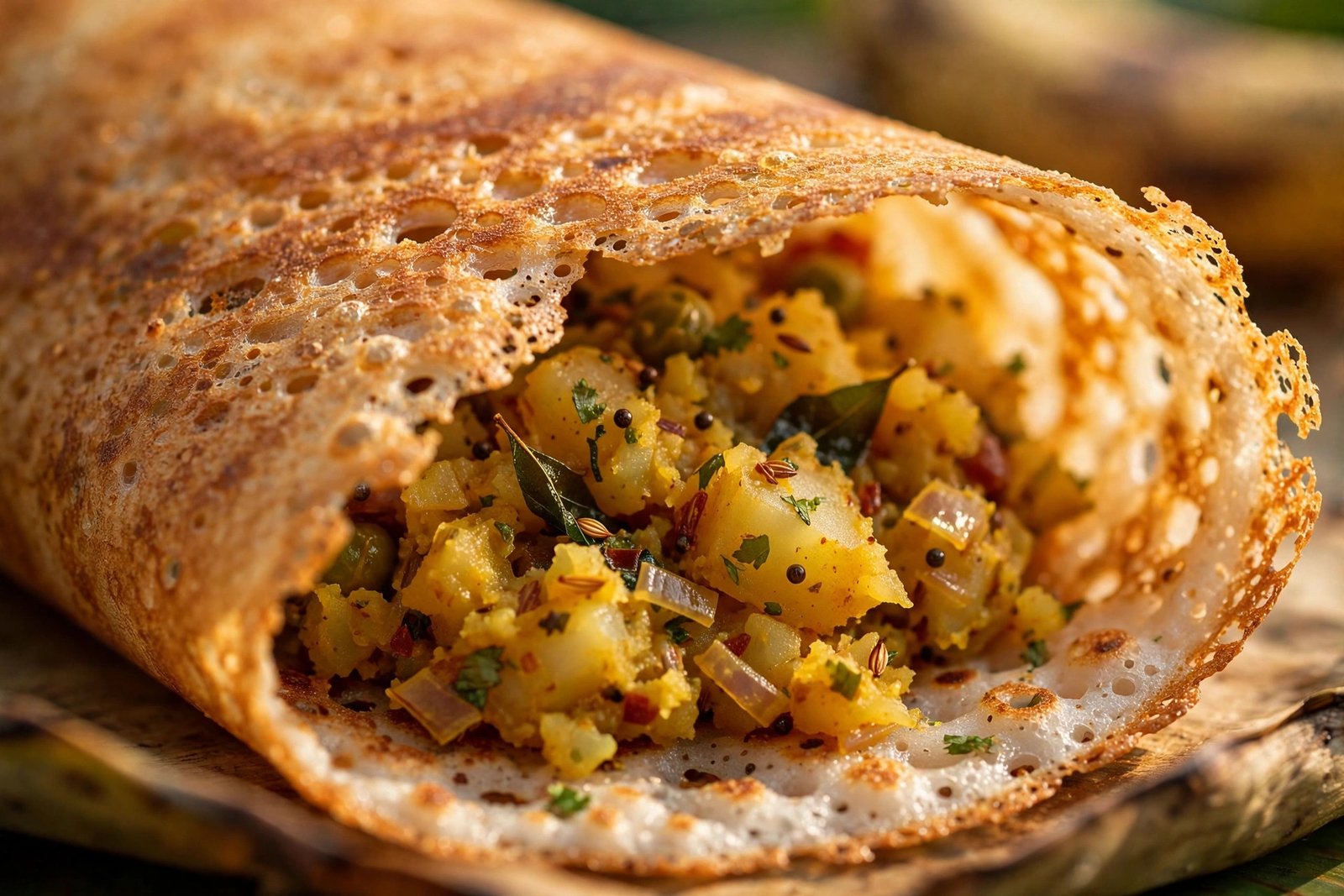
A masala dosa is traditionally served on a banana leaf or a steel plate with three accompaniments: coconut chutney, a tomato-onion chutney for tang, and a steel tumbler of hot sambar for dunking. Many purists pour a little sambar directly over the dosa. A glass of filter coffee is the classic South Indian pairing and honestly completes the experience. For a full breakfast spread, add medu vada and idli alongside, letting everyone mix and match. Serve dosas one at a time straight off the tawa; they lose their crispness within minutes, so the cook eats last in a dosa-loving household, and nobody minds.
Storage and Reheating
The fermented batter keeps in the refrigerator for 4-5 days in a covered container; it will continue to sour slowly, which is fine. Stir well and thin with a little water before each use, since it thickens when cold. Cooked dosas do not store well; they lose their crispness within 20 minutes and reheating makes them chewy, so always cook fresh. The potato palya, however, refrigerates beautifully for 3 days and also makes a great sandwich or paratha filling the next day. Coconut chutney keeps for 2 days refrigerated; bring to room temperature before serving, as cold chutney dulls its flavour. Leftover batter past day five is best turned into uttapam or paniyaram rather than thin dosas.
Frequently Asked Questions
My batter did not ferment. What went wrong?
The usual culprits are cold temperature, old urad dal, or salt added before fermentation. In winter, ferment inside the oven with the light on, or near a warm appliance. Always use fresh dal, add salt only after fermenting, and give it up to 14 hours in cold weather before declaring failure.
Why is my dosa sticking to the tawa?
Either the tawa is not seasoned enough or the temperature is wrong. For a new cast-iron tawa, season it by cooking several parathas or rubbing it with oil and onion first. Always do the water-drop test and the onion wipe before the first dosa, and never wash a hot tawa with soap.
Can I make dosa batter without a wet grinder?
Yes. A high-powered mixer grinder works; grind the dal in small batches with minimal water, resting the motor between batches so the batter does not heat up. Heat kills the fermentation bacteria, so use cold water and short grinding bursts.
Why are my dosas soft instead of crispy?
Soft dosas usually mean the batter is too thick, the tawa is too cool, or the rice-to-dal ratio is off. Thin the batter slightly, make sure the tawa passes the water-drop test, and check that you used parboiled rice rather than raw rice.
Is dosa batter gluten-free?
The basic batter of rice, urad dal, fenugreek, and poha is naturally gluten-free. Just ensure your poha and dals are certified gluten-free if you are cooking for someone with coeliac disease, to avoid cross-contamination from processing.
Can I freeze dosa batter?
Freezing is not recommended because it kills the live cultures and ruins the texture. Instead, refrigerate for up to 5 days. If you must, freeze unfermented ground batter, then thaw and ferment fresh, though the results are noticeably less tangy.
There is a special pride in serving a dosa that shatters audibly when torn. It takes a little practice, but every dosa you spread teaches your hands something new, and soon the spiral motion becomes pure muscle memory. Start with this batter, respect the ferment, heat that tawa well, and breakfast will never be boring again. Happy dosa making!