Recipe Card
Mumbai’s legendary street burger — a spiced potato vada tucked into a soft pav with fiery garlic chutney. This authentic recipe nails the flavour of the city’s beloved stalls.
Ingredients
- For the batata vada filling:
- 750g floury potatoes (about 5 medium), boiled whole in skins
- 2 tablespoons oil
- 1 teaspoon mustard seeds
- 1/2 teaspoon cumin seeds
- 10–12 fresh curry leaves
- 1/4 teaspoon asafoetida (hing)
- 4–5 green chillies, pounded with 6 garlic cloves and 2.5 cm ginger into a coarse paste
- 1/2 teaspoon turmeric powder
- 1 1/4 teaspoons salt, or to taste
- 2 tablespoons chopped fresh coriander leaves
- 1 tablespoon lemon juice
- For the batter:
- 1 1/2 cups (180g) besan (gram flour), sifted
- 1/2 teaspoon red chilli powder
- 1/4 teaspoon turmeric powder
- 1/4 teaspoon ajwain (carom seeds)
- 1/8 teaspoon baking soda
- 3/4 teaspoon salt
- 3/4 cup (180 ml) water, approximately
- 1 tablespoon hot oil, for the batter
- For the dry garlic chutney:
- 12–15 garlic cloves, roasted until golden
- 1/4 cup (35g) roasted peanuts
- 2 tablespoons desiccated coconut
- 2 teaspoons Kashmiri red chilli powder
- 3/4 teaspoon salt
- For assembly:
- 8 ladi pav (soft square rolls)
- 4 tablespoons butter, softened, for toasting
- 1/2 cup green mint-coriander chutney
- 8 whole green chillies, slit and fried in oil with salt (optional, traditional accompaniment)
- 1 large onion, thinly sliced into rings
- Oil for deep frying (about 750 ml)
Instructions
- Make the dry garlic chutney first. Dry-roast the garlic cloves in a small pan over medium heat, shaking often, until they turn golden with charred spots and smell sweet — about 5–6 minutes. Let them cool, then pound or grind with the roasted peanuts, desiccated coconut, red chilli powder, and salt into a coarse, crumbly powder. It should be textured, not a fine dust. Taste and adjust salt and chilli. Set aside in a jar — this keeps for 3 weeks at room temperature.
- Prepare the potato filling. Peel the warm boiled potatoes and mash them coarsely in a large bowl, leaving small lumps for texture. Heat 2 tablespoons of oil in a kadhai over medium-high heat. Add the mustard seeds and wait for them to crackle and pop completely — about 30 seconds — then add cumin seeds, curry leaves (they will splutter; stand back), and asafoetida. Immediately add the pounded green chilli-garlic-ginger paste and turmeric, and sauté for 1–2 minutes until the raw smell disappears and the paste turns fragrant and slightly golden.
- Season the potatoes. Tip the mashed potatoes into the kadhai with the salt. Mix thoroughly but gently, folding the tempering through the mash without overworking it. Cook for 2–3 minutes, stirring, so the flavours meld and excess moisture evaporates — the mixture should be dry enough to hold its shape. Off the heat, fold in the coriander leaves and lemon juice. Taste: it should be boldly salty, tangy, and spicy, because the bland batter and bread will mute it. Cool completely, then divide into 8 equal portions and shape into firm, slightly flattened balls about 6 cm across. Chill for 15 minutes so they firm up.
- Mix the batter. Whisk the besan with red chilli powder, turmeric, ajwain, baking soda, and salt. Add water gradually to make a batter slightly thinner than dosa batter — it should coat a potato ball in a thin, even veil, not a thick jacket. Whisk in a tablespoon of hot oil last. The batter should flow off a spoon in a steady ribbon; if it is too thick, the vadas turn doughy.
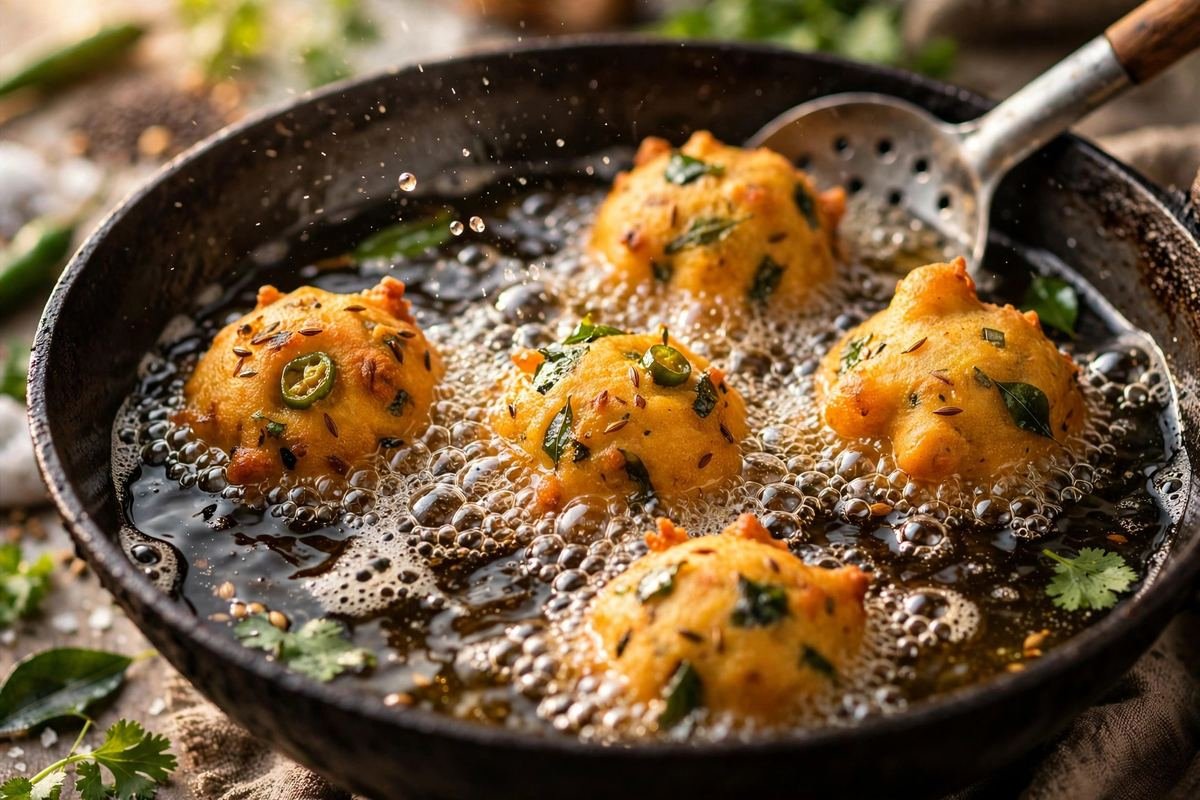
- Fry the vadas. Heat oil to 170–175°C (340–350°F). Dip each chilled potato ball into the batter, turning to coat thinly and letting excess drip off. Slide gently into the oil — fry 3–4 at a time so the temperature stays steady. Fry for 4–5 minutes, turning occasionally, until deeply golden and crisp all over. The vada is done when the vigorous bubbling subsides and the crust feels firm when tapped with the spoon. Drain on a wire rack.
- Fry the green chillies (traditional). In the same hot oil, slide in the slit green chillies and fry for 30–45 seconds until blistered, then lift out and sprinkle immediately with salt. These are the classic vada pav sidekick — intensely hot, so warn your guests.
- Toast the pav. Split each pav horizontally, keeping one edge hinged. Spread both cut faces generously with softened butter. Heat the tawa over medium-high and toast the pavs cut-side down, pressing gently, until golden and crisp — about 1–2 minutes per side. The butter should sizzle and the bread should smell toasty, not steamed.
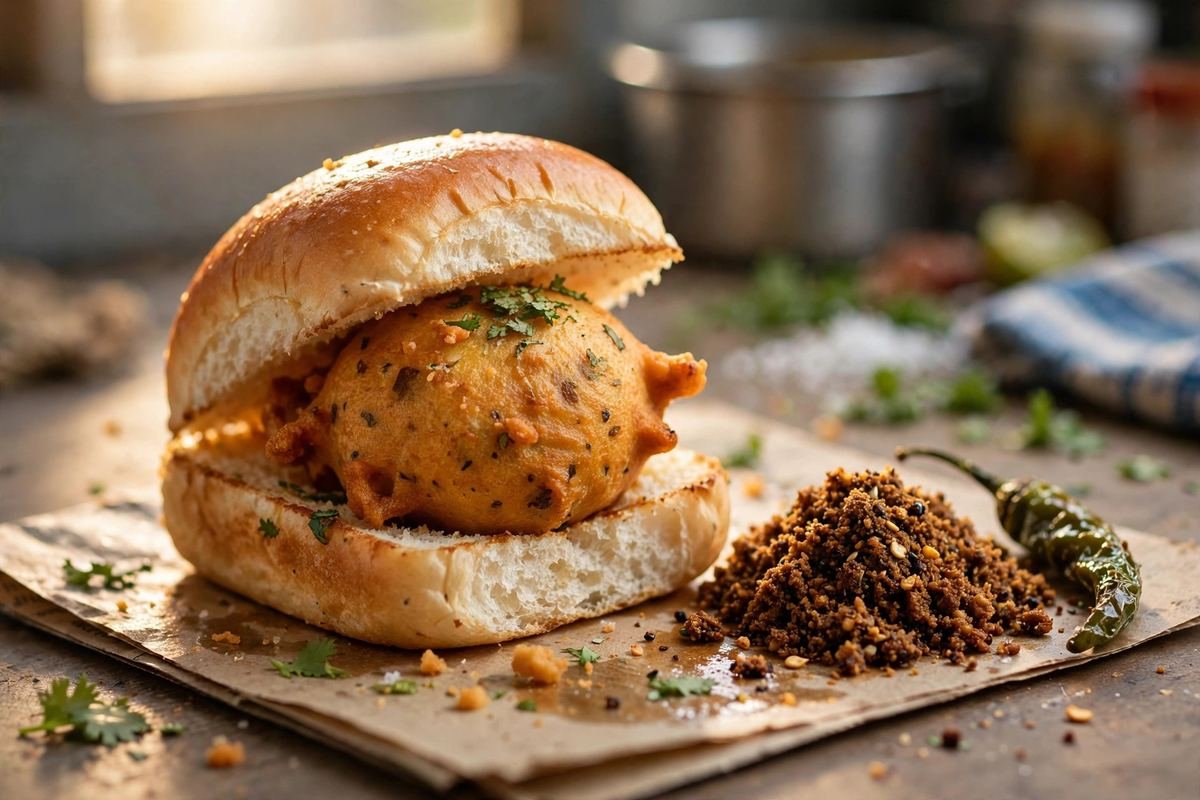
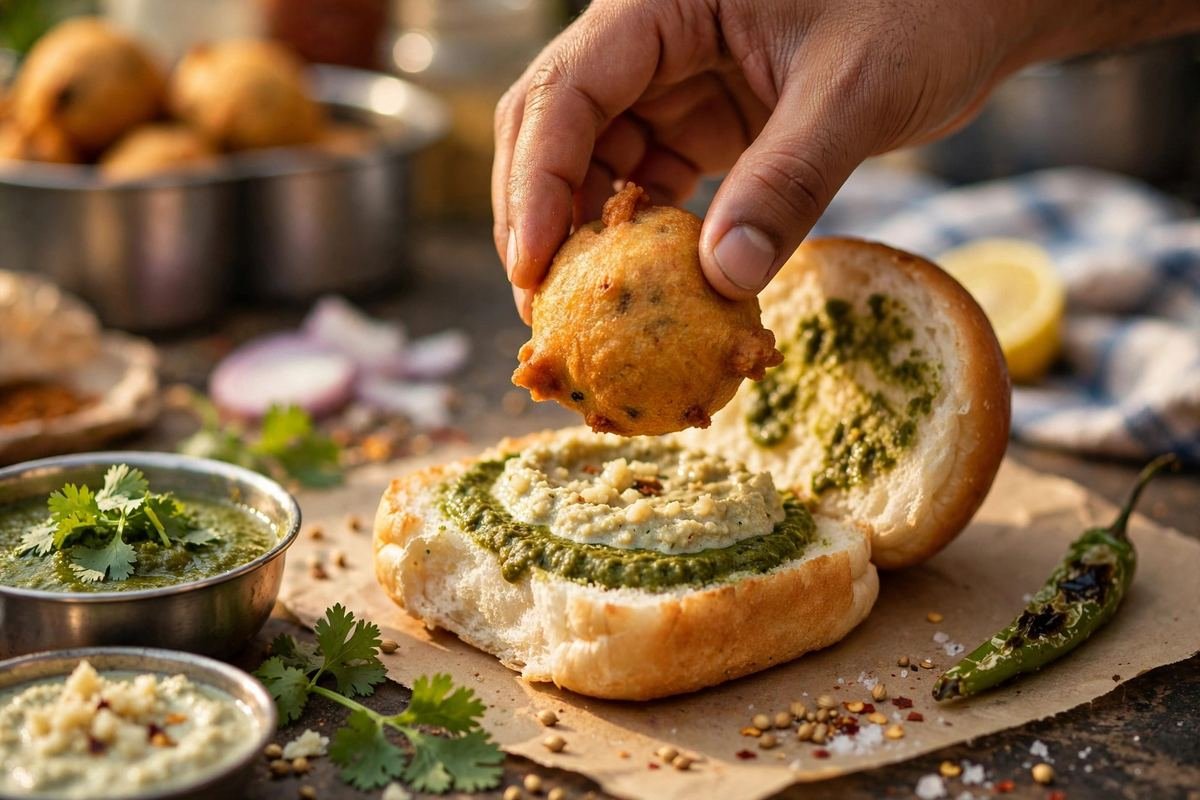
- Assemble like a street vendor. Working quickly while everything is hot: spread a thick layer of green chutney on the bottom half of each toasted pav, place one crisp vada in the centre, and shower it generously with 1–2 teaspoons of dry garlic chutney — do not be shy; this is the soul of the dish. Press the top half down firmly, tuck in a few onion rings and a fried green chilli alongside, and serve immediately while the contrast of crisp vada, buttery pav, and fiery chutney is at its peak.
Tip: Read through the full post below for step-by-step photos, pro tips, variations and FAQs before you start cooking.
Bombay’s Burger, Before Burgers Were Cool
Every great city has a food that explains it. For Mumbai, that food is the vada pav. It was born in the early 1970s outside Dadar railway station, when a street vendor named Ashok Vaidya had a simple, brilliant idea: take the humble batata vada — a spiced potato fritter that Maharashtrians had been eating for generations — and tuck it inside a soft ladi pav, the Portuguese-influenced bread roll that the city’s bakeries churned out by the thousand. He sold it for a few paise to mill workers and commuters rushing for their trains, and Mumbai has been eating it at a rate of millions a day ever since.
What makes the vada pav extraordinary is not complexity but perfect balance. The vada itself is a marvel of texture and seasoning: potatoes mashed with a pounded paste of green chilli, garlic, ginger, and curry leaves, tempered with mustard seeds and turmeric until deeply savoury, then wrapped in a seasoned gram-flour batter and fried to a deep, burnished gold. It goes into a pav that has been buttered and griddled until the cut faces turn crisp and caramelised. Then comes the signature move — a generous smear of dry garlic chutney, made from roasted garlic, peanuts, coconut, and red chillies pounded into a fiery, crumbly powder, plus a swipe of green chutney for freshness. Many stalls press a whole fried green chilli alongside it, daring you to eat the whole thing in one go.
The vada pav is democratic food in the truest sense. Film stars and taxi drivers queue at the same stalls. It costs less than a cup of coffee and satisfies like a meal. Mumbaikars eat it for breakfast with chai, for lunch between meetings, and at midnight outside stations. The city’s identity is wrapped up in it — there are vada pav festivals, vada pav rivalries between legendary stalls like Ashok Vada Pav and Gajanan Vada Pav, and fierce debates about whose garlic chutney is the fiercest.
This recipe is faithful to the street original: a properly seasoned batata vada with real texture (never gluey), a crisp-skinned batter, pavs toasted in butter until golden, and both chutneys made from scratch. It takes a little effort, but one bite of that crunchy, spicy, buttery, garlicky whole will tell you exactly why Mumbai runs on vada pav.
Why You’ll Love This Recipe
- Truly authentic flavour: the garlic chutney, vada seasoning, and butter-toasted pav match the great Dadar stalls bite for bite.
- Textbook vada texture: fluffy, well-seasoned potato inside and a thin, crisp batter shell — never thick, doughy, or greasy.
- Make-ahead friendly: the chutneys keep for weeks, and vadas can be fried ahead and reheated to order.
- Feeds a crowd cheaply: eight generous vada pavs from humble potatoes and flour — perfect for parties and match nights.
- Customisable heat: control the chilli in the vada and chutney so everyone from kids to chilli-heads is happy.
- Better than takeaway: hot, crisp, and assembled to order — street food at its absolute freshest.
Key Ingredients Explained
Potatoes are the heart of the vada, and the variety matters more than most people realise. Use floury, starchy potatoes — the kind that fall apart when boiled — because they mash into a fluffy, absorbent mixture that drinks up the seasoning. Waxy potatoes turn gluey when mashed and make dense, heavy vadas. Boil them whole in their skins until completely tender, then peel while warm and mash coarsely by hand; a few small lumps are desirable and give the vada its rustic texture. Never use a food processor, which overworks the starch into paste.
The green chilli-garlic-ginger paste is the soul of the vada’s flavour. Pound fresh green chillies, garlic cloves, and ginger together with a little salt — a mortar and pestle gives a coarser, more aromatic paste than a blender, but either works. Curry leaves, torn and fried in the tempering, add the unmistakable Maharashtrian aroma. Mustard seeds must crackle properly in hot oil before anything else goes in; under-toasted mustard seeds taste raw and bitter.
Dry garlic chutney (lasun chutney) is what separates vada pav from a mere potato sandwich. It is a coarse powder of roasted garlic, roasted peanuts, desiccated coconut, red chilli powder, and salt, pounded together. The garlic should be roasted until golden and sweet, not burnt. This chutney keeps for weeks in an airtight jar and is worth making in double quantity — you will find yourself sprinkling it on everything.
Ladi pav — the soft, square, pull-apart rolls — are the traditional bread. They should be fresh, soft, and slightly sweet. If you cannot find ladi pav, soft dinner rolls or slider buns are the closest substitute. The pav must be buttered generously and toasted on a hot tawa until the cut sides are golden and crisp; this buttery crunch against the soft vada is half the pleasure.
Besan batter for the vada should be thinner than pakora batter — just thick enough to coat the potato balls in a thin, even layer. A thick batter makes the vada doughy and overwhelms the delicate potato filling. A pinch of baking soda and a spoon of hot oil in the batter help it fry up crisp and light.
Equipment You’ll Need
- A kadhai or deep pan for frying the vadas evenly.
- A flat tawa or griddle for butter-toasting the pavs.
- A mortar and pestle (or small grinder) for the chutney and the green chilli paste.
- A slotted spoon and wire rack for frying and draining.
- A potato masher — coarse hand-mashing beats any machine for vada texture.
- For the batata vada filling:
- 750g floury potatoes (about 5 medium), boiled whole in skins
- 2 tablespoons oil
- 1 teaspoon mustard seeds
- 1/2 teaspoon cumin seeds
- 10–12 fresh curry leaves
- 1/4 teaspoon asafoetida (hing)
- 4–5 green chillies, pounded with 6 garlic cloves and 2.5 cm ginger into a coarse paste
- 1/2 teaspoon turmeric powder
- 1 1/4 teaspoons salt, or to taste
- 2 tablespoons chopped fresh coriander leaves
- 1 tablespoon lemon juice
- For the batter:
- 1 1/2 cups (180g) besan (gram flour), sifted
- 1/2 teaspoon red chilli powder
- 1/4 teaspoon turmeric powder
- 1/4 teaspoon ajwain (carom seeds)
- 1/8 teaspoon baking soda
- 3/4 teaspoon salt
- 3/4 cup (180 ml) water, approximately
- 1 tablespoon hot oil, for the batter
- For the dry garlic chutney:
- 12–15 garlic cloves, roasted until golden
- 1/4 cup (35g) roasted peanuts
- 2 tablespoons desiccated coconut
- 2 teaspoons Kashmiri red chilli powder
- 3/4 teaspoon salt
- For assembly:
- 8 ladi pav (soft square rolls)
- 4 tablespoons butter, softened, for toasting
- 1/2 cup green mint-coriander chutney
- 8 whole green chillies, slit and fried in oil with salt (optional, traditional accompaniment)
- 1 large onion, thinly sliced into rings
- Oil for deep frying (about 750 ml)
- Make the dry garlic chutney first. Dry-roast the garlic cloves in a small pan over medium heat, shaking often, until they turn golden with charred spots and smell sweet — about 5–6 minutes. Let them cool, then pound or grind with the roasted peanuts, desiccated coconut, red chilli powder, and salt into a coarse, crumbly powder. It should be textured, not a fine dust. Taste and adjust salt and chilli. Set aside in a jar — this keeps for 3 weeks at room temperature.
- Prepare the potato filling. Peel the warm boiled potatoes and mash them coarsely in a large bowl, leaving small lumps for texture. Heat 2 tablespoons of oil in a kadhai over medium-high heat. Add the mustard seeds and wait for them to crackle and pop completely — about 30 seconds — then add cumin seeds, curry leaves (they will splutter; stand back), and asafoetida. Immediately add the pounded green chilli-garlic-ginger paste and turmeric, and sauté for 1–2 minutes until the raw smell disappears and the paste turns fragrant and slightly golden.
- Season the potatoes. Tip the mashed potatoes into the kadhai with the salt. Mix thoroughly but gently, folding the tempering through the mash without overworking it. Cook for 2–3 minutes, stirring, so the flavours meld and excess moisture evaporates — the mixture should be dry enough to hold its shape. Off the heat, fold in the coriander leaves and lemon juice. Taste: it should be boldly salty, tangy, and spicy, because the bland batter and bread will mute it. Cool completely, then divide into 8 equal portions and shape into firm, slightly flattened balls about 6 cm across. Chill for 15 minutes so they firm up.
- Mix the batter. Whisk the besan with red chilli powder, turmeric, ajwain, baking soda, and salt. Add water gradually to make a batter slightly thinner than dosa batter — it should coat a potato ball in a thin, even veil, not a thick jacket. Whisk in a tablespoon of hot oil last. The batter should flow off a spoon in a steady ribbon; if it is too thick, the vadas turn doughy.
- Fry the vadas. Heat oil to 170–175°C (340–350°F). Dip each chilled potato ball into the batter, turning to coat thinly and letting excess drip off. Slide gently into the oil — fry 3–4 at a time so the temperature stays steady. Fry for 4–5 minutes, turning occasionally, until deeply golden and crisp all over. The vada is done when the vigorous bubbling subsides and the crust feels firm when tapped with the spoon. Drain on a wire rack.
- Fry the green chillies (traditional). In the same hot oil, slide in the slit green chillies and fry for 30–45 seconds until blistered, then lift out and sprinkle immediately with salt. These are the classic vada pav sidekick — intensely hot, so warn your guests.
- Toast the pav. Split each pav horizontally, keeping one edge hinged. Spread both cut faces generously with softened butter. Heat the tawa over medium-high and toast the pavs cut-side down, pressing gently, until golden and crisp — about 1–2 minutes per side. The butter should sizzle and the bread should smell toasty, not steamed.
- Assemble like a street vendor. Working quickly while everything is hot: spread a thick layer of green chutney on the bottom half of each toasted pav, place one crisp vada in the centre, and shower it generously with 1–2 teaspoons of dry garlic chutney — do not be shy; this is the soul of the dish. Press the top half down firmly, tuck in a few onion rings and a fried green chilli alongside, and serve immediately while the contrast of crisp vada, buttery pav, and fiery chutney is at its peak.
Pro Tips for Perfect Results
- Mash, don’t process. A food processor or over-enthusiastic masher turns potatoes gluey. Coarse hand-mashing with visible small lumps gives the authentic vada texture.
- Season boldly. The potato filling must taste slightly over-seasoned on its own — the batter coating and the pav both dilute the flavour. Taste the filling before shaping and adjust salt, lemon, and chilli fearlessly.
- Chill the shaped vadas. Fifteen minutes in the fridge firms the potato balls so they hold together when dipped and fried instead of crumbling into the oil.
- Keep the batter thin. The classic mistake is a thick, doughy coating. You want a crisp shell that shatters, revealing the potato — the batter is a jacket, not a blanket.
- Toast the pav properly. Pale, untoasted pav makes a sad vada pav. Generous butter and a properly hot tawa give the caramelised, crisp faces that contrast the soft crumb.
- Assemble to order. A vada pav waits for no one. Build each one only when you are ready to eat, so the vada’s crunch meets the pav at its hottest.
- Double the garlic chutney. It keeps for weeks and elevates everything from dal-rice to sandwiches. You will thank yourself.
Variations to Try
Cheese vada pav: place a slice of processed cheese on the hot vada just before closing the pav — it melts into glorious strings. A favourite at Mumbai’s modern vada pav joints.
Schezwan vada pav: swap the green chutney for schezwan sauce for an Indo-Chinese kick that Mumbai’s college crowd swears by.
Grilled vada pav: after assembling, press the whole thing in a sandwich griller with butter until the outside is golden and the inside melds together.
Mini vada pav sliders: make small 3 cm vadas and use mini pavs or dinner rolls — perfect party finger food.
Jain vada pav: skip the garlic in the chutney and filling, replace potato with raw banana filling, and you have a version that follows Jain dietary customs.
Serving Suggestions
Vada pav is a complete experience in itself, but the traditional accompaniments elevate it: a fried green chilli per pav, a tangle of raw onion rings, and a wedge of lemon. Serve with cutting chai — Mumbai’s strong, milky, half-glass tea — for the full station-stall ritual. For a crowd, set up a vada pav bar: keep vadas hot in a warm oven, pavs ready for toasting, and bowls of both chutneys, fried chillies, onions, and butter on the side so guests assemble their own. It also pairs wonderfully with a tall glass of masala chaas or fresh sugarcane juice on a hot afternoon.
Storage and Reheating
Fried vadas keep well: cool completely and refrigerate in an airtight container for up to 3 days, or freeze for up to a month with parchment between layers. Reheat refrigerated vadas in a 200°C (400°F) oven or air fryer for 8–10 minutes until crisp — they come back remarkably well. The dry garlic chutney keeps 3 weeks at room temperature in a sealed jar; the green chutney keeps 4–5 days refrigerated with a layer of lemon juice on top to preserve colour. Assemble vada pavs only just before eating — a pre-assembled vada pav turns soggy within 20 minutes. Leftover potato filling makes an excellent base for cutlets or a quick aloo paratha stuffing.
Frequently Asked Questions
Can I use regular burger buns instead of ladi pav?
You can, and it will still be delicious, but the texture will differ — ladi pav is softer, slightly sweet, and pulls apart in a way burger buns do not. Soft dinner rolls or slider buns are the closest substitute. Whatever you use, the butter-toasting step is non-negotiable.
Why did my vadas break apart while frying?
Usually the potato mixture was too wet or the balls were not chilled and firmed before battering. Make sure to cook off excess moisture in the kadhai, cool the mixture fully, and chill the shaped balls. A thin, well-adhering batter also helps hold everything together.
My batter coating is thick and doughy. How do I fix it?
Thin the batter with water a tablespoon at a time until it coats a potato ball in a sheer layer. Remember the vada is the star — the batter should be a crisp shell, not a second meal. Also check your oil temperature; too-cool oil makes even good batter turn heavy.
How spicy is authentic vada pav?
Properly spicy. Between the green chilli paste in the vada, the dry garlic chutney, and the traditional fried green chilli on the side, it is meant to make your nose tingle. For a milder version, halve the green chillies in the filling and go lighter on the garlic chutney — the flavour architecture still works.
Can I bake the vadas instead of frying?
You can brush battered vadas with oil and bake at 220°C (425°F) for 20–25 minutes, turning once. They will be tasty but will lack the shattering crust of deep-fried vadas — frying is fundamental to this particular street food. An air fryer at 200°C (400°F) for 12–15 minutes gives a closer result than the oven.
What is the difference between vada pav and a batata vada sandwich?
The garlic chutney. A batata vada in bread is just a sandwich; the dry lasun chutney — fiery, garlicky, nutty — is what makes it vada pav. Skip it and you have missed the entire point of the dish.
Make these on a weekend, eat them standing up in your kitchen the way Mumbaikars eat them leaning against a stall counter, and chase each bite with cutting chai. The vada pav is proof that the greatest foods are often the simplest — potato, bread, garlic, and fire, perfected over fifty years of hungry commuters.