Recipe Card
Learn to brew authentic South Indian filter coffee with a strong drip decoction, hot milk, and the classic frothy dabara pour. This recipe gives you cafe-style kaapi at home, ready in about 20 minutes.
Ingredients
- 4 tbsp (about 24 g) South Indian filter coffee powder (80:20 coffee-chicory blend)
- 240 ml (1 cup) hot water, just off the boil (about 95°C / 200°F)
- 360 ml (1½ cups) whole milk
- 2 to 3 tsp sugar (adjust to taste)
- A pinch of patience — the drip takes its time
Instructions
- Prepare the filter. Place the perforated bottom chamber of the filter on a stable surface. Add the 4 tablespoons of coffee powder and spread it evenly with the back of a spoon, then press it down gently and firmly with the plunger disc that comes with the filter. You want the bed of coffee to be level and compact but not rock-hard — think of it like tamping espresso, but much lighter. An over-compressed bed will drip too slowly or stall; a loose bed will let the water rush through and give a watery decoction.
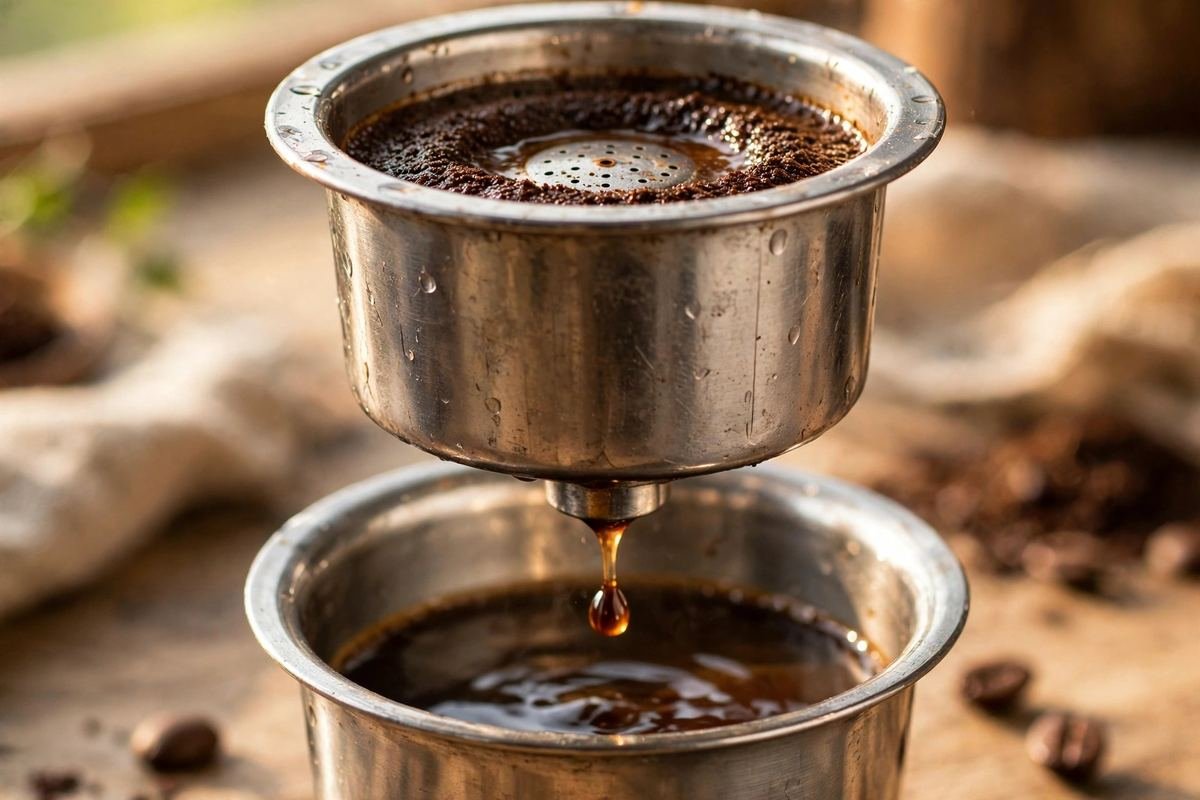
- Start the drip. Pour the hot water slowly over the pressed coffee in a circular motion, just enough to saturate the grounds and fill the top chamber to the brim — about 240 ml. Cover the filter with its lid to keep the heat in. Within a minute or two you should see the first dark drops emerging into the lower chamber. Now walk away. Let the filter sit undisturbed for 20 to 30 minutes. Good decoction cannot be rushed; it should come out thick, dark, and syrupy, like a thin espresso concentrate. The first press is always the strongest — this is what you want for your cup.
- Heat the milk. About 5 minutes before the decoction is ready, pour the milk into a small saucepan and bring it to a rolling simmer over medium heat, stirring once or twice so it does not catch at the bottom. You want it hot and steamy, just below boiling, with small bubbles forming around the edges. If the milk boils over, reduce the heat slightly — boiled milk is fine for coffee, but scorched milk will ruin the flavour, so keep an eye on it.
- Assemble the coffee. Pour about 60 to 80 ml of the fresh, hot decoction into each tumbler (adjust: more decoction for stronger coffee, less for milder). Add sugar to taste — start with 1 to 1½ teaspoons per cup and stir briefly so it dissolves in the hot decoction. Then pour in the hot milk, filling each tumbler to about three-quarters. Give it a good stir to combine everything into that beautiful amber-brown colour.
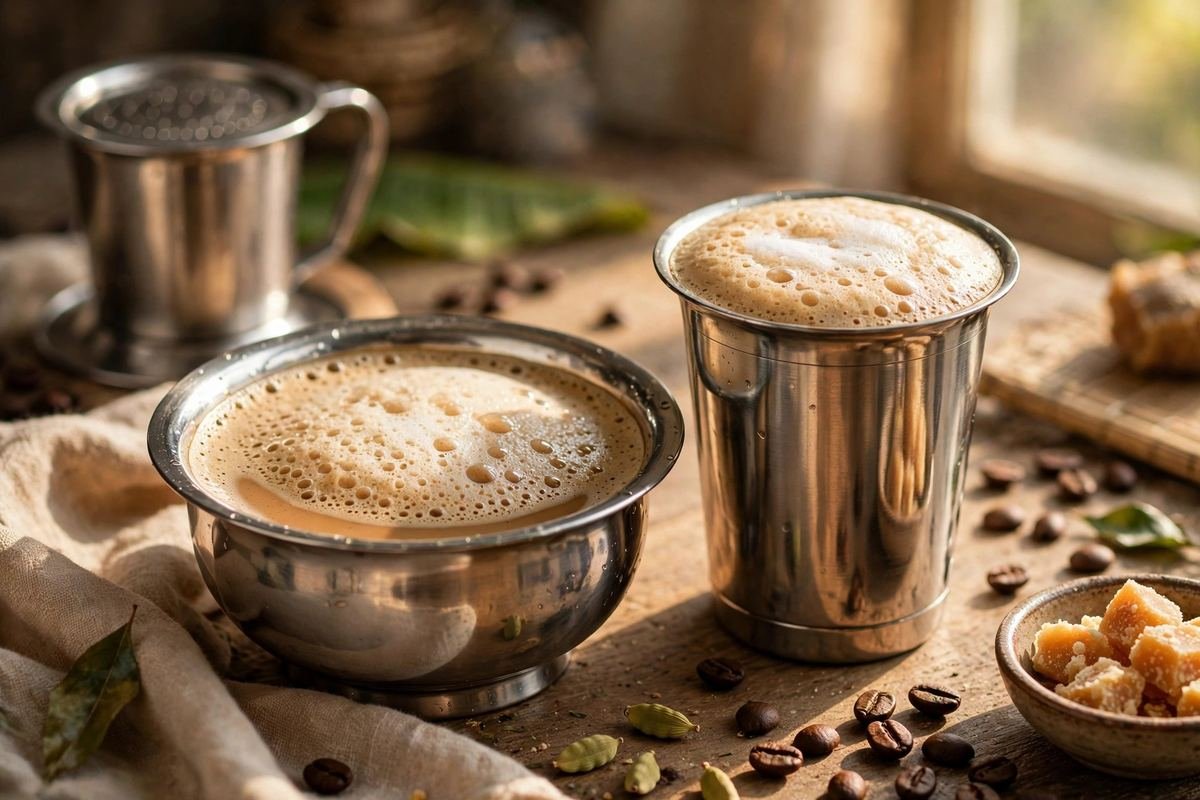
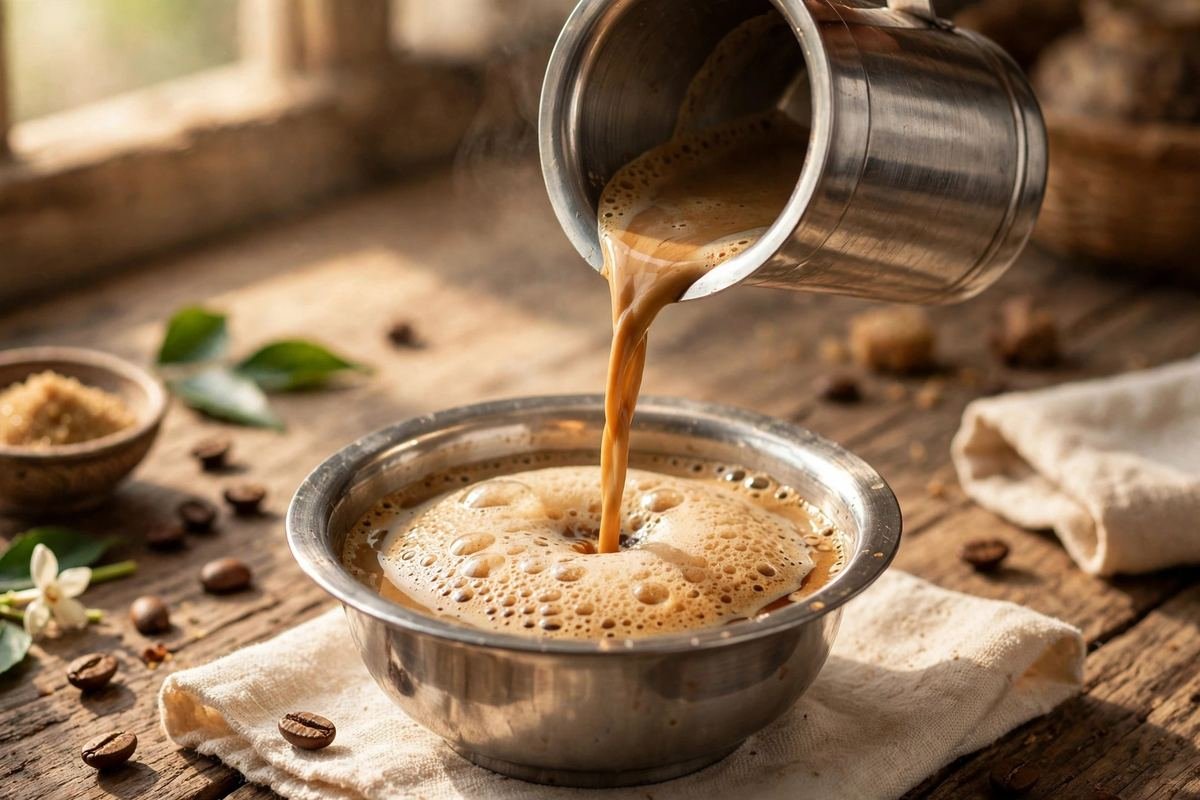
- The dabara pour. This is the signature move. Hold the tumbler in one hand and the dabara (the wide, shallow bowl) in the other. Pour the coffee from the tumbler into the dabara from a height of about 20 to 30 cm, in a steady stream. Then pour it back from the dabara into the tumbler the same way. Repeat 4 to 6 times. You will see a thick, creamy foam building up on the surface — this is the hallmark of great filter coffee. The pouring aerates the drink, cools it to sipping temperature, and blends everything perfectly. Pour the final foamy cup into the tumbler and serve immediately, nested in the dabara as tradition dictates.
Tip: Read through the full post below for step-by-step photos, pro tips, variations and FAQs before you start cooking.
There is a particular sound that wakes up a South Indian household in the morning. It is not the ring of an alarm clock or the whistle of a pressure cooker. It is the rhythmic clink of a tumbler against a dabara, the musical pour of hot coffee back and forth, back and forth, until a thick cap of foam rises on top like a tiny, fragrant crown. My grandmother used to say you could tell the mood of the house by how the filter coffee was made that day: hurried and thin on busy mornings, slow and strong when there was time to sit together.
South Indian filter coffee, or kaapi as it is affectionately called, is so much more than a caffeine delivery system. It is a ritual, a language of hospitality, and for many of us, the first thing we ever learned to make properly in the kitchen. The story goes that coffee first came to India in the 1600s, when a Sufi saint named Baba Budan smuggled seven coffee beans out of Yemen tied in his beard and planted them in the hills of Chikmagalur, Karnataka. Over the centuries, coffee growing took root in the Western Ghats of Karnataka, Kerala, and Tamil Nadu, and a distinct brewing culture grew around it.
What sets filter kaapi apart from every other cup of coffee in the world is the method. There is no machine, no paper filter, no plastic pod. There is a humble two-chambered steel or brass vessel called the filter, in which coarsely ground coffee powder is pressed down and hot water is poured over it. Gravity does the rest, drawing out a thick, syrupy concentrate called the decoction over twenty to thirty minutes. This decoction is then mixed with hot, sweetened milk and aerated by pouring it from a height between a wide shallow bowl (the dabara) and a small tumbler. That aeration does two things: it cools the coffee to a drinkable temperature, and it whips up a layer of froth that holds the aroma right under your nose as you sip.
The coffee powder itself is distinctive too. Traditional South Indian blends are roasted dark and ground fine, often with chicory mixed in — typically an 80:20 ratio of coffee to chicory. The chicory adds body, deepens the colour to that rich amber-brown, and gives the brew its characteristic slightly bittersweet depth. Many families still buy their powder fresh from neighbourhood grinding shops, specifying their preferred blend and degree of roast, the way wine lovers talk about vintages.
Why You’ll Love This Recipe
- Authentic cafe-style kaapi at home — no special equipment beyond a simple steel drip filter, which is inexpensive and lasts forever
- Intense, full-bodied flavour — the slow drip decoction is stronger and more aromatic than instant coffee or a regular drip brew
- Theatre and ritual — the dabara pour is as much fun to perform as it is to drink, and it genuinely improves the cup
- Completely customisable — dial the strength, sweetness, and milkiness to exactly how you like it
- Budget-friendly luxury — two generous cups cost a fraction of what a coffee shop would charge
- Beginner-friendly with practice — the technique looks fancy but has only a few moving parts to master
Key Ingredients Explained
The entire personality of filter coffee comes down to the powder, so let us start there. Look for a South Indian filter coffee powder with chicory — most Indian grocery stores stock it, and brands will usually say “80:20” or “60:40” on the pack, referring to the coffee-to-chicory ratio. The 80:20 blend is the classic middle ground: strong coffee character with the body and colour that chicory adds. A 60:40 blend will taste more bitter and dark; pure coffee without chicory gives a cleaner but thinner cup. If you buy from a grinding shop, ask for a fine grind meant for filter use, and a medium-dark roast. Freshly ground powder makes a noticeably more aromatic decoction than powder that has been sitting open for months, so buy in small quantities.
Milk matters more than most people realise. Full-cream whole milk gives the richest, creamiest kaapi with a good froth; that is what the traditional recipe calls for. Toned or low-fat milk will work, but the cup will taste lighter and the foam will not hold as long. Do not use cold or lukewarm milk — it must be hot, just below boiling, so that it marries with the decoction rather than cooling it into something tepid. Bring the milk to a rolling simmer and use it immediately.
Sugar is the third pillar. In South India, filter coffee is traditionally served sweet — not dessert-sweet, but sweet enough to round off the bitterness of the decoction. You can adjust to taste, and jaggery or brown sugar can be used for a slightly caramel note, though purists stick to white sugar. Hot water for the decoction should be just off the boil, around 95°C (200°F). Boiling water poured directly can scald the grounds and add harshness, while water that is too cool will under-extract and give a weak, thin decoction.
Equipment You’ll Need
- South Indian drip filter (steel or brass), sized for 2 cups
- Dabara and tumbler set (the wide bowl and small cup) — or any small bowl and a heat-safe cup
- Small saucepan for heating milk
- Kettle for hot water
- Measuring spoons
- 4 tbsp (about 24 g) South Indian filter coffee powder (80:20 coffee-chicory blend)
- 240 ml (1 cup) hot water, just off the boil (about 95°C / 200°F)
- 360 ml (1½ cups) whole milk
- 2 to 3 tsp sugar (adjust to taste)
- A pinch of patience — the drip takes its time
- Prepare the filter. Place the perforated bottom chamber of the filter on a stable surface. Add the 4 tablespoons of coffee powder and spread it evenly with the back of a spoon, then press it down gently and firmly with the plunger disc that comes with the filter. You want the bed of coffee to be level and compact but not rock-hard — think of it like tamping espresso, but much lighter. An over-compressed bed will drip too slowly or stall; a loose bed will let the water rush through and give a watery decoction.
- Start the drip. Pour the hot water slowly over the pressed coffee in a circular motion, just enough to saturate the grounds and fill the top chamber to the brim — about 240 ml. Cover the filter with its lid to keep the heat in. Within a minute or two you should see the first dark drops emerging into the lower chamber. Now walk away. Let the filter sit undisturbed for 20 to 30 minutes. Good decoction cannot be rushed; it should come out thick, dark, and syrupy, like a thin espresso concentrate. The first press is always the strongest — this is what you want for your cup.
- Heat the milk. About 5 minutes before the decoction is ready, pour the milk into a small saucepan and bring it to a rolling simmer over medium heat, stirring once or twice so it does not catch at the bottom. You want it hot and steamy, just below boiling, with small bubbles forming around the edges. If the milk boils over, reduce the heat slightly — boiled milk is fine for coffee, but scorched milk will ruin the flavour, so keep an eye on it.
- Assemble the coffee. Pour about 60 to 80 ml of the fresh, hot decoction into each tumbler (adjust: more decoction for stronger coffee, less for milder). Add sugar to taste — start with 1 to 1½ teaspoons per cup and stir briefly so it dissolves in the hot decoction. Then pour in the hot milk, filling each tumbler to about three-quarters. Give it a good stir to combine everything into that beautiful amber-brown colour.
- The dabara pour. This is the signature move. Hold the tumbler in one hand and the dabara (the wide, shallow bowl) in the other. Pour the coffee from the tumbler into the dabara from a height of about 20 to 30 cm, in a steady stream. Then pour it back from the dabara into the tumbler the same way. Repeat 4 to 6 times. You will see a thick, creamy foam building up on the surface — this is the hallmark of great filter coffee. The pouring aerates the drink, cools it to sipping temperature, and blends everything perfectly. Pour the final foamy cup into the tumbler and serve immediately, nested in the dabara as tradition dictates.
Pro Tips for Perfect Results
- Fresh powder is everything. Coffee powder loses its aroma quickly once opened. Buy small packs, keep the pack tightly sealed in a cool, dark cupboard (not the fridge, where it picks up odours), and try to use it within 3 to 4 weeks of opening.
- Do not skip the press. The plunger disc is not decorative — a gently pressed bed of grounds slows the water down and gives you a thick decoction. If your decoction drips out in under 10 minutes, press a little firmer next time or use a slightly finer grind.
- Watch the drip rate. The ideal is a slow, steady drip, not a thin stream. If it is flowing like a tap, your powder is too coarse or too loosely packed. If nothing comes out after 10 minutes, the bed is over-compressed or the powder is too fine — loosen it and start again.
- The first decoction is gold. The first pass of water extracts the most flavour. Some families do a second, weaker pass with more water for a lighter second round, but for the best cup, always use the first decoction.
- Milk must be genuinely hot. Lukewarm milk makes a flat, sad cup. Bring it to a proper simmer and combine it with the decoction right away.
- Pour from a real height. Timid little pours will not build foam. Commit to the lift — the stream should fall a good 20 to 30 cm. A little splashing is part of the learning curve and entirely acceptable.
- Serve immediately. Filter coffee waits for no one. The foam settles within minutes and the temperature drops fast, so pour, foam, and drink without delay.
Variations to Try
Once you have the classic down, there is a whole world of South Indian coffee variations to explore. Sukku malli coffee adds dried ginger (sukku) and coriander seeds to the brew for a warming, spicy cup that many families make during the monsoon or when someone has a cold. Degree coffee, famous in Kumbakonam, uses only the first-degree (first-pass) decoction with unpasteurised cow’s milk — intensely strong and creamy. For a festive touch, a tiny pinch of cardamom stirred into the decoction gives a lovely aroma. If you prefer it black, drink the decoction diluted with hot water and sugar — this is called black filter coffee or decoction coffee, and it is bracingly strong. And on hot afternoons, leftover decoction mixed with cold milk, sugar, and ice makes an excellent filter coffee frappe — shake it hard in a bottle for foam.
Serving Suggestions
Filter coffee is traditionally served in the dabara-tumbler set, the tumbler nested inside the wide bowl so you can hold the dabara without burning your fingers — and so you can cool each sip by pouring it into the bowl. Pair it the classic way: with murukku, thattai, or banana chips for a proper Tamil Nadu tea-time, or with mysore pak if you want sweet-on-sweet indulgence. For breakfast, it is the undisputed partner of idli, dosa, pongal, and upma — there is something about hot, crisp dosa and strong kaapi that feels like the day starting correctly. It also follows a heavy South Indian meal beautifully as a digestif of sorts, cutting through the richness of a banana-leaf lunch.
Storage and Make-Ahead
The decoction itself keeps well, which is a gift for busy mornings. Store leftover decoction in a clean, sealed glass jar in the refrigerator for up to 3 days — it will thicken slightly as it chills. To use, warm the decoction gently (never boil it), heat fresh milk, and combine as usual, finishing with the dabara pour for foam. You can also make a larger batch of decoction on a Sunday and portion it out through the week. Do not store the finished coffee with milk mixed in; it will sour quickly. Coffee powder should be kept airtight at room temperature and used within a month of opening for the best aroma.
Frequently Asked Questions
Can I make filter coffee without a South Indian filter?
You can approximate it. A fine-mesh sieve or a French press with a fine grind can produce a strong brew, but it will not have quite the same syrupy body as a true drip decoction. The French press method — steeping 4 tablespoons of fine powder in hot water for 4 minutes and pressing — gives the closest result. But a real steel filter is inexpensive, lasts decades, and is worth buying if you plan to make kaapi regularly.
Why is my decoction weak and watery?
The three usual suspects are stale coffee powder, water that rushed through too fast, or too little powder. Check that your powder is fresh and finely ground, press the bed down more firmly with the plunger, and make sure you are using about 4 tablespoons per cup of water. Also confirm your water is hot enough — water that has cooled to lukewarm will under-extract.
What is the best coffee-to-chicory ratio?
For a classic balanced cup, 80:20 (coffee to chicory) is the standard and the most widely available. If you like it stronger and more bitter, try 60:40. If you are new to filter coffee and find it intense, look for a pure coffee blend without chicory, which tastes cleaner and milder. There is no wrong answer — it is purely a matter of taste.
Can I use instant coffee powder instead?
You can make a decent milky coffee with instant powder, but it will not taste like filter kaapi. The slow drip extraction and the chicory roast are what give filter coffee its signature depth and body. If you cannot find filter coffee powder locally, it is widely available online — search for “South Indian filter coffee powder 80:20.”
Why does my coffee not get frothy when I pour it?
Froth comes from aeration plus hot milk with enough fat. Make sure your milk is whole/full-cream and genuinely hot, pour from a real height (20 to 30 cm) in a thin steady stream, and repeat the back-and-forth at least 4 to 6 times. Cold or low-fat milk, or a half-hearted pour, will give you very little foam.
Is filter coffee stronger than espresso?
Per millilitre, espresso is more concentrated. But a typical tumbler of filter coffee uses 60 to 80 ml of strong decoction plus milk, and the total caffeine in the cup is comparable to — sometimes more than — a regular coffee-shop brew. The chicory also adds a perceived intensity. If you are sensitive to caffeine, use less decoction per cup or choose a blend with more chicory.
There is a reason the dabara set has survived every trend the coffee world has thrown at it — pods, pour-overs, cold brews, all of it. Some mornings just ask for the slow drip, the hot milk, the high pour, and that first foamy sip that tastes like home. Make it once, and you will understand why South India never gave this ritual up. Now put the kettle on.