Recipe Card
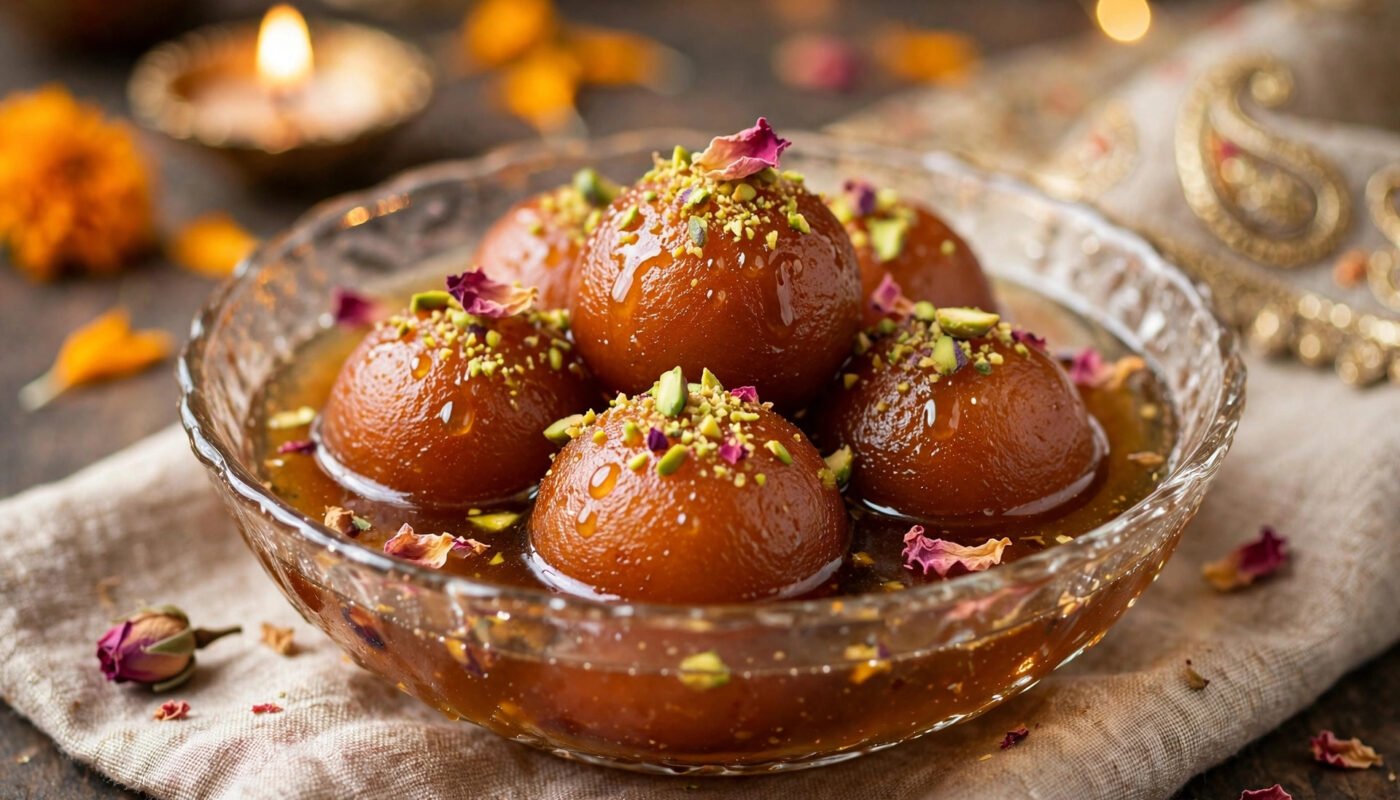
Pillowy-soft gulab jamuns soaked in fragrant rose-cardamom syrup. This fail-proof recipe covers both khoya and milk-powder versions with every troubleshooting tip you need.
Ingredients
- 1 cup full-cream milk powder (120g), plus extra for dusting if needed
- 3 tablespoons maida / all-purpose flour (25g)
- 1/4 teaspoon baking soda (scant — level it off)
- 1 tablespoon ghee, at room temperature
- 5–6 tablespoons lukewarm milk (75–90ml), added gradually
- 1 teaspoon fine semolina / sooji (optional, adds a lovely slight grain)
- Ghee or neutral oil, for deep-frying (about 3–4 cups / 750ml–1 litre)
- 2 cups sugar (400g)
- 2 cups water (480ml)
- 4–5 green cardamom pods, lightly crushed
- 8–10 saffron strands, soaked in 1 tablespoon warm water
- 1 teaspoon lemon juice
- 1 tablespoon rose water (add at the end, off the heat)
- 2 tablespoons pistachio slivers, for garnish (optional)
Instructions
- Make the syrup first. Combine the sugar, water, crushed cardamom pods, and lemon juice in a wide saucepan. Bring to a boil over medium heat, stirring until the sugar dissolves completely. Reduce the heat and simmer for 7–8 minutes until the syrup is sticky and reaches a one-string consistency — test by cooling a drop on a spoon, then pressing it between thumb and forefinger and pulling apart; one thin thread should form. Stir in the bloomed saffron with its soaking water, take the pan off the heat, and stir in the rose water. Cover and keep the syrup warm (not boiling hot) while you fry — it should be comfortably warm to the touch when the jamuns go in.
- Mix the dry ingredients. In a large mixing bowl, whisk together the milk powder, maida, baking soda, and semolina (if using) until completely uniform. Rub the ghee into the dry mixture with your fingertips until it resembles fine breadcrumbs — this coats the milk proteins in fat and keeps the crumb tender.
- Bring the dough together gently. Add lukewarm milk one tablespoon at a time, mixing with your fingers, until a soft, smooth, slightly tacky dough forms. You will likely need 5–6 tablespoons; stop the moment it comes together. Do not knead like bread dough — just press and fold it gently for about a minute until smooth. Over-kneading develops gluten and makes jamuns dense and chewy. Cover with a damp cloth and rest for 10–15 minutes; the dough will firm up slightly as the milk powder hydrates.
- Roll crack-free balls. Grease your palms lightly with ghee. Pinch off small portions (about 1 tablespoon each, roughly the size of a large marble — remember they nearly double when fried and soaked) and roll each between your palms with gentle, even pressure into a perfectly smooth ball with no cracks or seams. This is the most important step: any crack will split open in the hot oil. If a ball cracks, the dough is too dry — wet your palms and re-roll, or knead in half a teaspoon more milk. Cover the rolled balls with the damp cloth so they don’t dry out.
- Heat the oil low and slow. Pour ghee or oil into the kadhai to a depth of at least 2–3 inches and heat over the lowest flame. The target is about 140–150°C (300°F). Test without a thermometer: drop in a tiny piece of dough — it should sink to the bottom, sit there for a few seconds, then rise slowly to the surface with gentle, lazy bubbles around it. If it shoots straight up sizzling furiously, the oil is too hot; take the kadhai off the heat for a minute and try again.
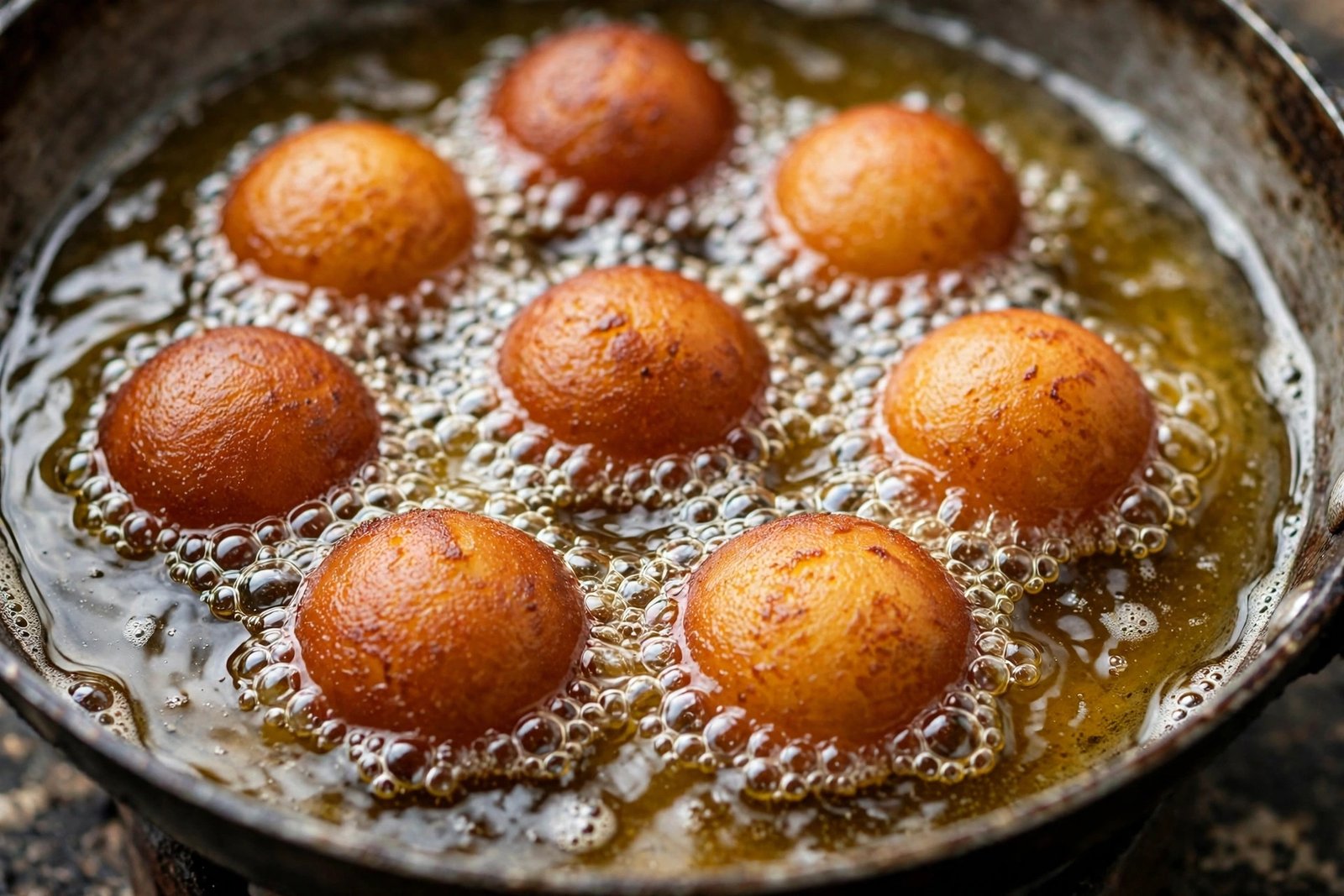
- Fry in batches, patiently. Gently slide in 6–8 balls, taking care not to crowd the kadhai. They will sink at first — do not touch them for the first minute. Then stir the oil very gently with the slotted spoon (not the jamuns themselves) so they roll and brown evenly on all sides. Keep the flame low throughout; the jamuns should take a full 8–10 minutes to turn a deep, even golden-brown. Rushing this step with higher heat browns the outside while leaving the inside raw and doughy. Lift out with the slotted spoon, let excess oil drip back for a few seconds.
- Soak immediately. Transfer the hot, freshly fried jamuns straight into the warm (not hot) syrup. They should sizzle softly on contact. Make sure they are submerged; the syrup level should cover them. Repeat frying and soaking with the remaining batches, keeping the syrup warm between batches — if it cools too much, warm it gently, but never boil the jamuns in it. Let the jamuns soak for at least 2 hours at room temperature (overnight in the fridge is even better) so the syrup penetrates to the very centre.
- Serve warm. Warm the soaked jamuns gently in their syrup over the lowest heat for a few minutes, or microwave a serving for 20–30 seconds. Garnish with pistachio slivers and serve 2–3 per person in small bowls with a generous spoonful of syrup.
Tip: Read through the full post below for step-by-step photos, pro tips, variations and FAQs before you start cooking.
A Sweet With a Thousand-Year Journey
Gulab jamun is the undisputed king of Indian mithai, and its story begins far from India’s borders. Food historians trace its roots to luqmat al-qadi, a golden, syrup-soaked dumpling from medieval Persia — literally “the judge’s morsel” — that travelled across Central Asia with traders and conquerors. When Persian and Turkic cooks arrived in India during the Sultanate and Mughal eras, they brought their technique of frying small dough balls and drenching them in fragrant syrup. Indian halwais did what they have always done best: they adapted it to local palates and local ingredients. Khoya — solidified milk, the backbone of so much Indian confectionery — replaced whatever dough the original used, and the syrup gained rose water (gulab, from the Persian gul for rose and ab for water), cardamom, and saffron. The name itself is a giveaway: “gulab” points to rose-scented syrup, and “jamun” refers to the Indian black plum, because a finished jamun is roughly the size and deep purple-brown colour of the fruit.
Another popular legend credits the Mughal emperor Shah Jahan’s royal kitchen with inventing the sweet, when a chef accidentally dropped khoya balls into hot syrup. True or not, by the Mughal period gulab jamun was firmly established as a celebratory sweet, and it has never left the Indian festive table since. Today it is the sweet that shows up at every wedding, every Diwali, every Holi, every Eid feast, every baby shower and housewarming — the one mithai no celebration feels complete without. There is something about a warm jamun that collapses softly on the tongue, syrup flooding out, that makes people close their eyes and smile. It is comfort food and celebration food at once.
And yet, for all its ubiquity, homemade gulab jamun has a reputation for being tricky. We have all had the dense, hard, suspiciously chewy ones, or watched jamuns crack open and disintegrate in hot oil. The good news is that every single failure has a clear, fixable cause — usually oil that was too hot, dough that was over-kneaded, or syrup that was too thick. Once you understand the science, which this recipe walks you through step by step, you can make jamuns that rival the best halwai in your city. This version uses milk powder instead of khoya, which means no hunting for fresh khoya and far more consistent results, and it works every single time.
Why You’ll Love This Recipe
- Guaranteed soft, melt-in-the-mouth texture — low, slow frying and a properly rested dough give you jamuns that are spongy to the core, never hard or doughy in the centre.
- Milk-powder based, no khoya needed — you can make these tonight with pantry staples; fresh khoya is lovely but hard to find and inconsistent in quality.
- Every troubleshooting fix included — cracked balls, hard centres, jamuns that won’t absorb syrup: this recipe tells you exactly what went wrong and how to fix it mid-batch.
- Perfectly balanced syrup — sticky, glossy, and fragrant with real cardamom, rose water, and saffron, but not cloyingly sweet or thread-thick.
- Scales beautifully — halve it for a small family dinner or double it for a Diwali party of fifty; the ratios hold.
- Make-ahead friendly — jamuns taste even better the next day after a long syrup soak, so they’re ideal party prep.
Key Ingredients Explained
The beauty of gulab jamun is that it needs very few ingredients — but each one does serious work, so it pays to understand them. The classic halwai recipe starts with khoya (also called mawa), which is milk slowly reduced until almost all its moisture evaporates, leaving a dense, fudge-like solid. Khoya gives jamuns their rich, milky depth. But fresh khoya is perishable, varies wildly in moisture content from batch to batch, and is genuinely hard to find outside India. That inconsistency is the number one reason home cooks get unpredictable results with khoya recipes. This recipe uses full-cream milk powder instead, which behaves like a perfectly standardised khoya every single time. Use full-cream, not skimmed — the fat is essential for tenderness. If you do want to make the khoya version, replace the milk powder and ghee below with 250g of fresh, soft khoya (grate it fine and knead it smooth), and skip the added fat.
A small amount of maida (all-purpose flour) binds the dough — about 3 tablespoons for this quantity. More than that and your jamuns turn bready and dense; less and they fall apart in the oil. A tiny pinch of baking soda (not baking powder) is the leavening: it creates the fine, even air pockets that make the crumb spongy so syrup can soak all the way through. Too much soda leaves a soapy aftertaste and makes jamuns puff up and then collapse, so measure it — a scant quarter teaspoon is plenty. A spoonful of ghee enriches the dough and keeps it short and tender, and lukewarm milk brings it together. Always add milk a teaspoon at a time; the dough should be soft and pliable like play-dough, never wet or sticky.
The sugar syrup is the other half of the dessert and deserves equal attention. Use roughly equal sugar and water by volume (2 cups sugar to 2 cups water is a good baseline) with a squeeze of lemon juice — the acid prevents the sugar from crystallising as it cools. You are aiming for a sticky, one-string consistency: dip a cool spoon in, touch it to your thumb and forefinger, and pull apart — a single thin thread should form before breaking. Thinner than that and the jamuns taste watery; thicker and the syrup can’t penetrate the fried balls, leaving them dry inside. Flavour the syrup with green cardamom (crushed pods, not just powder, for a deeper aroma), a few strands of saffron bloomed in warm water for that gorgeous golden colour, and rose water stirred in at the very end, off the heat — boiling rose water kills its delicate fragrance. If rose water is unavailable, a drop of kewra essence or a little extra cardamom works in a pinch.
Equipment You’ll Need
- A heavy-bottomed kadhai or deep wok for frying — thick metal holds a steady low temperature, which is everything for jamuns.
- A wide, heavy saucepan for the syrup (wide so jamuns can soak in a single layer later).
- A slotted spoon for lowering jamuns into oil and lifting them out.
- A small bowl of ghee or oil for greasing your palms while rolling.
- A kitchen thermometer is very helpful but not essential — the test-fry method described below works fine.
- Airtight container for soaking and storing.
Ingredients
For the jamuns (makes about 20):
- 1 cup full-cream milk powder (120g), plus extra for dusting if needed
- 3 tablespoons maida / all-purpose flour (25g)
- 1/4 teaspoon baking soda (scant — level it off)
- 1 tablespoon ghee, at room temperature
- 5–6 tablespoons lukewarm milk (75–90ml), added gradually
- 1 teaspoon fine semolina / sooji (optional, adds a lovely slight grain)
- Ghee or neutral oil, for deep-frying (about 3–4 cups / 750ml–1 litre)
For the syrup:
- 2 cups sugar (400g)
- 2 cups water (480ml)
- 4–5 green cardamom pods, lightly crushed
- 8–10 saffron strands, soaked in 1 tablespoon warm water
- 1 teaspoon lemon juice
- 1 tablespoon rose water (add at the end, off the heat)
- 2 tablespoons pistachio slivers, for garnish (optional)
Instructions
- Make the syrup first. Combine the sugar, water, crushed cardamom pods, and lemon juice in a wide saucepan. Bring to a boil over medium heat, stirring until the sugar dissolves completely. Reduce the heat and simmer for 7–8 minutes until the syrup is sticky and reaches a one-string consistency — test by cooling a drop on a spoon, then pressing it between thumb and forefinger and pulling apart; one thin thread should form. Stir in the bloomed saffron with its soaking water, take the pan off the heat, and stir in the rose water. Cover and keep the syrup warm (not boiling hot) while you fry — it should be comfortably warm to the touch when the jamuns go in.
- Mix the dry ingredients. In a large mixing bowl, whisk together the milk powder, maida, baking soda, and semolina (if using) until completely uniform. Rub the ghee into the dry mixture with your fingertips until it resembles fine breadcrumbs — this coats the milk proteins in fat and keeps the crumb tender.
- Bring the dough together gently. Add lukewarm milk one tablespoon at a time, mixing with your fingers, until a soft, smooth, slightly tacky dough forms. You will likely need 5–6 tablespoons; stop the moment it comes together. Do not knead like bread dough — just press and fold it gently for about a minute until smooth. Over-kneading develops gluten and makes jamuns dense and chewy. Cover with a damp cloth and rest for 10–15 minutes; the dough will firm up slightly as the milk powder hydrates.
- Roll crack-free balls. Grease your palms lightly with ghee. Pinch off small portions (about 1 tablespoon each, roughly the size of a large marble — remember they nearly double when fried and soaked) and roll each between your palms with gentle, even pressure into a perfectly smooth ball with no cracks or seams. This is the most important step: any crack will split open in the hot oil. If a ball cracks, the dough is too dry — wet your palms and re-roll, or knead in half a teaspoon more milk. Cover the rolled balls with the damp cloth so they don’t dry out.
- Heat the oil low and slow. Pour ghee or oil into the kadhai to a depth of at least 2–3 inches and heat over the lowest flame. The target is about 140–150°C (300°F). Test without a thermometer: drop in a tiny piece of dough — it should sink to the bottom, sit there for a few seconds, then rise slowly to the surface with gentle, lazy bubbles around it. If it shoots straight up sizzling furiously, the oil is too hot; take the kadhai off the heat for a minute and try again.
- Fry in batches, patiently. Gently slide in 6–8 balls, taking care not to crowd the kadhai. They will sink at first — do not touch them for the first minute. Then stir the oil very gently with the slotted spoon (not the jamuns themselves) so they roll and brown evenly on all sides. Keep the flame low throughout; the jamuns should take a full 8–10 minutes to turn a deep, even golden-brown. Rushing this step with higher heat browns the outside while leaving the inside raw and doughy. Lift out with the slotted spoon, let excess oil drip back for a few seconds.
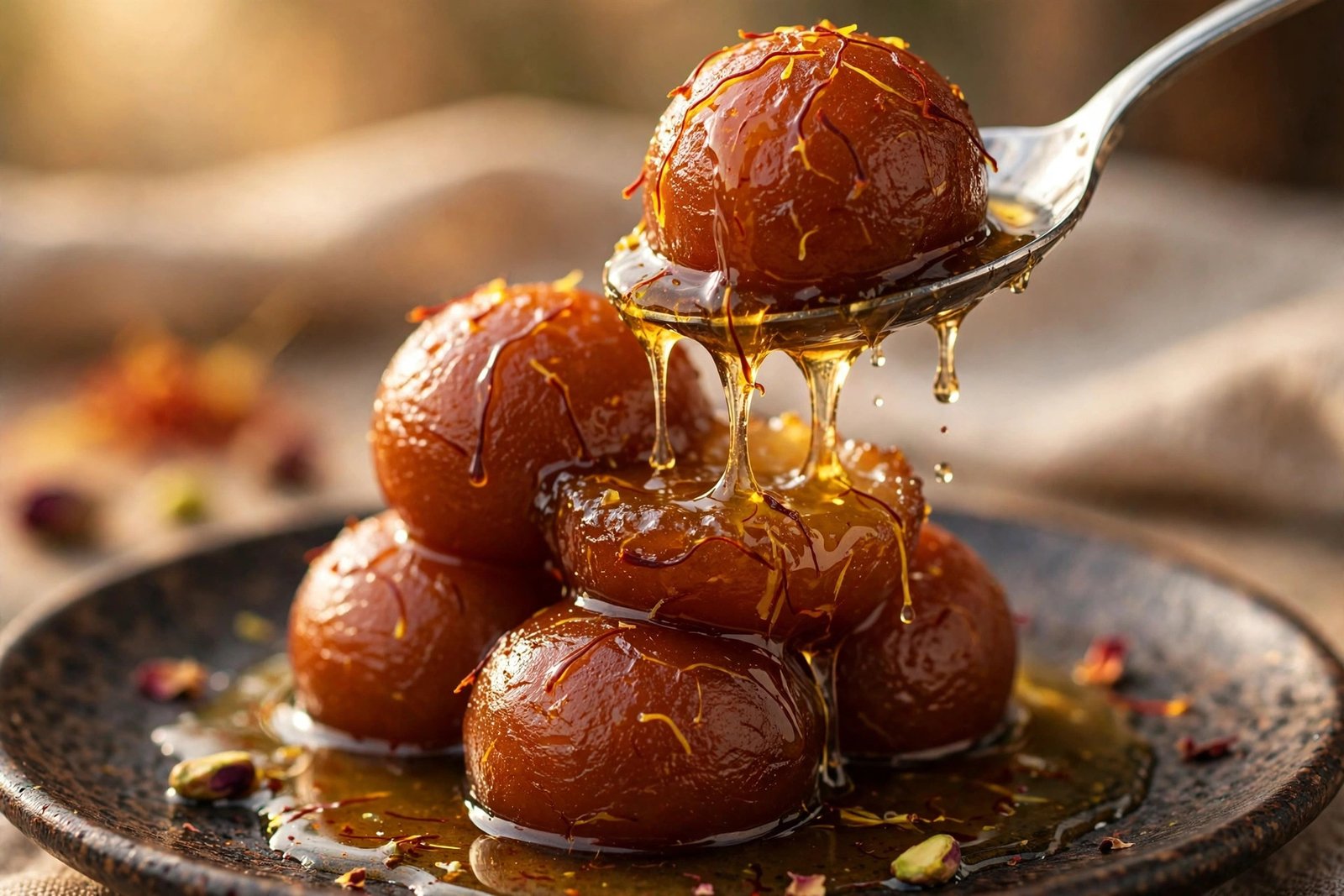
- Soak immediately. Transfer the hot, freshly fried jamuns straight into the warm (not hot) syrup. They should sizzle softly on contact. Make sure they are submerged; the syrup level should cover them. Repeat frying and soaking with the remaining batches, keeping the syrup warm between batches — if it cools too much, warm it gently, but never boil the jamuns in it. Let the jamuns soak for at least 2 hours at room temperature (overnight in the fridge is even better) so the syrup penetrates to the very centre.
- Serve warm. Warm the soaked jamuns gently in their syrup over the lowest heat for a few minutes, or microwave a serving for 20–30 seconds. Garnish with pistachio slivers and serve 2–3 per person in small bowls with a generous spoonful of syrup.
Pro Tips for Perfect Results
- No cracks, no explosions. Every crack in a raw ball becomes a split in the fryer. Roll with greased palms, gentle pressure, and patch any fissure by re-rolling with damp hands.
- Low oil temperature is non-negotiable. Jamuns fried too hot stay raw inside and turn hard as they cool. When in doubt, fry one test jamun first, cut it open, and check the centre before committing the batch.
- Match syrup and jamun temperatures. Hot jamuns go into warm syrup — never cold syrup (it won’t absorb) and never boiling syrup (the jamuns turn mushy and fall apart).
- Don’t overcrowd the kadhai. Balls that touch each other while frying stick together and brown unevenly. Fry in small batches even if it takes longer.
- Fix hard, dense jamuns next time. Hardness almost always means one of three things: too much maida, over-kneaded dough, or oil that was too hot. Reduce flour, handle the dough minimally, and fry lower and slower.
- Fix jamuns that won’t soak up syrup. The syrup was probably cooked past one-string into a thick thread stage. Thin it with a few tablespoons of hot water, warm it gently, and return the jamuns to soak longer.
- Keep the dough covered. Milk-powder dough dries out fast and forms a skin that cracks during rolling. The damp cloth between steps is not optional.
Variations to Try
Once you’ve mastered the classic, the jamun family has plenty of delicious cousins. Kala jamun is the dramatic sibling — the same dough fried a shade darker until deep brown-black, then soaked in the same syrup; the slight caramel bitterness is wonderful with the sweet syrup. Dry jamun skips the long soak: fry the balls, toss them in just enough warm syrup to glaze, then roll in desiccated coconut or finely chopped pistachios — perfect for gifting since they travel well. For stuffed jamun, flatten each ball, place a tiny pinch of chopped pistachios, almonds, and a fragment of cardamom in the centre, reseal carefully, and re-roll smooth before frying — the surprise centre is a party trick that never fails. And if you’re short on time, bread jamun is the clever shortcut: blend crustless white bread slices with a little milk into a dough, skip the maida and soda, and fry and soak exactly as above. It’s not identical, but it’s remarkably good for a fifteen-minute version.
Serving Suggestions
Gulab jamun is at its best served warm, when the syrup is fluid and the centres are soft and yielding. The classic pairing is with a scoop of vanilla ice cream — the hot-cold contrast is legendary, and a jamun sundae drizzled with extra syrup needs nothing else. For festive meals, serve two warm jamuns alongside a small katori of the syrup as the finale to a North Indian thali. They also pair beautifully with unsweetened accompaniments that balance the richness: a glass of cold masala chaas, or simply hot masala chai. For weddings and Diwali parties, present them in small individual bowls or shot glasses, one jamun per glass with a spoonful of syrup and a pistachio sliver on top — elegant, portion-controlled, and easy for guests to handle.
Storage and Reheating
Stored in their syrup in an airtight container, gulab jamuns keep beautifully in the refrigerator for up to a week — and honestly, day two and three are the peak, once the syrup has fully penetrated. They also freeze well: arrange soaked jamuns in a single layer in a freezer-safe container with some syrup, and they’ll keep for up to two months. Thaw overnight in the fridge. To reheat, warm them gently in their syrup over the lowest possible heat for 4–5 minutes, stirring the syrup (not the jamuns) occasionally — never boil them or they’ll disintegrate. A microwave works too: 20–30 seconds per serving in a covered bowl. If the syrup has thickened in the fridge, stir in a tablespoon or two of hot water while warming to loosen it back to a pouring consistency.
Frequently Asked Questions
Why did my gulab jamuns turn hard?
The three usual culprits are too much maida, over-kneaded dough, and oil that was too hot. Extra flour and kneading develop gluten, which makes the crumb dense and chewy instead of spongy, and hot oil sets the crust before the inside cooks through, so the jamun hardens as it cools. Next time, measure the flour carefully, handle the dough as little as possible, and fry at 140–150°C for a full 8–10 minutes per batch.
Can I make gulab jamun without khoya?
Absolutely — this recipe is designed exactly for that. Full-cream milk powder gives you consistent, reliable results without the hassle of sourcing fresh khoya, and most tasters can’t tell the difference. If you prefer the traditional route, substitute 250g of fresh soft khoya (grated fine) for the milk powder and ghee, and proceed the same way.
Why are my jamuns breaking apart in the oil?
This usually means the dough is too wet, the balls weren’t rolled tightly enough, or the oil temperature is wrong. Make sure the dough holds together firmly when rolled, seal every crack, and confirm the oil is at the low 140–150°C range — oil that’s too cool can also cause jamuns to absorb excess oil and fall apart. Fry one test ball first to check.
How do I know the syrup is the right consistency?
You’re aiming for sticky, one-string consistency: cool a drop on a spoon, press it between your thumb and forefinger, and pull apart — a single thin thread should form and break. If no thread forms, simmer a little longer. If you get two or three threads, it’s gone too far; stir in a few tablespoons of hot water to thin it back down.
Can I make gulab jamun ahead for a party?
They’re actually better made ahead. Jamuns soaked overnight absorb syrup to the very centre and taste richer the next day. Make them up to two days in advance, refrigerate in their syrup, and warm gently before serving. For longer storage, they freeze well for up to two months.
Is there a way to make them less sweet?
You can reduce the sugar in the syrup to 1½ cups without affecting the technique, though the syrup will be thinner — keep a close eye on consistency. Serving jamuns warm with unsweetened accompaniments like vanilla ice cream or plain rabri also balances the sweetness beautifully on the plate.
There you have it — every secret I know about making gulab jamuns that are soft to the centre, glossy with syrup, and fragrant with rose and cardamom. Make a batch this weekend, taste one warm straight from the syrup, and watch it disappear faster than you planned. And when someone asks for the recipe, you’ll know exactly what to tell them: low heat, smooth balls, and patience. Happy cooking!
