Recipe Card
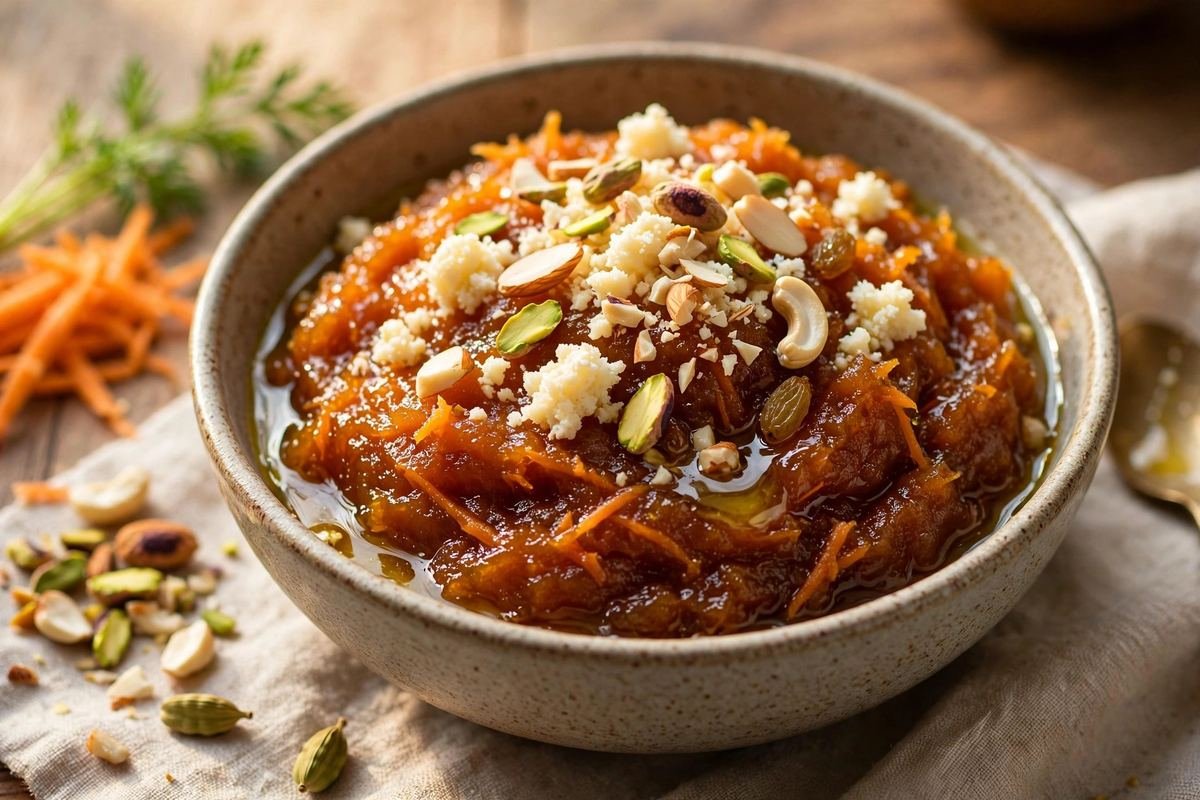
Authentic gajar ka halwa made the traditional way — tender red carrots simmered in milk, then slowly roasted in ghee with khoya and cardamom until rich, glossy, and irresistible.
Ingredients
- 1 kg red winter carrots (about 8–10 medium), washed, peeled, and grated (roughly 6 cups packed)
- 750 ml full-fat milk (3 cups)
- 100g ghee (about 7 tablespoons), divided
- 150–180g sugar (3/4 to 1 cup), to taste
- 150g fresh khoya (mawa), crumbled
- 6 green cardamom pods, seeds ground fresh
- 2 tablespoons almonds, blanched, peeled, and slivered
- 2 tablespoons cashews, roughly chopped
- 2 tablespoons pistachios, slivered
- 8–10 saffron strands soaked in 1 tablespoon warm milk (optional)
- 1 edible silver leaf (varak), for garnish (optional)
Instructions
- Prepare the carrots. Wash, peel, and grate the carrots on the medium holes of a box grater. You should have about 6 packed cups. Pick out any tough, pale core pieces — the woody centre of large carrots stays fibrous no matter how long you cook it. Set the grated carrots aside while you warm the milk.
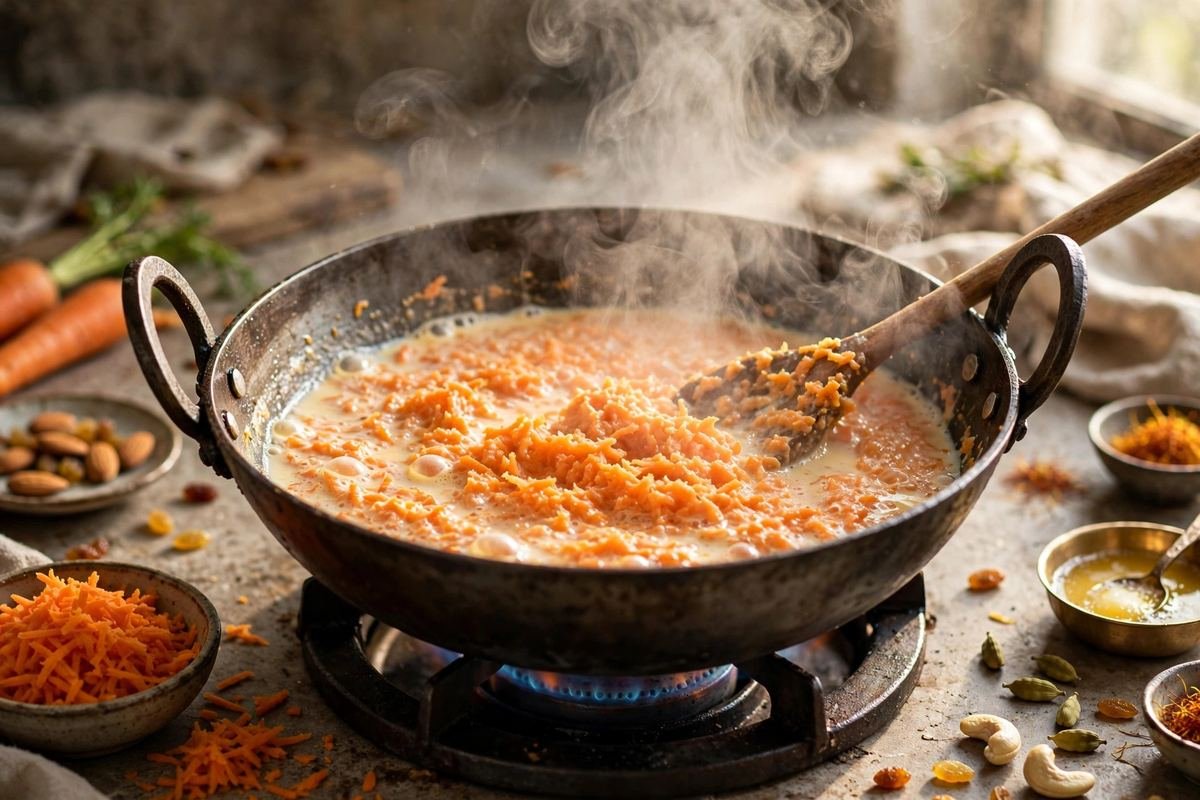
- Simmer in milk. Pour the 750 ml of milk into a heavy kadhai and bring it to a boil over medium-high heat. Add all the grated carrots, stir well, and lower the heat to a steady medium-low simmer. Cook uncovered for 35–45 minutes, stirring every 8–10 minutes and scraping the bottom, until the carrots are completely soft and nearly all the milk has been absorbed. The visual cue: when you drag your spatula through the mixture, no milky liquid should pool back into the track. The carrots will have turned from bright orange-red to a deeper, jammy shade.
- Add sugar and cook down. Stir in the sugar (start with 150g) and the saffron milk if using. The sugar will immediately release the carrots’ juices and the mixture will loosen — this is normal. Continue cooking on medium heat, stirring more frequently now, for 10–12 minutes until the liquid evaporates again and the mixture thickens. Taste and add more sugar if needed, remembering that khoya will add a little more richness but no sweetness.
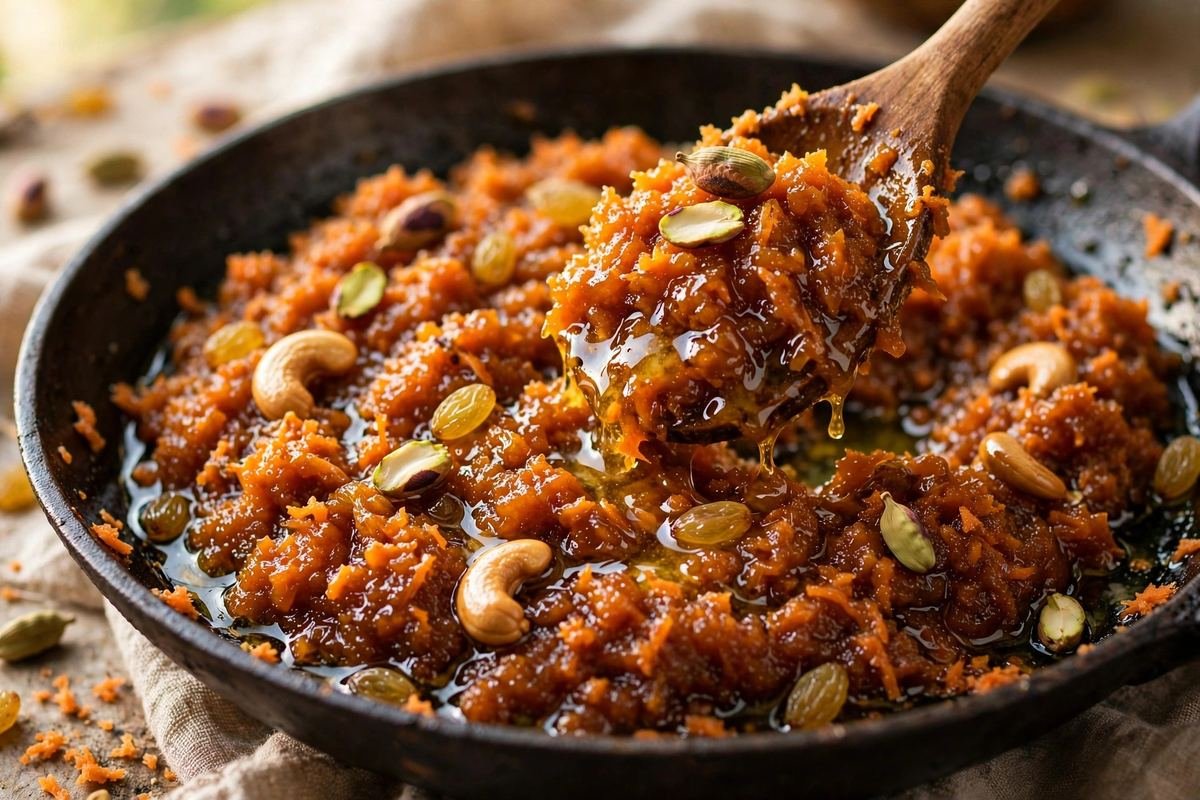
- Bhuno in ghee — the crucial stage. Add 5 tablespoons of the ghee and increase the heat to medium. Now roast the halwa, stirring constantly with a flat spatula and scraping the bottom of the kadhai, for 20–25 minutes. This is where the magic happens: the colour deepens to a rich ruby red, the raw carrot smell gives way to a toasty, caramel aroma, and the mixture becomes glossy. The done cue: the halwa pulls away from the sides of the pan in a mass, and tiny beads of ghee glisten at the edges. Do not rush this stage — under-bhunoed halwa tastes flat and boiled.
- Fold in khoya and cardamom. Lower the heat, crumble in the khoya, and stir for 5–6 minutes until it melts completely into the halwa and disappears. The texture will turn denser and creamier. Sprinkle in the freshly ground cardamom, stir through, and switch off the heat. Rest the halwa, covered, for 10 minutes so the flavours meld.
- Toast the nuts. While the halwa rests, heat the remaining 2 tablespoons of ghee in a small pan and toast the almonds, cashews, and pistachios over medium heat for 2–3 minutes until golden and fragrant. Drain on a plate — they should be crisp, not dark.
- Garnish and serve. Fluff the halwa with a fork, transfer to a serving bowl, and crown it with the toasted nuts. Lay on the silver varak if using. Serve warm — gajar ka halwa is at its absolute best warm, when the ghee is fluid and the aroma is at its peak.
Tip: Read through the full post below for step-by-step photos, pro tips, variations and FAQs before you start cooking.
The Story Behind Winter’s Most Beloved Sweet
Every winter in North India, when the markets fill with short, stubby, deep-red Delhi carrots, home kitchens begin the annual ritual of gajar ka halwa. This is not a dessert you make with the long orange carrots available all year — the traditional version belongs to the cold months, when the red winter carrot arrives with its intense sweetness, deep colour, and tender flesh. The dish itself is believed to have evolved during the Mughal era, when carrots were first cooked down with milk and ghee in royal kitchens, and it has remained the undisputed queen of Indian winter desserts ever since.
What makes gajar ka halwa special is the transformation it demands. A kilogram of pale-looking grated carrots goes through a slow, almost meditative metamorphosis: first simmered in milk until the carrots surrender completely and drink up the milky sweetness, then — the crucial stage — roasted in ghee with sugar until the mixture turns a deep ruby red, glossy and jammy, with the ghee glistening at the edges of the pan. This two-stage process, bhunoing (slow roasting), is what separates a merely sweet carrot pudding from the real thing. Rush it and you get boiled carrots in syrup; give it the full hour and you get something that tastes like winter itself — warm, rich, and deeply comforting.
This recipe follows the traditional method faithfully: milk first, ghee second, khoya folded in at the end for richness, and cardamom plus toasted nuts for the finish. We have included exact visual cues — what the carrots should look like at each stage, when the milk is fully absorbed, the moment the ghee begins to separate — so even a first-timer can nail it. There is also a shortcut-friendly condensed milk version in the variations for weeknight cravings, but try the classic once. Standing over a kadhai of slowly reddening carrots, stirring as the aroma of ghee and cardamom fills the house, is one of the great pleasures of an Indian winter kitchen.
Why You’ll Love This Recipe
- Authentic two-stage method — milk simmering followed by proper ghee bhunoing for deep, caramelised flavour, not just boiled sweet carrots.
- Visual cues at every step — know exactly what the carrots should look like when the milk is absorbed and when the ghee separates.
- Khoya for richness — folded in at the end for the luxurious texture of wedding-style halwa.
- Perfectly balanced sweetness — not cloying; the natural sweetness of winter carrots does half the work.
- Scales beautifully — make a big batch for festivals; it keeps for days and tastes better the next day.
- Naturally gluten-free — safe for guests avoiding gluten, with no flour involved.
- Versatile — serve warm with vanilla ice cream, or as a filling for halwa-stuffed pastries and parathas.
Key Ingredients Explained
Red winter carrots (1 kg) are the soul of this dish. The short, dark-red Delhi carrots available from November to February are sweeter, juicier, and far more flavourful than regular orange carrots, and they give the halwa its signature deep ruby colour. If red carrots are unavailable, use the sweetest orange carrots you can find and accept a slightly different hue — the technique stays the same. Grate them on the medium holes of a box grater: too fine and they turn to mush, too coarse and they take forever to soften. Never use a food processor’s fine shredding disc — it crushes the fibres and releases too much water.
Full-fat milk (750 ml) is what the carrots simmer in, and it does double duty: it softens the carrots completely while reducing into milk solids that enrich the halwa. Whole milk is essential — toned milk will thin out and the halwa will lack body. Some cooks replace part of the milk with khoya (150g) added at the end; khoya is simply milk reduced to a soft solid, and folding it in gives the halwa a dense, almost fudge-like richness. Fresh, soft khoya melts seamlessly; if yours is dry and crumbly, grate it before adding.
Ghee (100g, about 7 tablespoons) is added only after the milk has been absorbed — this order matters. Milk softens, ghee roasts. Adding ghee too early fries raw carrot in fat and gives a greasy, undercooked result. Good ghee, preferably homemade or a trusted brand, is non-negotiable; the entire final flavour rests on it. Sugar (150–180g) goes in after the carrots are tender — adding it earlier draws out water and prevents the carrots from softening properly. Winter carrots are sweet, so start with 150g and adjust.
Green cardamom (6 pods, ground fresh) is the classic perfume; add it near the end so its volatile aroma does not cook away. Mixed nuts (4 tablespoons) — almonds, cashews, and pistachios, toasted in a spoon of ghee until golden — add crunch and visual appeal. Soak and peel the almonds for a cleaner look. A pinch of saffron is optional but lovely for festive batches.
Equipment You’ll Need
- Heavy-bottomed kadhai or wide deep pan (at least 3-litre) — wide surface speeds evaporation
- Box grater (medium holes) — for the perfect carrot texture
- Long wooden spatula or flat ladle — for thorough stirring during bhunoing
- Small pan — for toasting the nuts in ghee
- Measuring cups and kitchen scale — halwa rewards accurate ratios
- 1 kg red winter carrots (about 8–10 medium), washed, peeled, and grated (roughly 6 cups packed)
- 750 ml full-fat milk (3 cups)
- 100g ghee (about 7 tablespoons), divided
- 150–180g sugar (3/4 to 1 cup), to taste
- 150g fresh khoya (mawa), crumbled
- 6 green cardamom pods, seeds ground fresh
- 2 tablespoons almonds, blanched, peeled, and slivered
- 2 tablespoons cashews, roughly chopped
- 2 tablespoons pistachios, slivered
- 8–10 saffron strands soaked in 1 tablespoon warm milk (optional)
- 1 edible silver leaf (varak), for garnish (optional)
- Prepare the carrots. Wash, peel, and grate the carrots on the medium holes of a box grater. You should have about 6 packed cups. Pick out any tough, pale core pieces — the woody centre of large carrots stays fibrous no matter how long you cook it. Set the grated carrots aside while you warm the milk.
- Simmer in milk. Pour the 750 ml of milk into a heavy kadhai and bring it to a boil over medium-high heat. Add all the grated carrots, stir well, and lower the heat to a steady medium-low simmer. Cook uncovered for 35–45 minutes, stirring every 8–10 minutes and scraping the bottom, until the carrots are completely soft and nearly all the milk has been absorbed. The visual cue: when you drag your spatula through the mixture, no milky liquid should pool back into the track. The carrots will have turned from bright orange-red to a deeper, jammy shade.
- Add sugar and cook down. Stir in the sugar (start with 150g) and the saffron milk if using. The sugar will immediately release the carrots’ juices and the mixture will loosen — this is normal. Continue cooking on medium heat, stirring more frequently now, for 10–12 minutes until the liquid evaporates again and the mixture thickens. Taste and add more sugar if needed, remembering that khoya will add a little more richness but no sweetness.
- Bhuno in ghee — the crucial stage. Add 5 tablespoons of the ghee and increase the heat to medium. Now roast the halwa, stirring constantly with a flat spatula and scraping the bottom of the kadhai, for 20–25 minutes. This is where the magic happens: the colour deepens to a rich ruby red, the raw carrot smell gives way to a toasty, caramel aroma, and the mixture becomes glossy. The done cue: the halwa pulls away from the sides of the pan in a mass, and tiny beads of ghee glisten at the edges. Do not rush this stage — under-bhunoed halwa tastes flat and boiled.
- Fold in khoya and cardamom. Lower the heat, crumble in the khoya, and stir for 5–6 minutes until it melts completely into the halwa and disappears. The texture will turn denser and creamier. Sprinkle in the freshly ground cardamom, stir through, and switch off the heat. Rest the halwa, covered, for 10 minutes so the flavours meld.
- Toast the nuts. While the halwa rests, heat the remaining 2 tablespoons of ghee in a small pan and toast the almonds, cashews, and pistachios over medium heat for 2–3 minutes until golden and fragrant. Drain on a plate — they should be crisp, not dark.
- Garnish and serve. Fluff the halwa with a fork, transfer to a serving bowl, and crown it with the toasted nuts. Lay on the silver varak if using. Serve warm — gajar ka halwa is at its absolute best warm, when the ghee is fluid and the aroma is at its peak.
Pro Tips for Perfect Results
- Choose the right carrots. Red winter carrots are sweeter and less fibrous. If using orange carrots, pick the freshest, sweetest ones — taste a raw piece; if it is bland, your halwa will be too.
- Grate, don’t process. A food processor shreds carrots too finely, turning them mushy. The medium holes of a box grater give the ideal texture — distinct but tender shreds.
- Sugar after softening, always. Sugar draws out moisture and toughens carrot fibres. Add it only after the milk stage has fully softened the carrots.
- Wide pan, faster evaporation. A broad kadhai cuts the milk-reduction time by a third compared to a deep narrow pot, because more surface is exposed to the heat.
- Constant stirring during bhunoing. The sugar-heavy mixture scorches easily at this stage. Stir and scrape the bottom continuously for those 20–25 minutes — put on music and settle in.
- Know the ghee-separation cue. Tiny glistening beads of ghee at the pan’s edge and a halwa that pulls away cleanly from the sides means it is done. Pull it off the heat promptly — carryover cooking will finish it.
- Day-two halwa is better. Like most slow-cooked sweets, the flavours deepen overnight. Reheat gently with a spoon of milk or ghee to restore the glossy texture.
Variations to Try
- Condensed milk shortcut: Replace the milk and half the sugar with 1 tin (400g) of sweetened condensed milk. Simmer the carrots in 1 cup of water first until soft, then add condensed milk and ghee and bhuno as usual. Ready in 40 minutes.
- Pressure cooker method: Cook grated carrots with the milk for 2 whistles, then transfer to a kadhai for the ghee-bhunoing stage. Saves 20 minutes of simmering.
- Beetroot halwa: Swap half the carrots for grated beetroot for an even deeper colour and an earthy-sweet twist — a stunning festive variation.
- Halwa with rabri: Serve warm halwa with a generous spoon of chilled rabri (thickened sweet milk) on top — the classic restaurant pairing.
- Stuffed halwa paratha: Use leftover halwa as a filling for sweet parathas, sealing the edges well and cooking in ghee. A brilliant way to use up a big batch.
Serving Suggestions
Serve gajar ka halwa warm in small bowls, crowned with toasted nuts and a silver leaf for festive occasions. The most beloved pairing is a scoop of vanilla ice cream melting into the warm halwa — the hot-cold contrast is irresistible. At weddings and Diwali parties, it is often served alongside rabri or a drizzle of warm condensed milk. For an elegant plated dessert, press the halwa into a small greased ring mould, unmould onto a plate, and garnish with pistachio dust and a saffron strand. Keep portions moderate — this is a rich dessert, and a small bowl (about 3/4 cup) per person is plenty after a heavy festive meal. Leftover halwa also makes a wonderful breakfast stirred into warm milk as a porridge-like treat.
Storage and Reheating
Gajar ka halwa keeps in an airtight container in the refrigerator for 5–6 days — the flavour actually improves by day two. It also freezes well for up to 2 months; portion it into freezer-safe boxes, thaw overnight in the fridge, and reheat gently. To reheat, warm it in a pan over low heat with a splash of milk (1–2 tablespoons per cup of halwa) and a teaspoon of ghee, stirring until it is steaming and glossy again. Microwaving works too — heat in 1-minute bursts, stirring between, with the same splash of milk. Never reheat on high heat, or the ghee will separate and the halwa will turn oily. If the halwa seems dry after storage, the milk-and-ghee trick restores it completely.
Frequently Asked Questions
Can I make gajar ka halwa with regular orange carrots?
Yes, absolutely — use the sweetest, freshest orange carrots you can find. The flavour will be excellent, though the colour will be a brighter orange rather than the deep ruby red of winter Delhi carrots, and you may need a little extra sugar since orange carrots are less sweet.
Why did my halwa turn out pale and watery?
Two likely causes: the milk was not fully absorbed before you added the ghee, or the bhunoing stage was cut short. The mixture must be nearly dry when the ghee goes in, and the 20–25 minute roast is what builds the deep colour and glossy texture. Patience at this stage is everything.
Can I reduce the ghee? Is 100g necessary?
You can reduce it to 60–70g, but the texture and flavour will suffer — ghee is what carries the roasted, caramelised flavour. A better strategy for a lighter halwa is to keep the ghee but serve smaller portions. Do not replace ghee with oil; the flavour will be completely wrong.
Is khoya essential, or can I skip it?
Khoya is optional but transformative — it adds a dense, creamy richness that defines wedding-style halwa. If you skip it, reduce the milk a little further in the first stage and add 2 tablespoons of milk powder with the sugar to compensate for the lost body.
My halwa tastes raw and carroty. What went wrong?
The bhunoing stage was too short. Raw carrot flavour disappears only after prolonged roasting in ghee — the carrots should be cooked until they lose all crunch, deepen in colour, and smell toasty and caramelised, not vegetal. Give it the full 20–25 minutes of constant stirring.
Can I make this in advance for a party?
Yes — it is an ideal make-ahead dessert. Cook it fully 1–2 days ahead, refrigerate, and reheat gently with a splash of milk before serving. Garnish with freshly toasted nuts at serving time so they stay crisp.
Gajar ka halwa is winter in a bowl — the season’s sweetest carrots, slow-cooked until they shine, perfumed with cardamom and crowned with golden nuts. Make it once the red carrots arrive, share it warm with the people you love, and you will understand why North India counts down the months until carrot season returns.