Recipe Card
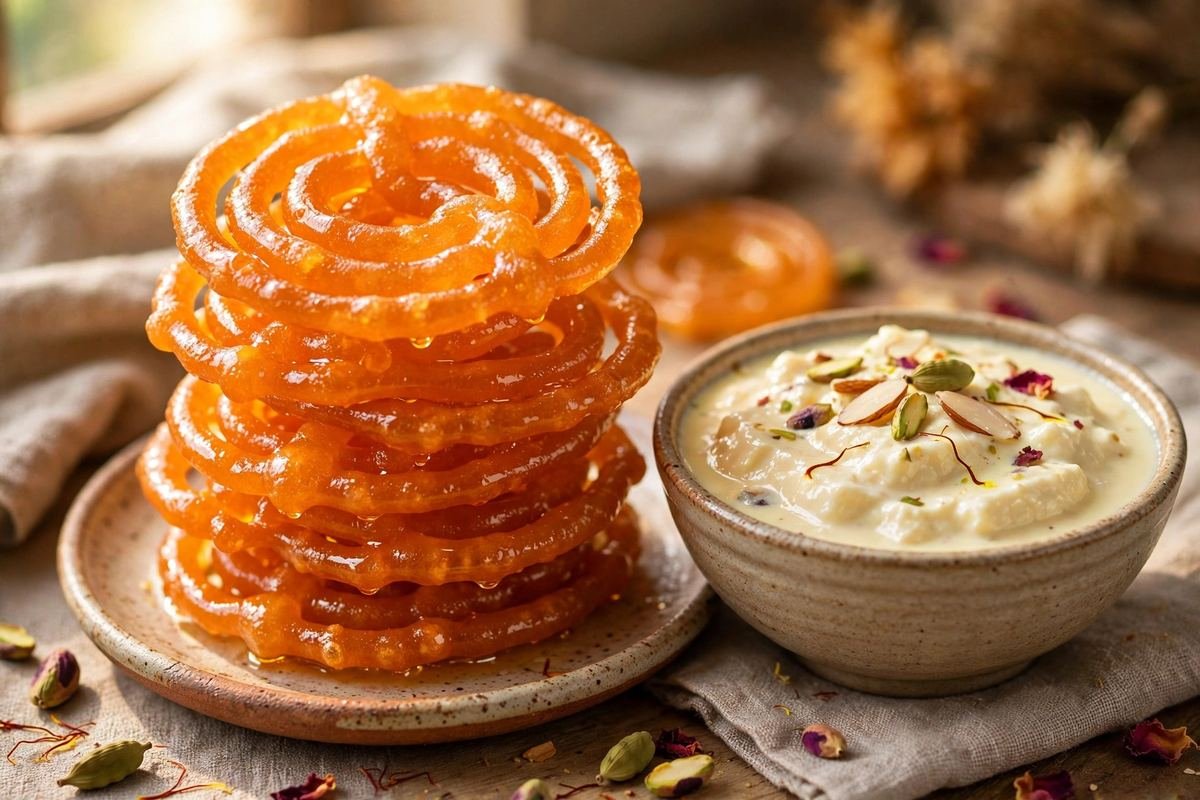
Shatteringly crisp jalebi spirals fried to golden and dunked in saffron-cardamom syrup. A fermented-batter method for that authentic tangy crunch.
Ingredients
- 1 cup (125g) all-purpose flour (maida)
- 1 tbsp cornflour (or fine rice flour)
- 2 tbsp sour yogurt (dahi)
- 3/4 cup (180 ml) lukewarm water, plus more as needed
- 1/8 tsp instant yeast (optional, recommended in cold weather)
- 1/4 tsp turmeric powder, or a few drops orange-yellow food colour
- 1/8 tsp baking soda (added just before frying)
- 1.5 cups (300g) sugar, for the syrup
- 3/4 cup (180 ml) water, for the syrup
- 1/2 tsp saffron strands, soaked in 1 tbsp warm water
- 4 green cardamom pods, crushed
- 1 tsp lemon juice
- 1 tsp rose water (optional)
- Oil or ghee, for deep frying (about 500 ml)
Instructions
- Mix and ferment the batter (night before). In a large bowl, whisk the maida, cornflour, yogurt, turmeric or colour, and yeast (if using) with the lukewarm water into a smooth, thick batter — it should fall off the spoon in a slow, continuous ribbon, roughly the consistency of pancake batter. Cover the bowl with a plate (not airtight — the ferment needs to breathe a little) and leave in a warm, draught-free spot for 10 to 12 hours, or overnight. A switched-off oven with the light on is perfect. The batter is ready when it has risen slightly, smells pleasantly sour like idli batter, and shows tiny bubbles on the surface. In hot summer weather it may be ready in 8 hours; in winter it can need 14.
- Prepare the syrup. About 30 minutes before frying, combine the sugar and water in a wide pan and bring to a boil, stirring until the sugar dissolves. Add the saffron with its soaking water, the crushed cardamom, and the lemon juice. Boil 4 to 5 minutes until the syrup reaches one-thread consistency: dip a cool spoon in, let it cool a second, then touch the syrup between your thumb and forefinger and pull apart — a single thin thread should form before breaking. Stir in the rose water if using. Keep the syrup warm (not hot, not cold) over the lowest possible heat or in a warm oven — around 50°C. Cold syrup will not soak in; boiling-hot syrup makes jalebis soggy.
- Finish the batter. Stir the fermented batter well to knock out large air pockets — it will deflate slightly, which is normal. Stir in the baking soda just before frying and mix gently. Check the consistency: it should flow smoothly from your piping tool in a steady stream. If it is too thick (common after fermenting), whisk in warm water a teaspoon at a time; if too thin, whisk in a teaspoon of maida. Fill your squeeze bottle or zip-lock bag, pressing out air bubbles.
- Heat the oil. Pour oil or ghee into your wide kadhai to a depth of about 4 cm and heat to 175–180°C (350–355°F). Test without a thermometer: drop in a tiny bit of batter — it should sizzle immediately, rise to the surface within 2 seconds, and turn golden in about 45 seconds. Too cool and the jalebis absorb oil and turn greasy; too hot and they brown before crisping through, leaving a raw, doughy interior.
- Pipe and fry the spirals. Hold the bottle about 3 cm above the oil and pipe tight, overlapping spirals roughly 5 to 7 cm across, moving quickly and steadily — 3 to 4 spirals per batch, giving them room. The batter will sizzle and set almost instantly. Fry 1.5 to 2 minutes per side, flipping once with a slotted spoon, until deep golden-orange and visibly crisp. They should feel firm and sound faintly hollow when tapped with the spoon. Do not overcrowd: the oil temperature drops with each addition, and crowded jalebis steam instead of crisping.
- Dunk in syrup immediately. Lift each batch out, let excess oil drip off for 5 seconds, and plunge straight into the warm syrup. Press them gently under the surface with the spoon and soak for 30 to 45 seconds — no longer, or they soften — then lift out, let the excess syrup drip back, and transfer to a serving plate. The jalebis should glisten but not swim. Repeat with the remaining batter, letting the oil come back to temperature between batches.
- Serve hot and crisp. Jalebi waits for no one: serve within 10 to 15 minutes of frying, while the shell still shatters and the syrup inside is warm. Pile them high on a plate, and if you like, scatter a few crushed pistachios over the top. Offer with a side of thick rabri for the classic jalebi-rabri pairing, or with fafda for the Gujarati Dussehra breakfast tradition.
Tip: Read through the full post below for step-by-step photos, pro tips, variations and FAQs before you start cooking.
The Story Behind Jalebi
If any Indian sweet can be said to have a sound, it is the jalebi — that unmistakable sizzle as batter hits hot oil, followed by the delicate shatter as your teeth break through the crisp shell into a burst of warm, saffron-scented syrup. Jalebi’s journey to India is a well-travelled one: food historians trace it to the Middle East, where a similar fritter called zalabiya was being described in Arabic cookbooks as early as the tenth century. It arrived in India with traders and invaders, and like so many adopted dishes, it was transformed here — fermented for tang, perfumed with saffron and cardamom, dyed a festive orange-gold — until it became something entirely, recognisably Indian. Today it is the undisputed king of the Indian sweet shop’s hot counter, the essential partner of Dussehra morning’s jalebi-fafda breakfast in Gujarat, the monsoon-evening craving across the North, and the sweet that no wedding dessert table is complete without.
What makes jalebi special is the engineering of its texture. A perfect jalebi is crisp all the way through — not just on the outside — with a lacy, almost hollow interior that holds syrup in every coil. That crunch comes from fermentation: the batter, left overnight, develops a gentle sourness and a network of tiny bubbles that expand violently in hot oil, creating the characteristic crisp-tender structure. The syrup must be the right consistency — one thread, warm but not hot — so it soaks into the hot fritter without making it soggy. Eaten within minutes of frying, a jalebi is a study in contrasts: shattering, juicy, tangy, sweet, floral, all at once. Eaten cold hours later, it is merely sweet. The lesson is simple and non-negotiable: jalebi is a serve-immediately sweet.
Homemade jalebi intimidates people because of the piping, but here is the truth: the spirals do not need to be beautiful. Some of the best jalebis from old Delhi’s legendary shops are gloriously lopsided. What matters is the batter’s fermentation, the oil temperature, and the syrup consistency — all of which this recipe makes precise and forgiving. I will also give you the honest shortcut (a quick-rise version for when you cannot wait overnight) and the tools that make piping easy, including a humble zip-lock bag that outperforms most fancy equipment.
Why You’ll Love This Recipe
- Authentic fermented tang: The overnight ferment gives real jalebi flavour — that subtle sourness no baking-powder shortcut can fake.
- Shatteringly crisp, stays crisp: Correct batter thickness and syrup temperature mean jalebis that crunch for hours, not minutes.
- Piping made easy: A squeeze bottle or zip-lock bag method with clear guidance — no special jalebi cloth or years of halwai practice needed.
- Festival-scale friendly: The batter fries quickly in batches, so you can make a mountain of jalebis for a crowd without stress.
- Bonus quick version included: A same-day variation for sudden cravings, with honest notes on how it compares.
Key Ingredients Explained
The batter is built on all-purpose flour (maida) — 1 cup (125g) — which gives jalebi its characteristic crispness and pale colour. Whole wheat flour makes a denser, darker jalebi (that is the related sweet, imarti, made with urad dal); for classic jalebi, stick to maida. A tablespoon of cornflour or rice flour in the batter is the crispness booster: it reduces gluten development and fries up extra crunchy. Yogurt (dahi) — 2 tablespoons of sour yogurt if you have it — kickstarts fermentation and adds tenderness. The traditional ferment needs no added yeast at all in warm weather; the wild cultures in the yogurt and flour do the work over 10 to 12 hours. In cold weather, a tiny pinch (1/8 teaspoon) of instant yeast guarantees the ferment, though purists will tell you patience and a warm spot work just as well.
A pinch of turmeric or a few drops of orange-yellow food colour gives jalebi its festive golden-orange hue — turmeric is the traditional choice and adds no detectable flavour at this quantity, while food colour gives the vivid sweet-shop look. Some recipes add a pinch of baking soda just before frying to boost puffiness; use it sparingly (1/8 teaspoon) and only at the last moment, because it deflates the batter’s structure if added early. For frying, use a neutral oil with a high smoke point — refined sunflower, canola, or groundnut oil — or, for the most authentic flavour, ghee, or a mix of ghee and oil as the old halwais do. Ghee-fried jalebi has an unmatched aroma, though it costs more and smokes sooner, so watch your temperature carefully.
The syrup is sugar (1.5 cups / 300g) dissolved in water (3/4 cup / 180 ml), brought to a one-thread consistency and flavoured with green cardamom and saffron — the saffron here is doing real work, perfuming every coil. A teaspoon of lemon juice in the syrup prevents crystallisation, keeping it smooth and glossy for hours. A teaspoon of rose water stirred in at the end is optional but adds a lovely floral finish that pairs beautifully with the saffron.
Equipment You’ll Need
- Wide, flat-bottomed kadhai or deep frying pan (wide surface makes piping spirals easy)
- Squeeze bottle with a medium nozzle, OR a sturdy zip-lock bag with a corner snipped, OR a traditional jalebi cloth
- Slotted spoon or spider strainer for lifting jalebis
- Candy thermometer (helpful but optional — visual cues work too)
- Large bowl for fermenting the batter, covered with a plate or cloth
- Wide, shallow dish for the syrup, kept warm
- 1 cup (125g) all-purpose flour (maida)
- 1 tbsp cornflour (or fine rice flour)
- 2 tbsp sour yogurt (dahi)
- 3/4 cup (180 ml) lukewarm water, plus more as needed
- 1/8 tsp instant yeast (optional, recommended in cold weather)
- 1/4 tsp turmeric powder, or a few drops orange-yellow food colour
- 1/8 tsp baking soda (added just before frying)
- 1.5 cups (300g) sugar, for the syrup
- 3/4 cup (180 ml) water, for the syrup
- 1/2 tsp saffron strands, soaked in 1 tbsp warm water
- 4 green cardamom pods, crushed
- 1 tsp lemon juice
- 1 tsp rose water (optional)
- Oil or ghee, for deep frying (about 500 ml)
- Mix and ferment the batter (night before). In a large bowl, whisk the maida, cornflour, yogurt, turmeric or colour, and yeast (if using) with the lukewarm water into a smooth, thick batter — it should fall off the spoon in a slow, continuous ribbon, roughly the consistency of pancake batter. Cover the bowl with a plate (not airtight — the ferment needs to breathe a little) and leave in a warm, draught-free spot for 10 to 12 hours, or overnight. A switched-off oven with the light on is perfect. The batter is ready when it has risen slightly, smells pleasantly sour like idli batter, and shows tiny bubbles on the surface. In hot summer weather it may be ready in 8 hours; in winter it can need 14.
- Prepare the syrup. About 30 minutes before frying, combine the sugar and water in a wide pan and bring to a boil, stirring until the sugar dissolves. Add the saffron with its soaking water, the crushed cardamom, and the lemon juice. Boil 4 to 5 minutes until the syrup reaches one-thread consistency: dip a cool spoon in, let it cool a second, then touch the syrup between your thumb and forefinger and pull apart — a single thin thread should form before breaking. Stir in the rose water if using. Keep the syrup warm (not hot, not cold) over the lowest possible heat or in a warm oven — around 50°C. Cold syrup will not soak in; boiling-hot syrup makes jalebis soggy.
- Finish the batter. Stir the fermented batter well to knock out large air pockets — it will deflate slightly, which is normal. Stir in the baking soda just before frying and mix gently. Check the consistency: it should flow smoothly from your piping tool in a steady stream. If it is too thick (common after fermenting), whisk in warm water a teaspoon at a time; if too thin, whisk in a teaspoon of maida. Fill your squeeze bottle or zip-lock bag, pressing out air bubbles.
- Heat the oil. Pour oil or ghee into your wide kadhai to a depth of about 4 cm and heat to 175–180°C (350–355°F). Test without a thermometer: drop in a tiny bit of batter — it should sizzle immediately, rise to the surface within 2 seconds, and turn golden in about 45 seconds. Too cool and the jalebis absorb oil and turn greasy; too hot and they brown before crisping through, leaving a raw, doughy interior.
- Pipe and fry the spirals. Hold the bottle about 3 cm above the oil and pipe tight, overlapping spirals roughly 5 to 7 cm across, moving quickly and steadily — 3 to 4 spirals per batch, giving them room. The batter will sizzle and set almost instantly. Fry 1.5 to 2 minutes per side, flipping once with a slotted spoon, until deep golden-orange and visibly crisp. They should feel firm and sound faintly hollow when tapped with the spoon. Do not overcrowd: the oil temperature drops with each addition, and crowded jalebis steam instead of crisping.
- Dunk in syrup immediately. Lift each batch out, let excess oil drip off for 5 seconds, and plunge straight into the warm syrup. Press them gently under the surface with the spoon and soak for 30 to 45 seconds — no longer, or they soften — then lift out, let the excess syrup drip back, and transfer to a serving plate. The jalebis should glisten but not swim. Repeat with the remaining batter, letting the oil come back to temperature between batches.
- Serve hot and crisp. Jalebi waits for no one: serve within 10 to 15 minutes of frying, while the shell still shatters and the syrup inside is warm. Pile them high on a plate, and if you like, scatter a few crushed pistachios over the top. Offer with a side of thick rabri for the classic jalebi-rabri pairing, or with fafda for the Gujarati Dussehra breakfast tradition.


Pro Tips for Perfect Results
- Judge the ferment by smell, not the clock: Pleasantly sour and bubbly is ready; alcoholic or sharp means over-fermented — still usable, but reduce the soak time in syrup slightly.
- Warm syrup, hot jalebi: This temperature contrast is the whole secret of syrup absorption. Keep the syrup pan on the lowest flame beside your kadhai.
- One-thread syrup, tested properly: Always test the thread on cooled syrup between your fingers — hot syrup always looks thinner than it is, which leads to overcooking it into a two-thread, soggy-making syrup.
- Do not skip the lemon juice: It is the difference between glossy syrup that stays smooth for hours and syrup that crystallises into graininess as it cools.
- Pipe fast and confident: Hesitation makes blobby, uneven spirals. A quick, steady hand gives even coils that cook uniformly. Ugly but even beats pretty but uneven.
- Maintain oil temperature between batches: Give the oil 30 to 60 seconds to recover after each batch. A thermometer removes all guesswork and is worth the investment if you fry often.
- Fry to a deep colour: Pale jalebis look underdone because they are — the deep golden-orange colour signals that the interior moisture has cooked out and lasting crispness is achieved.
Variations to Try
The jalebi family has delicious relatives worth meeting. Imarti (amitti) uses a fermented urad dal batter piped into flower-like shapes and soaked in syrup — denser, chewier, and magnificent. Kesar jalebi doubles down on saffron in both batter and syrup for special occasions. Panner jalebi, a Bengali speciality, folds fresh chenna into the batter for a softer, milky interior. For a modern twist, chocolate jalebi adds cocoa to the batter and is served with a chocolate syrup dip — a hit at kids’ parties. Jalebi-rabri is less a variation than a mandatory pairing: serve hot jalebis nestled in chilled, thick rabri and watch them disappear. In Rajasthan, mawa jalebi enriches the batter with khoya for an extra-luxe festive version. And if you ever visit Indore, try the legendary poha-jalebi breakfast — the combination of savoury flattened rice with hot, syrupy jalebi is one of India’s great morning traditions.
Serving Suggestions
Jalebi is at its peak in the 15 minutes after frying, so plan your serving around the fryer, not the other way around — fry the last batch as guests sit down. The classic presentation is a tall, glistening pile on a steel plate or in a traditional thali, served with small bowls of chilled rabri for dunking. For Dussehra or Diwali mornings, pair with fafda (crisp gram-flour strips) and fried green chillies for the full Gujarati festive breakfast. At weddings and parties, a live jalebi counter — where a halwai fries to order — is always the most crowded station; at home, you can recreate a little of that theatre by frying in the kitchen with the door open so the aroma does the inviting. Jalebi also pairs wonderfully with a glass of cold milk or masala chai, and a few pieces alongside vanilla ice cream make an easy, crowd-pleasing fusion dessert.
Storage and Reheating
Let us be honest: jalebi does not store well, and it is not meant to. At room temperature in a loosely covered container (never airtight while warm — trapped steam kills the crunch), it stays acceptably crisp for 8 to 12 hours. Refrigeration is the enemy: the cold turns the syrup gummy and the shell leathery. If you must revive day-old jalebis, spread them on a baking tray and warm in a 160°C (320°F) oven for 5 to 7 minutes until the shell crisps again — they will not be as good as fresh, but they will be respectable. Do not microwave jalebi; it turns rubbery in seconds. The unfermented batter, however, keeps well: refrigerate it for up to 2 days (it will continue to ferment slowly, so use it sooner in warm weather) and bring to room temperature before frying. Leftover syrup keeps for weeks in the fridge and can be reused for the next batch or drizzled over pancakes.
Frequently Asked Questions
Why are my jalebis soft instead of crisp?
The three usual suspects: batter too thin (add a little maida), oil not hot enough (test with the batter-drop method), or syrup too hot or over-soaked (keep syrup warm, not boiling, and limit the dunk to 30–45 seconds). Also make sure you fried to a deep golden colour — pale jalebis retain interior moisture.
My batter did not ferment — no bubbles, no sour smell. What now?
In cold weather this is common. Move it somewhere warmer (inside an off oven with the light on works wonders), give it more time, and next time add that 1/8 teaspoon of instant yeast as insurance. If you are in a hurry, the quick version below gets you frying today.
Can I make jalebi without overnight fermentation?
Yes — the quick method: make the batter with 1/2 teaspoon of baking powder plus 1/4 teaspoon of baking soda and 2 tablespoons of extra-sour yogurt, rest it just 30 minutes, and fry. The texture is crisp and the taste is good, but it lacks the characteristic tangy depth of the fermented version. Think of it as jalebi’s cheerful cousin rather than the real thing.
Why did my syrup crystallise?
Either the lemon juice was skipped or the syrup was stirred while cooling. The lemon juice’s acidity interferes with crystal formation; if your syrup still crystallises, warm it gently with a tablespoon of water and it will smooth out again.
Can I reuse the frying oil?
Yes, if it is not dark or smoky-smelling. Strain it through a fine mesh or muslin cloth after cooling, store in a sealed container, and reuse within a week for other frying. Ghee used for frying can also be strained and reused once or twice.
How do I pipe neat spirals without a special bottle?
A sturdy zip-lock bag with a 5mm corner snipped off works beautifully — double-bag it for strength. In a pinch, a clean, empty ketchup-style squeeze bottle from the kitchen store does the job. The traditional method uses a cloth with a hole (the “jalebi cloth”), but it takes practice to control the flow.
Jalebi is one of those sweets that teaches you to trust your senses over the recipe — the smell of the ferment, the sizzle of the oil, the thread of the syrup between your fingers. Make it once for a festival morning, serve it hot while everyone crowds around the plate, and you will understand why this ancient fritter has outlasted centuries of food fashions. Crisp, juicy, golden, gone in minutes — that is jalebi done right.