Recipe Card
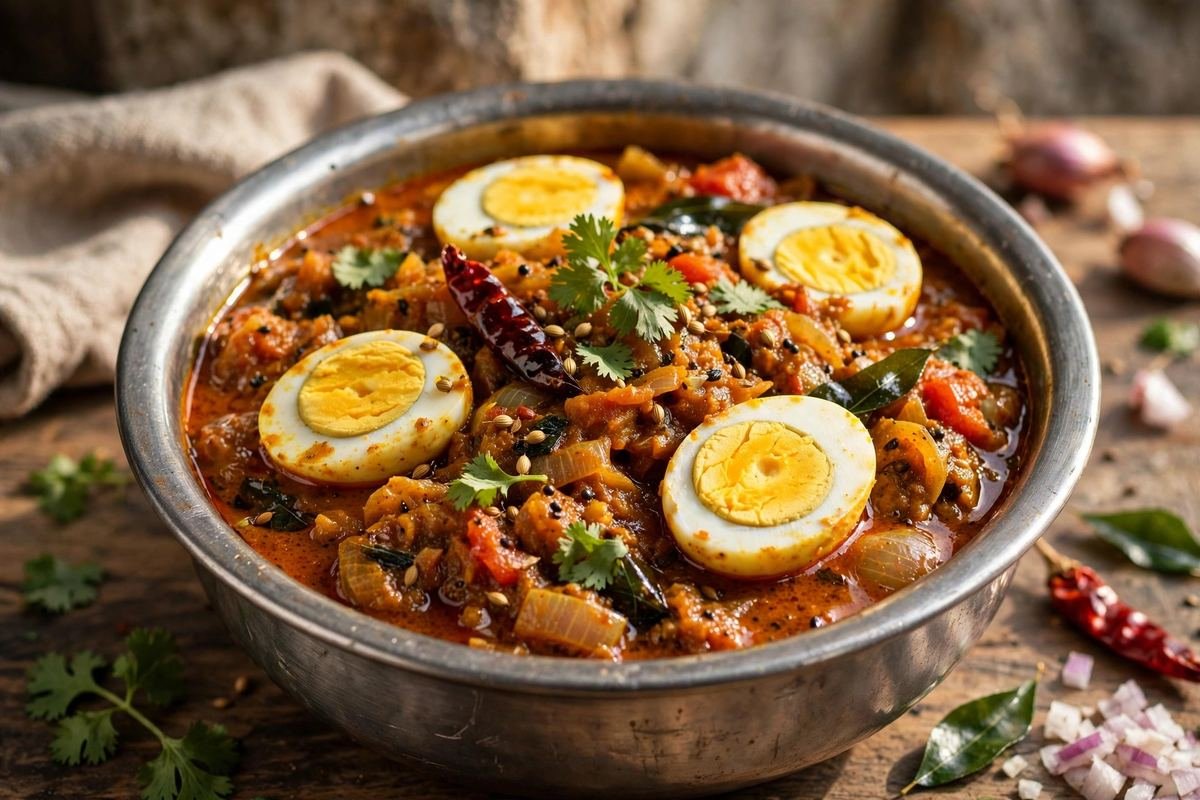
A fiery, rustic egg curry inspired by highway dhabas — golden fried eggs simmered in a thick onion-tomato masala. Bold, comforting, and ready in under an hour.
Ingredients
- 6 large eggs
- 3 tbsp mustard oil (or ghee / neutral oil), plus 2 tbsp more for frying the eggs
- 1 bay leaf
- 3 green cardamom pods, lightly crushed
- 4 cloves
- 1-inch cinnamon stick
- 1 tsp cumin seeds
- 3 large onions (about 450 g), finely chopped
- 1 tbsp ginger-garlic paste
- 3 medium tomatoes (about 350 g), finely chopped or hand-crushed
- 2 green chillies, slit lengthwise
- 1 tsp turmeric powder, divided
- 1 tbsp coriander powder
- 1 tsp Kashmiri red chilli powder (for colour; add hot chilli powder to taste for heat)
- 1 tsp garam masala, plus a pinch more to finish
- 1 tsp kasuri methi (dried fenugreek leaves)
- 1¼ tsp salt, or to taste
- 1½ cups (360 ml) hot water, plus more as needed
- 2 tbsp chopped fresh coriander leaves, to garnish
Instructions
- Boil the eggs. Lower the eggs into a saucepan of boiling water and cook for exactly 9 minutes. Transfer immediately to a bowl of ice water and leave for 5 minutes — this halts cooking and makes the shells slip off. Peel carefully and pat the eggs completely dry with a kitchen towel; any surface moisture will spit violently in hot oil.
- Prick and season. Using a fork or toothpick, prick each egg 6–8 times all over, going just under the surface. This lets the seasoning and later the gravy penetrate. Toss the eggs with ½ teaspoon turmeric and ¼ teaspoon salt until evenly coated.
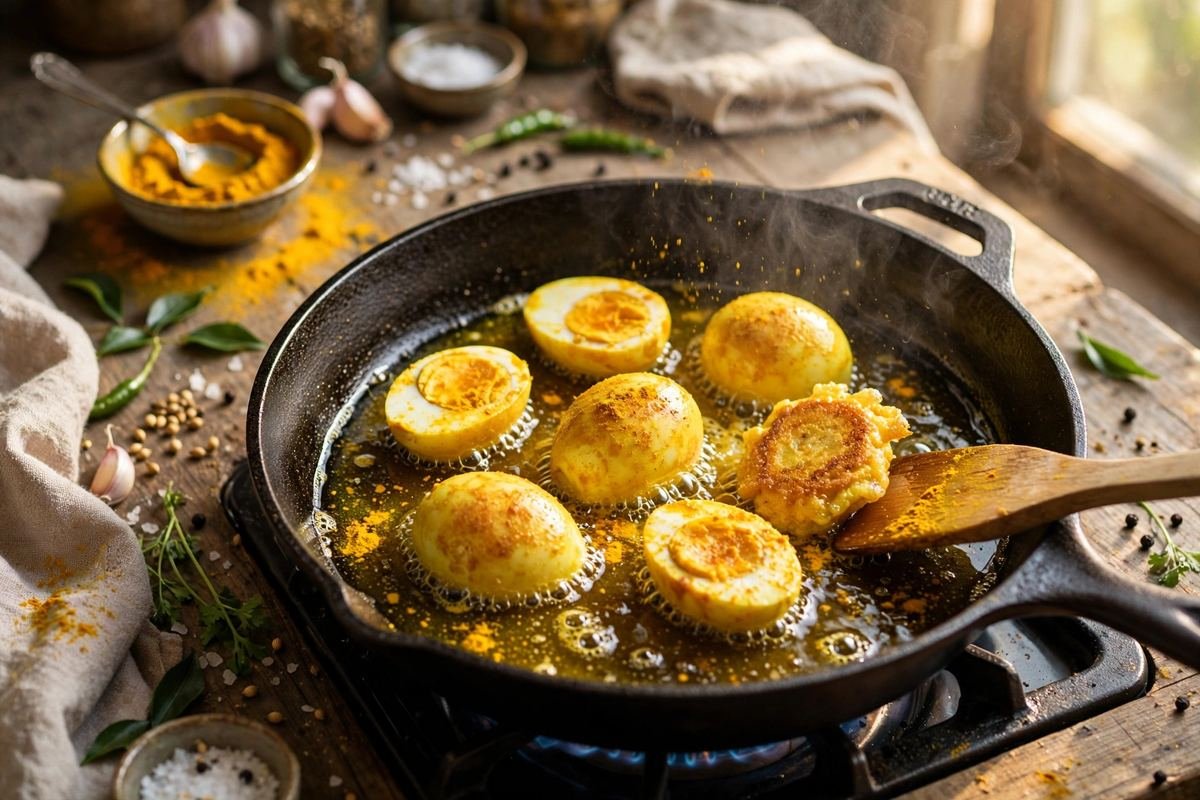
- Fry the eggs golden. Heat 2 tablespoons of oil in your kadhai over medium-high heat until shimmering. Add the eggs in a single layer and fry, turning gently with a spoon, for 4–5 minutes until the entire surface is deep golden with crisp, blistered patches. Do not crowd the pan — fry in two batches if needed. Lift out with a slotted spoon and set aside; these will finish in the gravy.
- Bloom the whole spices. In the same kadhai, add the remaining 3 tablespoons of mustard oil. If using mustard oil, heat it until it just begins to smoke, then reduce the heat to medium and wait 30 seconds. Add the bay leaf, cardamom, cloves, cinnamon, and cumin seeds. Sizzle for 30–40 seconds until the cumin darkens a shade and the oil smells intensely fragrant — but do not let the spices blacken, or the whole curry will taste bitter.
- Brown the onions. Add the chopped onions and ½ teaspoon salt (salt draws out moisture and speeds browning). Cook over medium heat, stirring every couple of minutes, for 12–15 minutes until the onions turn a deep, even golden-brown. This is the flavour foundation — pale, hurried onions make a pale, hurried curry. Scrape the bottom of the kadhai as you go to fold the caramelised bits back in.
- Cook the ginger-garlic and tomatoes. Stir in the ginger-garlic paste and cook for 1–2 minutes until the raw smell disappears. Add the tomatoes and green chillies along with the remaining ½ teaspoon turmeric, coriander powder, and Kashmiri chilli powder. Cook over medium heat for 8–10 minutes, mashing the tomatoes with the back of your spoon, until they melt into the onions and you see glossy oil separating around the edges of the masala. This separation is your cue that the masala is properly bhunoed.
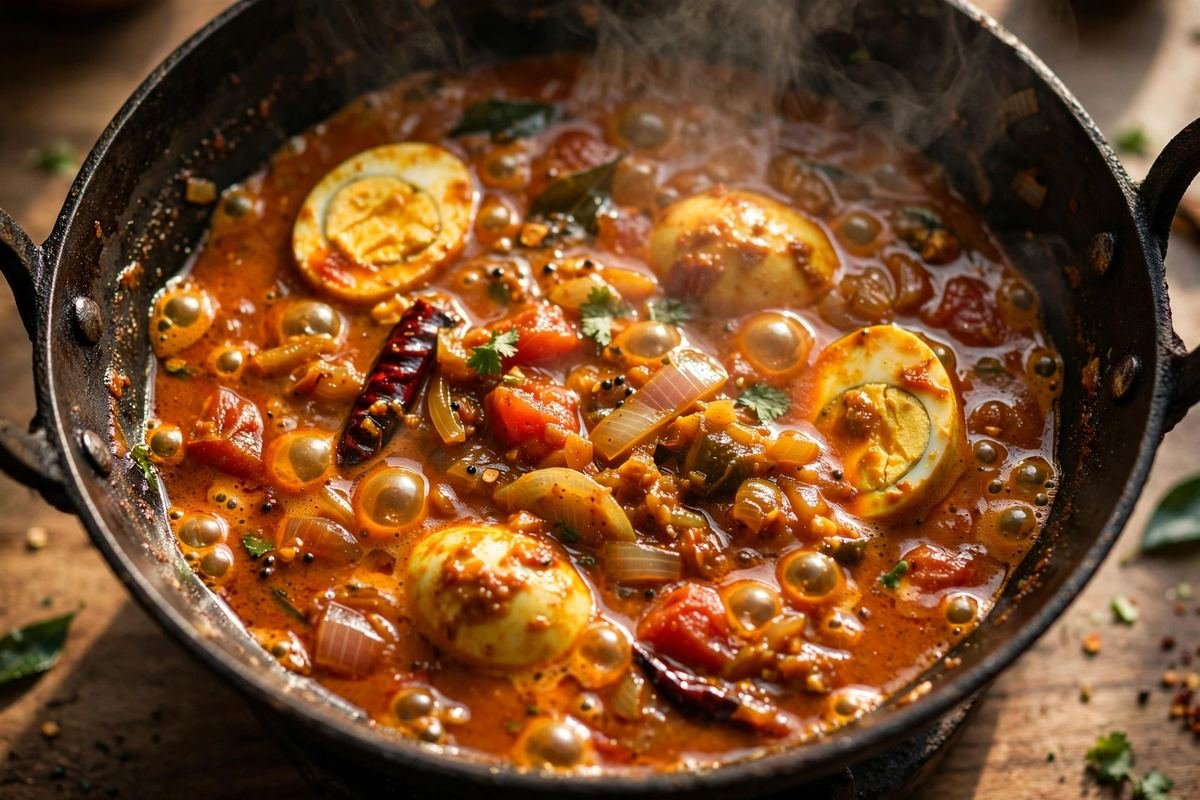
- Simmer the gravy. Pour in 1½ cups of hot water (hot water keeps the temperature up and the gravy smooth) and stir well, scraping up every browned bit from the base. Bring to a boil, then reduce to a gentle simmer. Taste and adjust salt. The gravy should be thick enough to coat a spoon — dhaba egg curry is never thin.
- Add the eggs. Gently slide the fried eggs into the simmering gravy. Spoon gravy over them so they are submerged. Cover and simmer on low for 8–10 minutes, turning the eggs once halfway through, so the fried crusts soak up the masala and the flavours marry. If the gravy thickens too much, splash in a little more hot water.
- Finish dhaba-style. Crush the kasuri methi between your palms directly over the kadhai and stir it in with the garam masala. Simmer uncovered for 2 final minutes so the fenugreek perfumes the gravy. Turn off the heat, shower with chopped coriander, and rest the curry covered for 5 minutes before serving — this short rest lets the oil settle back into the gravy and the flavours round out.
Tip: Read through the full post below for step-by-step photos, pro tips, variations and FAQs before you start cooking.
The Highway Dhaba Legend
Ask any long-haul truck driver in North India what they dream about between Delhi and Amritsar, and somewhere near the top of the list will be a plate of dhaba egg curry with butter-smeared tandoori rotis. Dhabas — those open-air roadside eateries with charpoy seating and tandoors roaring through the night — turned humble ingredients into legends, and egg curry might be their greatest sleight of hand. It takes one of the cheapest proteins in the market and treats it with the full ceremony of a meat curry: a long-bhunoed onion-tomato masala, whole spices cracked in hot oil, and eggs fried until their outsides blister into a golden crust that drinks up gravy like a sponge.
The dhaba version is deliberately rougher than its city cousin. There is no blended-to-silk gravy here; the onions are chopped coarse and cooked until they collapse into sweetness, the tomatoes are crushed by hand, and the masala is fried until the oil separates in glistening pools around the edges. That separated oil is not a flaw — in dhaba cooking it is the signature of a masala that has been bhunoed properly, coaxed past rawness into something deep, dark, and caramelised.
What makes this recipe special is the two-stage treatment of the eggs. First they are hard-boiled to a jam-free, fully set yolk that will survive simmering. Then they are pricked, tossed in turmeric and salt, and shallow-fried until the surface turns amber and crisp. This is the step most home recipes skip, and it is the step that matters most: a boiled egg slipped straight into gravy stays slippery and bland, while a fried egg develops a craggy, seasoned skin that grips the masala and adds a roasted, almost meaty depth to every bite.
The spice profile is unapologetically bold. This is not a gentle, creamy curry. Black pepper, garam masala, and green chillies bring the heat; kasuri methi adds the unmistakable dhaba perfume; and a spoon of ghee or mustard oil at the finish gives it that roadside richness. Served with charred tandoori rotis or plain steamed rice, it is the kind of meal that silences a table — everyone too busy tearing bread and chasing the last of the gravy to talk.
Why You’ll Love This Recipe
- Authentic dhaba flavour — the fried-egg technique and bhunoed masala deliver the real roadside taste, not a watered-down restaurant version.
- Budget-friendly protein — eggs are among the cheapest complete proteins available, making this a filling family dinner for very little money.
- Weeknight fast — from boiling the eggs to a simmering pot in about 55 minutes, with most of that hands-off.
- One-pot comfort — everything happens in a single kadhai, which means deep flavour and minimal washing up.
- Crowd-pleaser — even committed non-vegetarians ask for seconds; the fried eggs have a satisfying, meaty bite.
- Meal-prep friendly — the gravy tastes even better the next day, and it reheats beautifully.
Key Ingredients Explained
Eggs: The star, and the ingredient most worth getting right. Use large, fresh eggs and boil them for exactly 9 minutes for yolks that are fully set but not chalky — a greenish-grey ring around the yolk means overcooking, which makes the eggs rubbery and gives the gravy a sulphurous edge. Older eggs (a week or so) actually peel more cleanly than farm-fresh ones, so do not feel you need the freshest dozen. After boiling, an ice-water bath stops the cooking instantly and shrinks the egg slightly inside the shell, making peeling dramatically easier.
Onions: The backbone of the gravy. Dhaba cooks use a mountain of onions — roughly three large ones for six eggs — and cook them long past translucent into a deep golden-brown. This caramelisation is where the gravy’s sweetness and body come from, so resist the urge to rush it. Chop them fine but not minced; you want texture that melts rather than a paste.
Tomatoes: Provide acidity and the rich red colour. Ripe, juicy tomatoes work best; in winter, when tomatoes are pale and sour, add a teaspoon of tomato paste or use canned crushed tomatoes for consistency. The tomatoes must cook until they completely lose their raw smell and the oil separates — this is the visual cue dhaba cooks swear by.
Ginger-garlic paste: The aromatic foundation. Freshly pounded is noticeably better than bottled, which can carry a vinegary preservative note. If you only have bottled, it works fine — just cook it a full minute longer to drive off the raw edge.
Kasuri methi (dried fenugreek leaves): The dhaba signature. Crushed between your palms and stirred in at the end, it adds a bittersweet, smoky perfume that instantly says “roadside eatery”. There is no real substitute, though a pinch of celery leaves comes vaguely close — better to simply buy kasuri methi, as a packet lasts months.
Mustard oil or ghee: Traditional dhabas cook in mustard oil, which lends a pungent, earthy depth. Heat it to its smoking point first to tame the raw bite, then cool slightly before adding spices. If mustard oil’s assertiveness is not your thing, ghee or any neutral oil works — the curry will still be excellent.
Whole spices: Bay leaf, green cardamom, cloves, and cinnamon go into the hot oil first, blooming for 30 seconds until fragrant. They perfume the oil itself, so every subsequent ingredient picks up their warmth.
Equipment You’ll Need
- Heavy kadhai or deep wok — even heat and high sides for frying and simmering in one vessel
- Slotted spoon — for lifting the fried eggs out of hot oil without carrying excess oil
- Medium saucepan — for boiling the eggs
- Sharp knife and cutting board — for the onions, tomatoes, and chillies
- Small bowl of ice water — stops the eggs cooking and eases peeling
- 6 large eggs
- 3 tbsp mustard oil (or ghee / neutral oil), plus 2 tbsp more for frying the eggs
- 1 bay leaf
- 3 green cardamom pods, lightly crushed
- 4 cloves
- 1-inch cinnamon stick
- 1 tsp cumin seeds
- 3 large onions (about 450 g), finely chopped
- 1 tbsp ginger-garlic paste
- 3 medium tomatoes (about 350 g), finely chopped or hand-crushed
- 2 green chillies, slit lengthwise
- 1 tsp turmeric powder, divided
- 1 tbsp coriander powder
- 1 tsp Kashmiri red chilli powder (for colour; add hot chilli powder to taste for heat)
- 1 tsp garam masala, plus a pinch more to finish
- 1 tsp kasuri methi (dried fenugreek leaves)
- 1¼ tsp salt, or to taste
- 1½ cups (360 ml) hot water, plus more as needed
- 2 tbsp chopped fresh coriander leaves, to garnish
Instructions
- Boil the eggs. Lower the eggs into a saucepan of boiling water and cook for exactly 9 minutes. Transfer immediately to a bowl of ice water and leave for 5 minutes — this halts cooking and makes the shells slip off. Peel carefully and pat the eggs completely dry with a kitchen towel; any surface moisture will spit violently in hot oil.
- Prick and season. Using a fork or toothpick, prick each egg 6–8 times all over, going just under the surface. This lets the seasoning and later the gravy penetrate. Toss the eggs with ½ teaspoon turmeric and ¼ teaspoon salt until evenly coated.
- Fry the eggs golden. Heat 2 tablespoons of oil in your kadhai over medium-high heat until shimmering. Add the eggs in a single layer and fry, turning gently with a spoon, for 4–5 minutes until the entire surface is deep golden with crisp, blistered patches. Do not crowd the pan — fry in two batches if needed. Lift out with a slotted spoon and set aside; these will finish in the gravy.
- Bloom the whole spices. In the same kadhai, add the remaining 3 tablespoons of mustard oil. If using mustard oil, heat it until it just begins to smoke, then reduce the heat to medium and wait 30 seconds. Add the bay leaf, cardamom, cloves, cinnamon, and cumin seeds. Sizzle for 30–40 seconds until the cumin darkens a shade and the oil smells intensely fragrant — but do not let the spices blacken, or the whole curry will taste bitter.
- Brown the onions. Add the chopped onions and ½ teaspoon salt (salt draws out moisture and speeds browning). Cook over medium heat, stirring every couple of minutes, for 12–15 minutes until the onions turn a deep, even golden-brown. This is the flavour foundation — pale, hurried onions make a pale, hurried curry. Scrape the bottom of the kadhai as you go to fold the caramelised bits back in.
- Cook the ginger-garlic and tomatoes. Stir in the ginger-garlic paste and cook for 1–2 minutes until the raw smell disappears. Add the tomatoes and green chillies along with the remaining ½ teaspoon turmeric, coriander powder, and Kashmiri chilli powder. Cook over medium heat for 8–10 minutes, mashing the tomatoes with the back of your spoon, until they melt into the onions and you see glossy oil separating around the edges of the masala. This separation is your cue that the masala is properly bhunoed.
- Simmer the gravy. Pour in 1½ cups of hot water (hot water keeps the temperature up and the gravy smooth) and stir well, scraping up every browned bit from the base. Bring to a boil, then reduce to a gentle simmer. Taste and adjust salt. The gravy should be thick enough to coat a spoon — dhaba egg curry is never thin.
- Add the eggs. Gently slide the fried eggs into the simmering gravy. Spoon gravy over them so they are submerged. Cover and simmer on low for 8–10 minutes, turning the eggs once halfway through, so the fried crusts soak up the masala and the flavours marry. If the gravy thickens too much, splash in a little more hot water.
- Finish dhaba-style. Crush the kasuri methi between your palms directly over the kadhai and stir it in with the garam masala. Simmer uncovered for 2 final minutes so the fenugreek perfumes the gravy. Turn off the heat, shower with chopped coriander, and rest the curry covered for 5 minutes before serving — this short rest lets the oil settle back into the gravy and the flavours round out.
Pro Tips for Perfect Results
- Dry the eggs before frying. Even a little surface water causes dangerous splattering and prevents the skin from crisping. Pat them thoroughly dry after peeling.
- Do not skip the pricking. Unpricked eggs stay bland inside no matter how good the gravy is. Those tiny holes are channels for flavour.
- Brown onions patiently. The 12–15 minutes of onion browning builds more flavour than any spice can. Medium heat, regular stirring, no shortcuts.
- Wait for the oil to separate. After adding tomatoes, keep cooking until you see oil glistening at the edges. That visual cue means the masala’s rawness is gone.
- Use hot water for the gravy. Cold water shocks the masala, seizes the oil, and can make the gravy grainy. Always add hot water to a hot masala.
- Fry eggs in batches. Crowding drops the oil temperature and steams the eggs instead of crisping them. Two uncrowded batches beat one soggy one.
- Rest before serving. Five covered minutes off the heat transforms the curry — the gravy thickens slightly and the spices settle into harmony.
- Adjust heat at the end. Dhaba curry should be spicy, but taste before serving: a pinch of sugar can balance aggressive heat without making the curry sweet.
Variations to Try
Coconut dhaba curry: Replace half the water with thin coconut milk for a Goan-shack twist — the coconut rounds off the heat beautifully. Egg curry with peas: Add a handful of green peas with the eggs for colour and sweetness, a classic dhaba add-on. Masala omelette curry: Instead of boiled eggs, make a thick two-egg masala omelette, cut it into wedges, and simmer those in the gravy — a Mumbai-street favourite. Smoky dhaba finish: For the full roadside effect, place a piece of live charcoal in a small steel bowl inside the kadhai after cooking, drizzle with ghee, cover for 2 minutes, then remove — the curry picks up a haunting tandoor-like smokiness. Milder family version: Halve the chillies, use only Kashmiri chilli powder, and stir in 2 tablespoons of cream at the end for a gentler curry kids will eat.
Serving Suggestions
The canonical pairing is tandoori roti or naan — something with char and chew to scoop up that thick gravy. If you are making rotis at home, brush them with butter the moment they come off the tawa. Steamed basmati rice is the other classic; the grains soak up the masala wonderfully. For a full dhaba spread, serve alongside sliced raw onions, lemon wedges, and green chillies on the side, plus a simple kheera-tamatar salad and a glass of masala chaas to cool the palate. A spoon of ghee melted over the top just before serving is never a mistake.
Storage and Reheating
Refrigerate leftovers in an airtight container for up to 3 days — the curry genuinely tastes better on day two as the eggs absorb more masala. Reheat gently on the stovetop over low heat with a splash of water, turning the eggs carefully so they do not break. Avoid the microwave if you can: it heats unevenly and can make the eggs rubbery. This curry also freezes well for up to 2 months; thaw overnight in the fridge and reheat slowly. The texture of the eggs softens slightly after freezing but the flavour remains excellent. Do not refreeze once thawed.
Frequently Asked Questions
Why fry the eggs instead of adding them boiled?
Frying creates a golden, blistered crust that grips the gravy and adds roasted depth. A plain boiled egg has a smooth, slippery surface that the masala slides right off — fried eggs taste seasoned all the way through after simmering.
My gravy tastes raw and sharp. What went wrong?
The masala was under-bhunoed. The onions need a full deep-golden browning and the tomatoes must cook until the oil visibly separates at the edges. If you have already added water, just keep simmering — an extra 10 minutes of gentle bubbling will still improve it considerably.
Can I make this with duck eggs?
Yes, and it is delicious — duck eggs are richer and hold their shape beautifully. Boil them for 10 minutes instead of 9, since they are larger, and otherwise follow the recipe exactly.
How do I keep the eggs from breaking in the gravy?
Slide them in gently rather than dropping, keep the simmer truly gentle (lazy bubbles, not a rolling boil), and turn them only once with a spoon — never a whisk or vigorous stir.
Is mustard oil essential?
It is traditional and adds a distinctive pungent depth, but the curry is excellent with ghee or neutral oil too. If using mustard oil, always heat it to smoking point first to mellow its raw bite.
Can I make the gravy ahead?
Absolutely. Make the masala through the simmering step, cool, and refrigerate for up to 3 days. When ready to serve, reheat the gravy, fry fresh eggs (or reuse refrigerated fried eggs), and simmer together for 10 minutes. It is an ideal dinner-party strategy.
There is something deeply satisfying about a curry that costs so little and delivers so much. This dhaba-style egg curry is proof that great Indian cooking is about technique, not expensive ingredients — a properly bhunoed masala, eggs with a crackling golden skin, and the patience to let it all come together. Make it once, and it will quietly join your regular rotation, the recipe you reach for when you want maximum comfort with minimum fuss.