Recipe Card
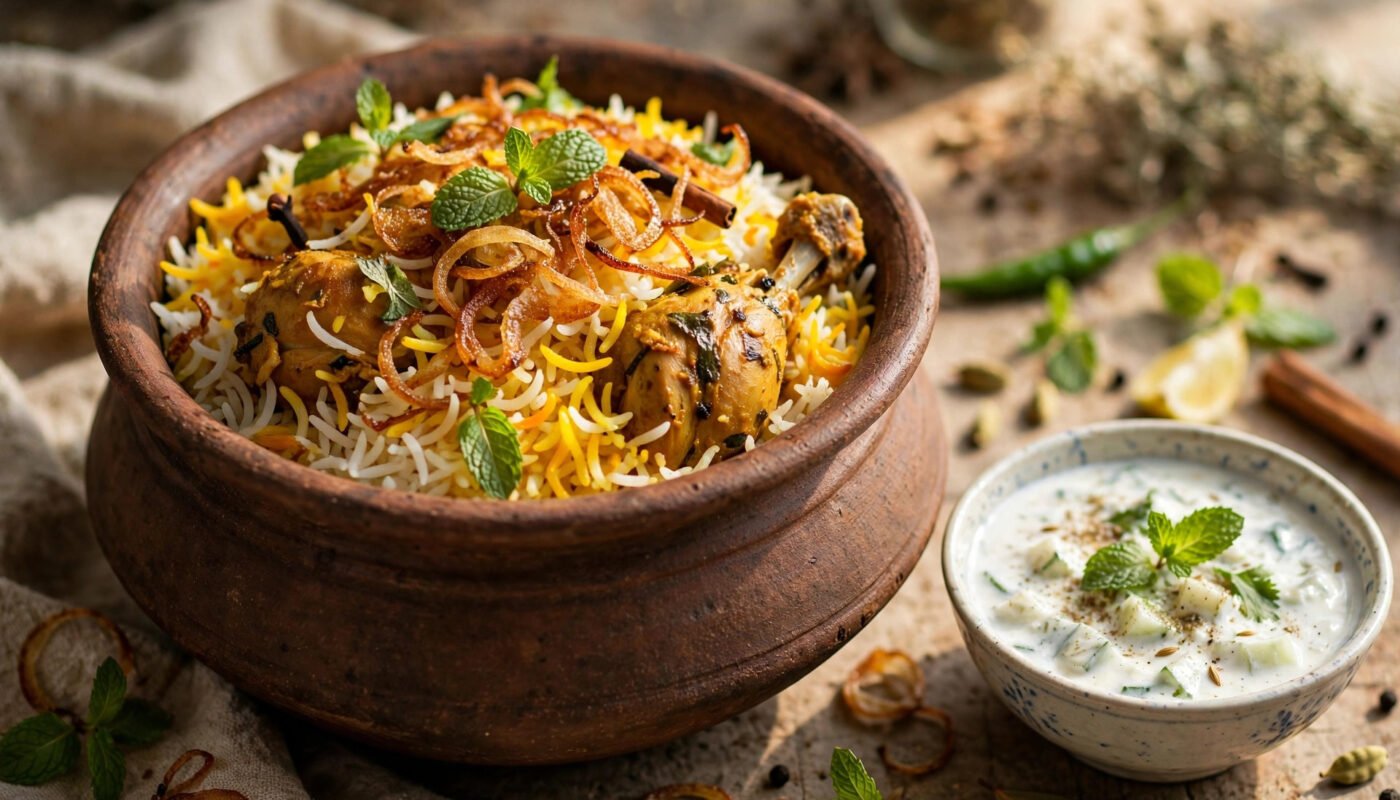
Layered raw-marinated chicken and fragrant basmati, sealed and slow-steamed on dum. This authentic Hyderabadi biryani recipe delivers restaurant-level aroma at home.
Ingredients
- 750g chicken, bone-in, cut into large pieces
- 200g (about 3/4 cup + 1 tbsp) thick yoghurt, whisked smooth
- 2 tbsp ginger-garlic paste
- 2 tsp red chilli powder
- 1/2 tsp turmeric powder
- 1.5 tsp garam masala
- 4-5 green chillies, slit lengthwise
- 1/2 cup fresh mint leaves, chopped
- 1/2 cup fresh coriander leaves, chopped
- 3 tbsp lemon juice
- 3 tbsp mustard or neutral oil
- 2 tsp salt, plus more for rice water
- 500g (2.5 cups) aged long-grain basmati rice
- 4 green cardamom pods
- 4 cloves
- 1 cinnamon stick (2-inch)
- 1 tsp shahi jeera (caraway seeds)
- 2 bay leaves
- 2 large onions, thinly sliced, for birista
- 1/2 cup oil, for frying onions
- 1/4 tsp (a generous pinch) saffron threads soaked in 3 tbsp warm milk
- 1 tsp kewra water
- 3 tbsp ghee, melted
- 2 tbsp fresh coriander and mint, extra, for layering
Instructions
- Marinate the chicken. In a large bowl, combine the whisked yoghurt, ginger-garlic paste, red chilli powder, turmeric, garam masala, slit green chillies, chopped mint and coriander, lemon juice, oil, and 2 tsp salt. Add the chicken pieces and rub the marinade in thoroughly, working it under the skin and into every crevice. Cover and refrigerate for at least 2 hours, or overnight for the deepest flavour. Bring the marinated chicken back to room temperature 30 minutes before layering.
- Prepare the rice. Rinse the basmati in several changes of water until the water runs mostly clear, then soak for exactly 30 minutes and drain. Bring a large pot of water to a rolling boil with 2 tablespoons of salt, the cardamom, cloves, cinnamon, shahi jeera, and bay leaves. Add the drained rice and cook for 5-6 minutes until the grains are 70 percent done: they should still have a firm white core when you bite one. Drain immediately in a colander and spread on a tray to stop the cooking.
- Fry the birista. Heat 1/2 cup oil in a wide pan over medium-high heat. Fry the sliced onions in two batches, stirring often, for 8-10 minutes per batch until deep golden brown and crisp. They go from pale to burnt quickly at the end, so watch closely and lift them out just as they turn golden; they crisp further as they cool. Drain on paper towels and reserve 2 tablespoons of the onion-infused oil.
- Layer the handi. Spread the marinated chicken in an even layer at the bottom of your heavy handi. Scatter half the birista, half the extra herbs, and drizzle 1 tablespoon of ghee over it. Top with half the par-cooked rice, spreading gently without pressing. Repeat: remaining birista, herbs, ghee, and the rest of the rice. Drizzle the saffron milk in streaks over the top, sprinkle the kewra water, and finish with the remaining ghee and the reserved onion oil.
- Seal for dum. If using dough, roll whole wheat dough into a long rope and press it around the rim of the handi, then press the lid firmly onto it to create an airtight seal. Alternatively, drape a clean damp kitchen towel over the rim and place the tight lid on top, or seal tightly with two layers of foil before lidding. The seal traps the steam that cooks everything.
- Cook on dum. Place a flat tawa over high heat for 2 minutes to warm it, then set the sealed handi on the tawa. Cook on high heat for 8-10 minutes until you hear a gentle sizzle and see steam trying to escape, then reduce to the lowest possible flame and cook for 40-45 minutes. Do not open the lid during this time; every peek releases the steam doing the work. The tawa diffuses the heat so the bottom layer steams instead of scorching.
- Rest and serve. Turn off the heat and let the handi rest, still sealed, for 15 minutes. This resting period lets the steam redistribute so every grain finishes evenly. Break the seal, and gently fluff from the sides with a flat spoon, lifting the bottom masala layer up without breaking the long grains. Serve hot directly from the handi for maximum drama.
Tip: Read through the full post below for step-by-step photos, pro tips, variations and FAQs before you start cooking.
Introduction
Few dishes command the reverence that biryani does, and within the biryani universe, the Hyderabadi dum biryani sits on the throne. Born in the royal kitchens of the Nizams of Hyderabad, this is the kacchi-style biryani, meaning the chicken goes into the pot raw, marinated in yoghurt and spices, layered with par-cooked basmati rice, and then the whole handi is sealed and slow-steamed on dum. Dum, from the Persian word for breath, is the gentle art of cooking in trapped steam, and it is what transforms simple rice and chicken into something transcendent.
What sets the Hyderabadi version apart from its Lucknowi cousin is boldness. The marinade is fiery with green chillies, the rice is perfumed with saffron and kewra water, and the whole dish is crowned with crispy birista, golden fried onions that add sweetness and crunch. When you lift the lid, or break the dough seal in the traditional style, a cloud of fragrant steam rises carrying saffron, cardamom, and rose. It is theatre and dinner in one.
I will be honest with you: this recipe demands respect and a little patience. It is the most technically involved recipe in this collection, and your first attempt requires focus. But I have broken the process into clear, timed stages, and I have included every safeguard I know, from the exact water ratios to the fail-safe dum setup using a tawa. Follow the method and you will produce a biryani with distinct, fluffy grains, chicken that falls off the bone, and layers of colour that make the dish as beautiful as it is delicious. Let us cook like the Nizams.

Why You’ll Love This Recipe
- Authentic kacchi dum method: Raw-marinated chicken steamed with rice, exactly like Hyderabad’s legendary biryani houses.
- Detailed timing safeguards: Precise par-cooking and dum timings so you never end up with mushy rice or undercooked chicken.
- Feeds a crowd: One handi generously serves six, making it ideal for Sunday lunches and celebrations.
- Make-ahead components: Marinate overnight and fry the onions in advance to split the work across two days.
- Restaurant-level aroma: Saffron, kewra, and birista create the signature fragrance of a proper Hyderabadi biryani.
- Complete meal in one pot: Protein, carbs, and aromatics all in a single handi, with simple sides to finish.
Key Ingredients Explained
Biryani is a dish of layers, and each layer has its star players. Start with the rice: use aged long-grain basmati, and I mean proper aged basmati, not everyday rice. Aged grains are drier, so they stay separate and elongate beautifully instead of turning sticky. Soak the rice for exactly 30 minutes, no longer, then par-cook it to 70 percent doneness. That 70 percent figure is the most important number in this recipe; fully cooked rice will collapse into mush on dum, while undercooked rice stays hard.
The chicken should be bone-in, cut into large pieces. Bone-in pieces stay moist through the long dum and the bones enrich the masala. The marinade is a powerhouse: thick yoghurt, ginger-garlic paste, red chilli powder, turmeric, garam masala, and crucially, a generous amount of chopped green chillies and mint and coriander leaves. The fresh herbs are not garnish here; they are a core flavour layer that perfumes the steam.
Then come the aromatics that make it Hyderabadi. Saffron soaked in warm milk gives the golden streaks; use real saffron threads, a small pinch is enough, and never use food colour as a substitute if you want the true flavour. Kewra water, distilled from pandanus flowers, adds the haunting floral note characteristic of Hyderabadi biryani; a teaspoon is plenty, as too much turns soapy. Birista, the crisp fried onions, contribute sweetness and texture, so fry your own rather than using store-bought if you can. Finally, ghee is drizzled between layers for richness, and whole spices like green cardamom, cloves, cinnamon, and shahi jeera perfume the rice water. Do not skip salting the rice water aggressively; it should taste like seawater, because this is the only chance to season the rice itself.
Equipment You’ll Need
- Heavy-bottomed handi or Dutch oven with tight lid: Even heat is critical for dum; thin pots scorch the bottom layer.
- Large pot: For par-cooking the basmati rice.
- Fine-mesh strainer or colander: For draining the par-cooked rice quickly.
- Flat tawa or griddle: Placed under the handi during dum to diffuse heat and prevent burning.
- Whole wheat dough or foil: For sealing the lid traditionally, though a tight lid with a kitchen towel works too.
Ingredients
- 750g chicken, bone-in, cut into large pieces
- 200g (about 3/4 cup + 1 tbsp) thick yoghurt, whisked smooth
- 2 tbsp ginger-garlic paste
- 2 tsp red chilli powder
- 1/2 tsp turmeric powder
- 1.5 tsp garam masala
- 4-5 green chillies, slit lengthwise
- 1/2 cup fresh mint leaves, chopped
- 1/2 cup fresh coriander leaves, chopped
- 3 tbsp lemon juice
- 3 tbsp mustard or neutral oil
- 2 tsp salt, plus more for rice water
- 500g (2.5 cups) aged long-grain basmati rice
- 4 green cardamom pods
- 4 cloves
- 1 cinnamon stick (2-inch)
- 1 tsp shahi jeera (caraway seeds)
- 2 bay leaves
- 2 large onions, thinly sliced, for birista
- 1/2 cup oil, for frying onions
- 1/4 tsp (a generous pinch) saffron threads soaked in 3 tbsp warm milk
- 1 tsp kewra water
- 3 tbsp ghee, melted
- 2 tbsp fresh coriander and mint, extra, for layering
Instructions
- Marinate the chicken. In a large bowl, combine the whisked yoghurt, ginger-garlic paste, red chilli powder, turmeric, garam masala, slit green chillies, chopped mint and coriander, lemon juice, oil, and 2 tsp salt. Add the chicken pieces and rub the marinade in thoroughly, working it under the skin and into every crevice. Cover and refrigerate for at least 2 hours, or overnight for the deepest flavour. Bring the marinated chicken back to room temperature 30 minutes before layering.
- Prepare the rice. Rinse the basmati in several changes of water until the water runs mostly clear, then soak for exactly 30 minutes and drain. Bring a large pot of water to a rolling boil with 2 tablespoons of salt, the cardamom, cloves, cinnamon, shahi jeera, and bay leaves. Add the drained rice and cook for 5-6 minutes until the grains are 70 percent done: they should still have a firm white core when you bite one. Drain immediately in a colander and spread on a tray to stop the cooking.
- Fry the birista. Heat 1/2 cup oil in a wide pan over medium-high heat. Fry the sliced onions in two batches, stirring often, for 8-10 minutes per batch until deep golden brown and crisp. They go from pale to burnt quickly at the end, so watch closely and lift them out just as they turn golden; they crisp further as they cool. Drain on paper towels and reserve 2 tablespoons of the onion-infused oil.
- Layer the handi. Spread the marinated chicken in an even layer at the bottom of your heavy handi. Scatter half the birista, half the extra herbs, and drizzle 1 tablespoon of ghee over it. Top with half the par-cooked rice, spreading gently without pressing. Repeat: remaining birista, herbs, ghee, and the rest of the rice. Drizzle the saffron milk in streaks over the top, sprinkle the kewra water, and finish with the remaining ghee and the reserved onion oil.
- Seal for dum. If using dough, roll whole wheat dough into a long rope and press it around the rim of the handi, then press the lid firmly onto it to create an airtight seal. Alternatively, drape a clean damp kitchen towel over the rim and place the tight lid on top, or seal tightly with two layers of foil before lidding. The seal traps the steam that cooks everything.
- Cook on dum. Place a flat tawa over high heat for 2 minutes to warm it, then set the sealed handi on the tawa. Cook on high heat for 8-10 minutes until you hear a gentle sizzle and see steam trying to escape, then reduce to the lowest possible flame and cook for 40-45 minutes. Do not open the lid during this time; every peek releases the steam doing the work. The tawa diffuses the heat so the bottom layer steams instead of scorching.
- Rest and serve. Turn off the heat and let the handi rest, still sealed, for 15 minutes. This resting period lets the steam redistribute so every grain finishes evenly. Break the seal, and gently fluff from the sides with a flat spoon, lifting the bottom masala layer up without breaking the long grains. Serve hot directly from the handi for maximum drama.
Pro Tips for Perfect Results
- 70 percent rice is the golden rule. Bite a grain at the par-cooking stage; it should be soft outside with a distinct firm core. When in doubt, undercook slightly rather than overcook.
- Room-temperature chicken matters. Cold marinated chicken straight from the fridge lowers the handi temperature and can leave the bottom layer undercooked. Give it 30 minutes on the counter.
- Salt the rice water like the sea. This is your only chance to season the rice grains themselves. Bland rice cannot be fixed after dum.
- Do not peek during dum. Lifting the lid releases the pressurised steam that is cooking the chicken and finishing the rice. Trust the timing.
- Use a tawa underneath. Direct flame on a heavy handi for 45 minutes will scorch the bottom masala. The tawa is the traditional insurance policy.
- Fry birista patiently. Evenly golden, crisp onions need medium-high heat and stirring. Dark brown onions taste bitter and will darken the whole biryani.
- Rest before opening. The 15-minute rest is not optional; it evens out the cooking and lets the grains firm up so they do not break when fluffed.
Variations to Try
The dum method adapts beautifully. For a pakki-style biryani, cook the chicken masala fully first, then layer with the par-cooked rice and dum for just 20 minutes; this is more forgiving for beginners. A vegetable dum biryani swaps the chicken for cauliflower, carrots, beans, and paneer marinated in the same spiced yoghurt, with a slightly shorter 30-minute dum. Egg biryani is a Hyderabadi favourite: hard-boil eggs, make shallow slits, fry them golden in the onion oil, and layer them over a potato masala base.
For special occasions, try a mutton dum biryani using the same method but marinating the mutton overnight and extending the low dum to a full hour, since mutton needs longer to turn tender. And if saffron feels too precious for a weeknight, a weeknight chicken pulao captures the spirit in one pot: saute the marinated chicken, add soaked rice and water in a 1:1.5 ratio, and pressure cook for one whistle. It is not dum biryani, but it scratches the itch in 30 minutes.

Serving Suggestions
Biryani is traditionally served with mirchi ka salan, a tangy peanut-sesame curry with large green chillies, and raita, usually a simple onion or boondi raita, to cool the heat. These two accompaniments are not optional in Hyderabad; they are part of the dish’s identity. Add kachumber salad for freshness and lemon wedges for brightness. Serve the biryani in the handi at the table and fluff it in front of your guests; the unveiling is half the pleasure. For drinks, chaas or a fresh lime soda cuts the richness. Finish the meal with double ka meetha or qubani ka meetha, Hyderabad’s classic bread pudding and apricot desserts, if you want to go all in.
Storage and Reheating
Leftover biryani keeps in the refrigerator for up to 2 days in an airtight container. The rice will firm up when cold, which is normal. To reheat, sprinkle 2-3 tablespoons of water over the portion, cover tightly, and warm in a pan on low heat for 8-10 minutes, or microwave covered with a damp paper towel. The added moisture re-steams the grains. Avoid reheating more than once, as the chicken dries out with repeated heating. Biryani does not freeze well because the rice grains turn mushy on thawing, so cook only what you will eat within two days. The marinated raw chicken, however, freezes excellently for up to a month; thaw overnight and proceed with the layering.
Frequently Asked Questions
Why did my chicken stay raw while the rice overcooked?
This is the classic kacchi biryani failure and it almost always comes down to two things: the chicken pieces were too large or fridge-cold, or the dum heat was too high, cooking the rice before the steam could penetrate the chicken. Use medium-large pieces, bring them to room temperature, and keep the dum flame truly low after the initial high-heat blast.
Can I make dum biryani without a handi?
Yes. Any heavy, deep pot with a tight-fitting lid works, such as a Dutch oven. The keys are a heavy base for even heat, a good seal (use the foil or towel method), and the tawa underneath to prevent scorching.
What can I use instead of kewra water?
Rose water is the closest substitute; use half the quantity since it is stronger. In a pinch, skip it entirely and add a few extra drops of saffron milk and a pinch of cardamom powder to the top layer. The biryani will still be delicious, just less distinctly Hyderabadi.
How do I stop the bottom layer from burning?
The tawa diffuser is essential, as is the lowest possible flame. Also make sure there is enough marinade moisture at the bottom; if your yoghurt was very thick and the chicken looks dry, add 3-4 tablespoons of water to the handi before layering the rice.
Can I use boneless chicken?
You can, but reduce the low-dum time to 30-35 minutes since boneless pieces cook faster. Bone-in is traditional and more forgiving, but boneless works for a quicker, easier version.
Why is my biryani one flat colour instead of layered white and orange?
The colour variation comes from drizzling the saffron milk in streaks over only the top layer and not mixing the rice after dum. Fluff gently from the sides rather than stirring, and the beautiful marbled layers will show.
And there it is, the king of rice dishes, made in your own kitchen. Dum biryani rewards the cook who respects the process: the marinade, the 70-percent rice, the seal, the wait. When you break that seal and the saffron steam hits your face, you will understand why Hyderabad has guarded this recipe for centuries. Serve it proudly, accept the compliments gracefully, and keep the raita coming.