Recipe Card
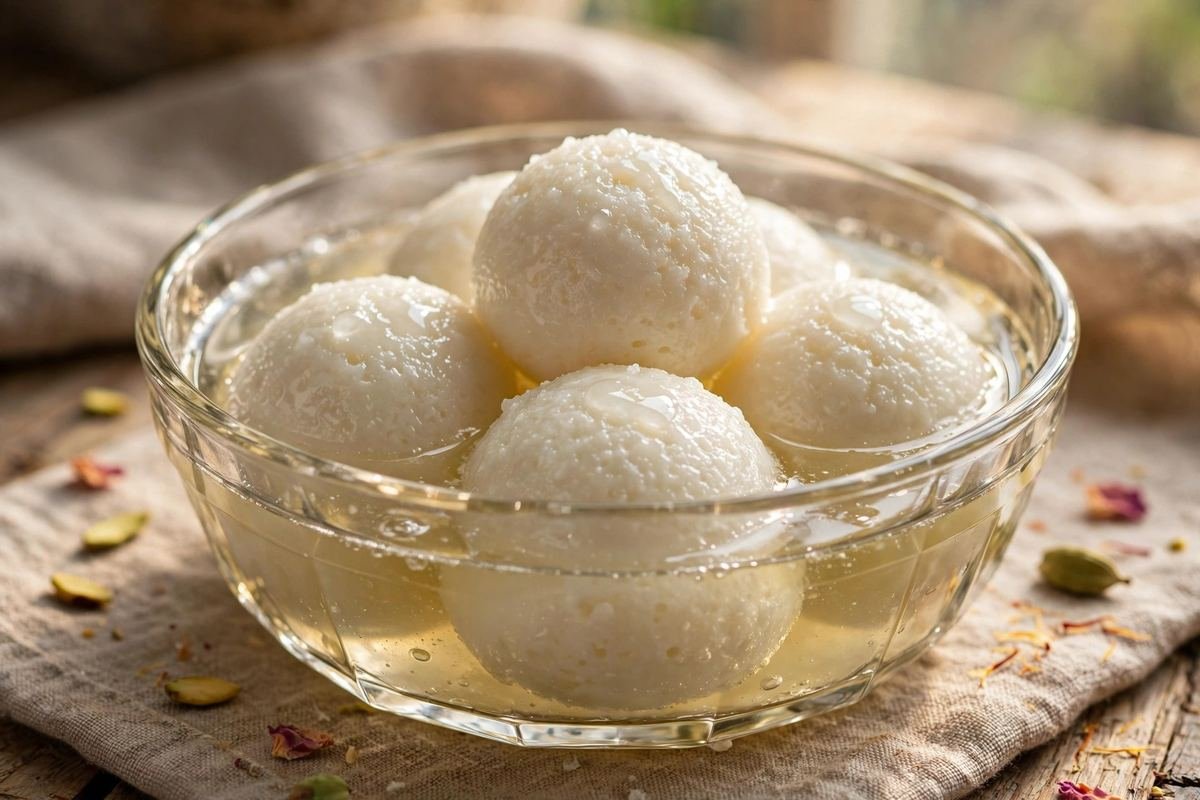
Pillowy-soft rasgullas that bounce back when pressed, simmered in light syrup. The complete chenna method for spongy rasgullas that never turn hard.
Ingredients
- 1.5 litres full-cream milk
- 2–3 tbsp lemon juice or white vinegar, diluted in 1/4 cup water
- 1 tsp cornflour (or fine semolina)
- 1.25 cups (250g) sugar
- 4 cups (1 litre) water, for the syrup
- 2 green cardamom pods, lightly crushed (optional)
Instructions
- Curdle the milk. Bring the 1.5 litres of full-cream milk to a rolling boil in a heavy pot, stirring to prevent sticking. Switch off the heat and wait 2 to 3 minutes — the milk should still be steaming hot but no longer violently bubbling. Add the diluted lemon juice one tablespoon at a time, stirring gently. The milk will separate into soft white curds and clear, pale-green whey. Stop adding acid the moment the separation is clean; if the whey is still milky, add a little more.
- Strain, rinse, and drain. Pour the curdled milk through a muslin-lined strainer set over the sink. Gather the cloth and rinse the chenna under cool running water for about 30 seconds, tossing gently — this washes off the lemon tang and stops the curds from cooking further. Squeeze gently to remove excess water, then hang the bundle for 30 minutes. The target texture: moist and crumbly, holding together when pressed but breaking apart easily — like fresh paneer. Too wet and the balls will dissolve in syrup; too dry and they will crack and turn hard.
- Knead to perfect smoothness. Turn the chenna onto a clean plate, sprinkle over the cornflour, and knead with the heel of your palm for 6 to 8 minutes. Press, fold, and turn until the chenna transforms from crumbly to completely smooth, soft, and pliable — it should feel like firm play-dough and roll into a ball with a satiny, crack-free surface. This is the most important step in the entire recipe: under-kneaded chenna makes grainy rasgullas that break apart, while over-kneaded chenna releases its fat and makes dense, oily balls. Stop the moment it is smooth.
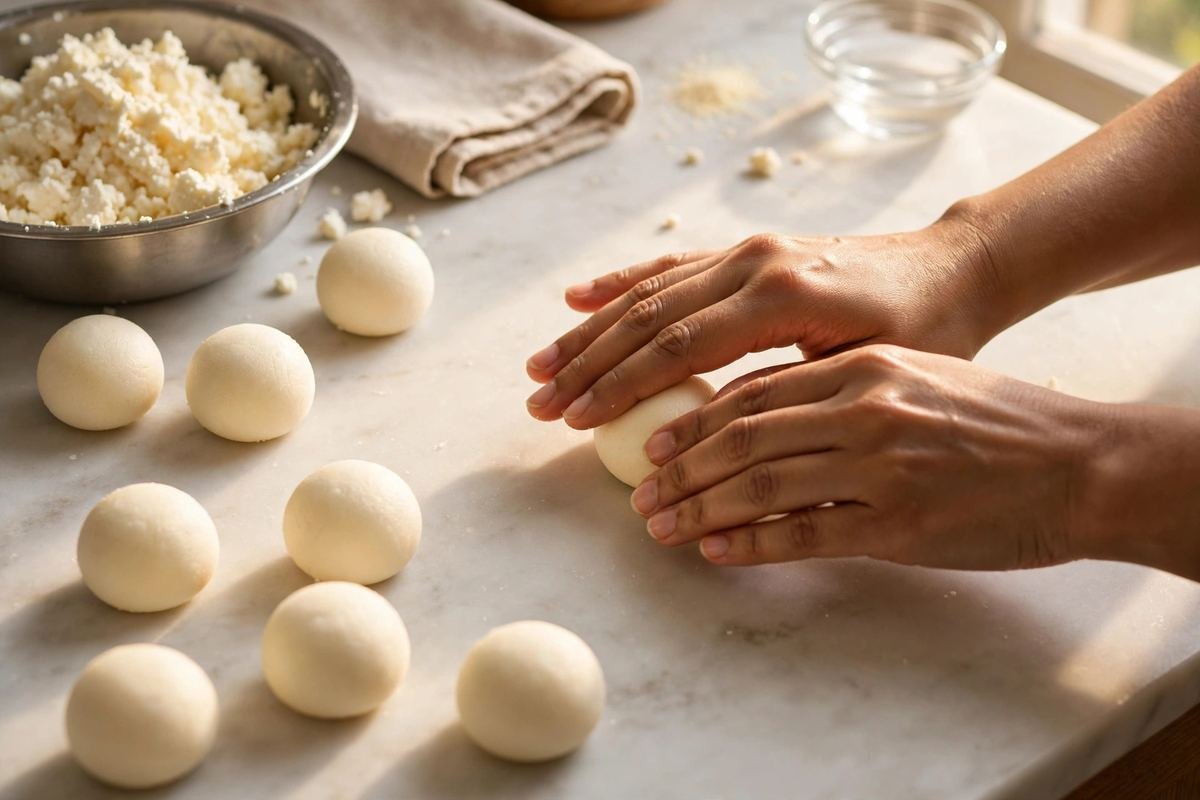
- Shape crack-free balls. Divide the kneaded chenna into 12 equal portions. Roll each between your palms into a smooth ball about 3 cm across, checking carefully for cracks — even a hairline crack will open up in the boiling syrup. If the surface cracks, the chenna is slightly dry: knead in a few drops of water and re-roll. The balls should feel firm and look like little white marbles. Keep them covered with a damp cloth while you prepare the syrup so they do not dry out.
- Prepare the thin syrup and bring to a rolling boil. In your widest pot, combine the sugar and water (plus cardamom if using) and bring to a vigorous, rolling boil over high heat. The syrup must be thin and at a full boil when the balls go in — the violent bubbling is what cooks them through and makes them expand. Have a cup of hot water nearby: if the syrup reduces too much during cooking, you will top it up to keep it thin.
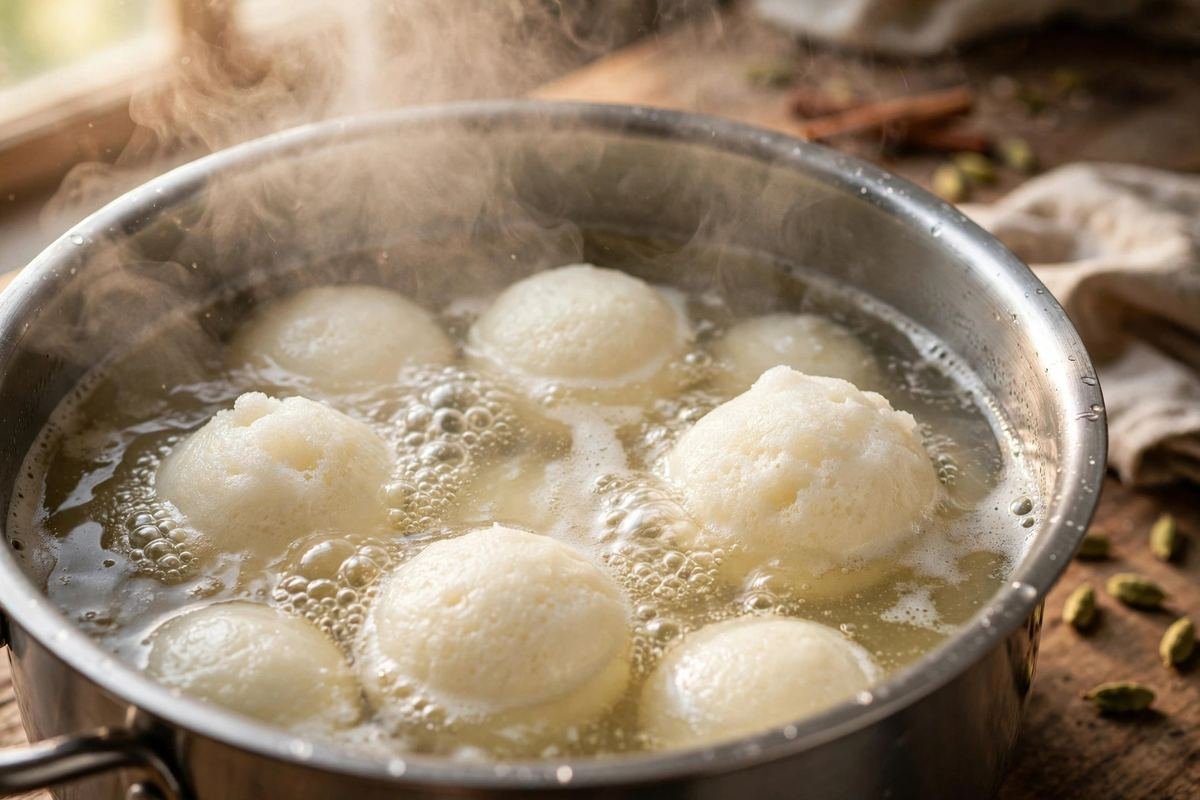
- Simmer the rasgullas. Gently slide the balls into the boiling syrup one by one. They will sink first, then rise as they cook — this is normal. Cover with the lid and cook on high heat for 7 to 8 minutes, then remove the lid, gently flip any balls that look unevenly cooked, and cook uncovered for another 7 to 8 minutes. The rasgullas should nearly double in size, turn slightly off-white and translucent-looking, and feel spongy. Total cooking time: 15 to 18 minutes. If the syrup thickens visibly, splash in some of the hot water to keep it thin.
- Test for doneness. Drop one rasgulla into a bowl of plain room-temperature water: if it sinks to the bottom, it is cooked through; if it floats, it needs a few more minutes. Alternatively, press a rasgulla gently — it should spring back to shape immediately. A perfect rasgulla, cut open, shows an even, fine spongy texture throughout with no dense or doughy centre.
- Rest in the syrup. Switch off the heat and let the rasgullas cool completely in their syrup — at least 1 hour. As they cool, they absorb syrup and settle into their final juicy texture. Do not squeeze or press them at any stage (unlike rasmalai discs); rasgullas should stay plump and round.
- Serve. Serve at room temperature or chilled, 2 per person, in small bowls with generous ladles of the light syrup. They are at their best within the first day, when the sponge is at its bounciest.
Tip: Read through the full post below for step-by-step photos, pro tips, variations and FAQs before you start cooking.
The Story Behind Rasgulla
Few Indian sweets have inspired as much passion — and as much legal drama — as the rasgulla. When Odisha and West Bengal both staked claims to its origin, the battle went all the way to Geographical Indication status, with Bengal winning the GI tag for “Banglar Rasogolla” in 2017 while Odisha secured its own for the Pahala rasgulla. Beneath the politics lies a simple, beloved truth: the rasgulla is one of India’s most perfect sweets — a snow-white ball of fresh chenna, simmered in the lightest of sugar syrups until it turns spongy and juicy, served at room temperature or chilled, melting in the mouth with almost no chewing required. Its invention is credited to Nobin Chandra Das of Kolkata in 1868, who is said to have solved the puzzle of binding chenna into balls that would hold together in boiling syrup — a breakthrough that launched a sweet empire and changed Bengali mithai forever.
What makes rasgulla special is its purity. Unlike most Indian sweets, it contains no ghee, no khoya, no nuts, no heavy flavourings — just milk, a little acid, sugar, and water. Its pleasure is entirely textural: the gentle resistance of the spongy ball, the rush of light syrup when you bite through, the clean milky finish. A great rasgulla should be so soft that it springs back when pressed lightly, and so juicy that syrup wells up around the bite. It is also, by Indian sweet standards, remarkably light — which is why it is the sweet of choice after heavy festive meals, the first sweet offered to guests, and the comfort sweet for every Bengali occasion from Durga Puja to a simple afternoon craving.
Homemade rasgulla has a fearsome reputation, but the fear is mostly misplaced. The entire sweet hinges on two skills: making soft chenna and kneading it just enough. Get those right and the simmering practically takes care of itself. This recipe gives you the exact moisture level to aim for in the chenna, the kneading endpoint to feel for, the syrup ratio that lets the balls expand freely, and the troubleshooting for every common failure — flat, hard, broken, or rubbery rasgullas. Follow it carefully and you will pull a batch of snowy, bouncy rasgullas from your own pot that rival any sweet shop.
Why You’ll Love This Recipe
- Genuinely spongy texture: The chenna moisture and kneading method here produce rasgullas that spring back when pressed — the true test.
- Light, clean sweetness: A thin syrup keeps the sweet delicate and milky, never cloying.
- Every failure decoded: Flat, hard, cracked, or dissolved rasgullas — each cause and fix is explained so you can diagnose your batch.
- No special ingredients: Milk, lemon, sugar, water, and a teaspoon of cornflour or semolina — that is the whole list.
- Scales for festivals: The method works identically for a dozen or four dozen; just use a wider pot.
Key Ingredients Explained
Everything begins with full-cream milk — 1.5 litres for about 12 rasgullas. As with all chenna sweets, the milk’s fat and protein content determines the outcome: full-cream milk gives chenna with the body and elasticity to form smooth balls, while toned milk gives a crumbly chenna that falls apart in the syrup. The milk must be absolutely fresh; even slightly sour milk curdles into grainy, unworkable chenna. Bring it to a full boil, then rest it off the heat for 2 to 3 minutes before adding acid — this cooling step is what keeps the chenna soft rather than rubbery.
For the acid, lemon juice or white vinegar diluted in water both work well; use 2 to 3 tablespoons. Lemon juice is traditional and mild, vinegar is more consistent in strength. Add it gradually and stop the moment you see clean separation — clear greenish whey and soft white curds. More acid than necessary makes the chenna sour and tough, and no amount of rinsing fully fixes over-acidified chenna. After straining, rinse the chenna thoroughly under cool water: this removes the acidic tang and, just as importantly, cools the curds so they do not keep cooking in their own heat.
The binding question — what keeps the balls together — is where recipes diverge. Traditional Bengali halwais use nothing but well-kneaded chenna, but for home cooks a teaspoon of cornflour (or fine semolina/sooji) kneaded into the chenna is cheap insurance against breakage, and it does not affect the final texture when used in this small quantity. The syrup is deliberately thin: 1.25 cups of sugar (250g) to 4 cups of water (roughly 1 litre). A thin syrup is critical because the rasgullas need to boil vigorously, expand to nearly double their size, and cook through — a heavy syrup weighs them down and makes them dense. A crushed cardamom pod or two in the syrup is optional; classic rasgulla syrup is unflavoured, letting the milky chenna speak for itself.
Equipment You’ll Need
- Large, wide heavy-bottomed pot or pressure cooker (without the whistle/weight) — wide surface area is more important than depth
- Muslin cloth or clean thin cotton towel for straining chenna
- Large bowl of ice water for rinsing chenna
- Slotted spoon
- Flat plate or thali for kneading and shaping
- Tight-fitting lid for the pot
- 1.5 litres full-cream milk
- 2–3 tbsp lemon juice or white vinegar, diluted in 1/4 cup water
- 1 tsp cornflour (or fine semolina)
- 1.25 cups (250g) sugar
- 4 cups (1 litre) water, for the syrup
- 2 green cardamom pods, lightly crushed (optional)
- Curdle the milk. Bring the 1.5 litres of full-cream milk to a rolling boil in a heavy pot, stirring to prevent sticking. Switch off the heat and wait 2 to 3 minutes — the milk should still be steaming hot but no longer violently bubbling. Add the diluted lemon juice one tablespoon at a time, stirring gently. The milk will separate into soft white curds and clear, pale-green whey. Stop adding acid the moment the separation is clean; if the whey is still milky, add a little more.
- Strain, rinse, and drain. Pour the curdled milk through a muslin-lined strainer set over the sink. Gather the cloth and rinse the chenna under cool running water for about 30 seconds, tossing gently — this washes off the lemon tang and stops the curds from cooking further. Squeeze gently to remove excess water, then hang the bundle for 30 minutes. The target texture: moist and crumbly, holding together when pressed but breaking apart easily — like fresh paneer. Too wet and the balls will dissolve in syrup; too dry and they will crack and turn hard.
- Knead to perfect smoothness. Turn the chenna onto a clean plate, sprinkle over the cornflour, and knead with the heel of your palm for 6 to 8 minutes. Press, fold, and turn until the chenna transforms from crumbly to completely smooth, soft, and pliable — it should feel like firm play-dough and roll into a ball with a satiny, crack-free surface. This is the most important step in the entire recipe: under-kneaded chenna makes grainy rasgullas that break apart, while over-kneaded chenna releases its fat and makes dense, oily balls. Stop the moment it is smooth.
- Shape crack-free balls. Divide the kneaded chenna into 12 equal portions. Roll each between your palms into a smooth ball about 3 cm across, checking carefully for cracks — even a hairline crack will open up in the boiling syrup. If the surface cracks, the chenna is slightly dry: knead in a few drops of water and re-roll. The balls should feel firm and look like little white marbles. Keep them covered with a damp cloth while you prepare the syrup so they do not dry out.
- Prepare the thin syrup and bring to a rolling boil. In your widest pot, combine the sugar and water (plus cardamom if using) and bring to a vigorous, rolling boil over high heat. The syrup must be thin and at a full boil when the balls go in — the violent bubbling is what cooks them through and makes them expand. Have a cup of hot water nearby: if the syrup reduces too much during cooking, you will top it up to keep it thin.
- Simmer the rasgullas. Gently slide the balls into the boiling syrup one by one. They will sink first, then rise as they cook — this is normal. Cover with the lid and cook on high heat for 7 to 8 minutes, then remove the lid, gently flip any balls that look unevenly cooked, and cook uncovered for another 7 to 8 minutes. The rasgullas should nearly double in size, turn slightly off-white and translucent-looking, and feel spongy. Total cooking time: 15 to 18 minutes. If the syrup thickens visibly, splash in some of the hot water to keep it thin.
- Test for doneness. Drop one rasgulla into a bowl of plain room-temperature water: if it sinks to the bottom, it is cooked through; if it floats, it needs a few more minutes. Alternatively, press a rasgulla gently — it should spring back to shape immediately. A perfect rasgulla, cut open, shows an even, fine spongy texture throughout with no dense or doughy centre.
- Rest in the syrup. Switch off the heat and let the rasgullas cool completely in their syrup — at least 1 hour. As they cool, they absorb syrup and settle into their final juicy texture. Do not squeeze or press them at any stage (unlike rasmalai discs); rasgullas should stay plump and round.
- Serve. Serve at room temperature or chilled, 2 per person, in small bowls with generous ladles of the light syrup. They are at their best within the first day, when the sponge is at its bounciest.
Pro Tips for Perfect Results
- Moisture is everything: After hanging, squeeze a handful of chenna — it should hold together when pressed and crumble when poked. Wetter than this, hang longer; drier, sprinkle water while kneading.
- Cook a test ball first: Simmer one ball alone for the full time. If it holds and puffs, proceed with confidence; if it breaks, knead the rest 2 minutes more.
- Wide pot, fewer balls per batch: The balls double in size and need room to tumble in the boiling syrup. Twelve balls need at least a 5-litre wide pot; otherwise cook in two batches.
- Keep the boil vigorous: A lazy simmer will not cook the centres through, leaving doughy middles. High heat and a lid for the first half trap the steam that expands the balls.
- Top up with hot water, never cold: Cold water drops the syrup temperature and shocks the balls; hot water keeps the boil continuous.
- Do not open the lid constantly: Every peek releases the steam pressure that puffs the rasgullas. Trust the timing for the first 7 minutes.
- Fresh milk, always: Milk that is even a day past its prime gives grainy chenna. When in doubt, smell and taste the milk before you begin.
Variations to Try
Once you can make a classic white rasgulla, a whole family of variations opens up. Rajbhog is the royal cousin — larger balls stuffed with a mixture of khoya, saffron, and chopped nuts before simmering. Kesar rasgulla adds saffron to the syrup for a golden colour and floral perfume. Chocolate rasgulla, a modern Kolkata favourite, flavours the chenna with cocoa powder. Orange or pineapple rasgulla simmers the balls in fruit-juice-lightened syrup for a tangy twist. Baked rasgulla — a beloved Odia speciality — takes finished rasgullas, drains them, and bakes them with thickened caramelised milk until browned and custardy. For summer, mango rasgulla served in chilled mango pulp is spectacular. And do not miss rasmalai itself, which is simply the rasgulla technique taken one step further — flattened discs simmered in syrup, then soaked in saffron rabri.
Serving Suggestions
Rasgulla is traditionally served at room temperature in small bowls or on steel plates with a ladle of its light syrup — 2 pieces per person is the classic serving. It is the default sweet for welcoming guests, the prasad-adjacent sweet at pujas, and the palate-cleansing finish to a heavy Bengali meal of luchi, cholar dal, and mishti doi. At celebrations, present them chilled in a glass bowl so their snowy whiteness shows, perhaps with a single saffron strand on each. They pair beautifully with a cup of hot chai — the contrast of warm tea and cool, juicy sweet is deeply satisfying. For a fusion dessert, serve a chilled rasgulla alongside a scoop of vanilla or mango ice cream with a drizzle of its own syrup. Avoid pairing with other very sweet desserts; rasgulla’s charm is its lightness, and it shines brightest as the delicate sweet among richer ones.
Storage and Reheating
Store rasgullas in their syrup in an airtight container in the refrigerator for 4 to 5 days; they stay good and many people feel they taste even better on day two. They are served cold or at room temperature — never heated, which would destroy the delicate sponge. Do not freeze rasgullas: thawing turns them rubbery and waterlogged. If the syrup crystallises slightly in the fridge (rare with this thin syrup), warm the container briefly in a bowl of warm water and stir gently. Always use a clean, dry spoon to serve, and keep the container refrigerated — chenna is a fresh dairy product and spoils quickly at room temperature, especially in warm weather. If the syrup ever smells fermented or the balls feel slimy, discard the batch.
Frequently Asked Questions
Why did my rasgullas turn out flat like discs?
Flat rasgullas mean they did not get the vigorous boil they needed to puff — the heat was too low, the pot was overcrowded, or the syrup was too thick. Use high heat, a wide pot, thin syrup, and keep the lid on for the first half of cooking to trap steam.
Why are my rasgullas hard and chewy?
Hard rasgullas come from tough chenna (acid added to boiling-hot milk), over-kneading, or chenna that was too dry. Cool the milk 2 to 3 minutes before adding acid, knead only until smooth, and make sure the drained chenna is still moist.
My rasgullas dissolved/broke apart in the syrup. Why?
The chenna was either too wet or under-kneaded. Hang the chenna until it is moist but not dripping, knead until completely smooth with no grains, and test-cook one ball before committing the batch. The teaspoon of cornflour also helps significantly.
Why do my rasgullas have cracks on the surface?
Cracks mean the chenna was too dry when shaped. Sprinkle a few drops of water over the chenna and knead briefly until pliable, then re-roll the balls, checking each one carefully. Even tiny cracks expand in boiling syrup.
Can I make rasgulla with toned or low-fat milk?
It is not recommended. Low-fat milk produces chenna that is crumbly and lacks the protein structure to hold together in boiling syrup — the balls will likely disintegrate. Full-cream milk is essential for this sweet.
How is rasgulla different from rasmalai?
They start from the same chenna, but rasgulla balls are simmered and served in a light, thin sugar syrup, while rasmalai uses flattened chenna discs that are first cooked in syrup, then pressed and soaked in thickened, saffron-and-cardamom-flavoured milk (rabri). Rasgulla is light and clean; rasmalai is rich and milky.
The rasgulla is proof that the simplest sweets are often the hardest to perfect — and the most rewarding when you do. There is a particular joy in pressing a homemade rasgulla and feeling it spring back under your finger, in watching syrup well up around the first bite, in serving something so purely, cleanly delicious that it needs no garnish and no apology. Make them for your next celebration, and watch how quickly the bowl empties. Some sweets impress; rasgulla simply delights.