Recipe Card
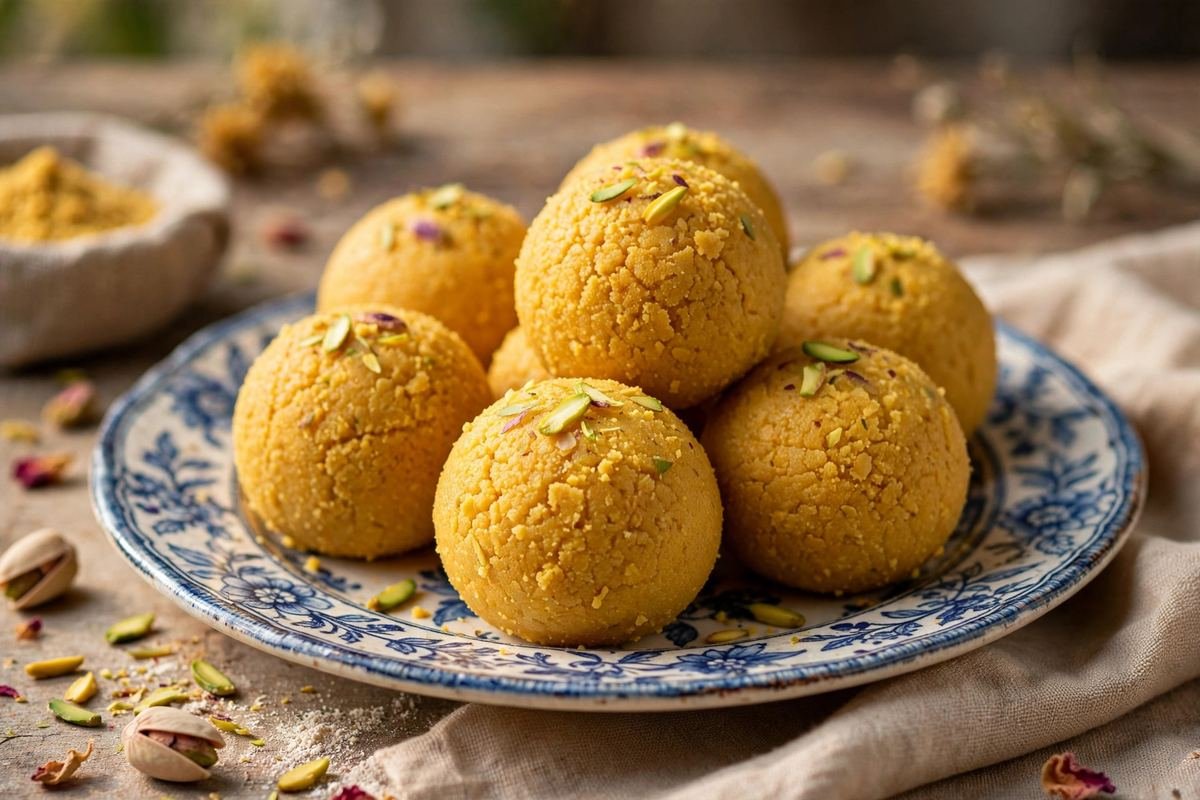
Classic besan ladoo with a foolproof roasting method — coarse besan slow-roasted in ghee until nutty and golden, sweetened with powdered sugar and cardamom, shaped into perfect melt-in-mouth spheres.
Ingredients
- 375g fine besan (gram flour), about 3 cups, sifted
- 125g coarse besan (mota besan), about 1 cup, sifted
- 250g ghee (1 cup + 1 tablespoon), plus 1 extra tablespoon if needed
- 300g powdered sugar (2½ cups), sifted
- 8 green cardamom pods, seeds ground to a fine powder
- 1/4 teaspoon freshly grated nutmeg (optional)
- 3 tablespoons melon seeds (magaz) or finely chopped pistachios (optional)
- 20 pistachio slivers or cashew halves, for garnish (optional)
Instructions
- Sift and prep. Sift the fine and coarse besan together into a large bowl, breaking up every lump — lumps that survive roasting become hard, raw-tasting specks in the finished ladoo. Powder the sugar in a mixer if needed and sift it as well. Grind the cardamom seeds to a fine powder. Have everything ready before you start, because the roast demands your full attention.
- Begin the roast. Melt the ghee in a heavy kadhai over low-medium heat until it is liquid and shimmering but not smoking. Add all the sifted besan and stir immediately to coat every grain with ghee. The mixture will look like wet sand. Lower the heat to low — this entire roast happens on low heat, and rushing it with higher heat is the single most common cause of bitter, burnt ladoos.
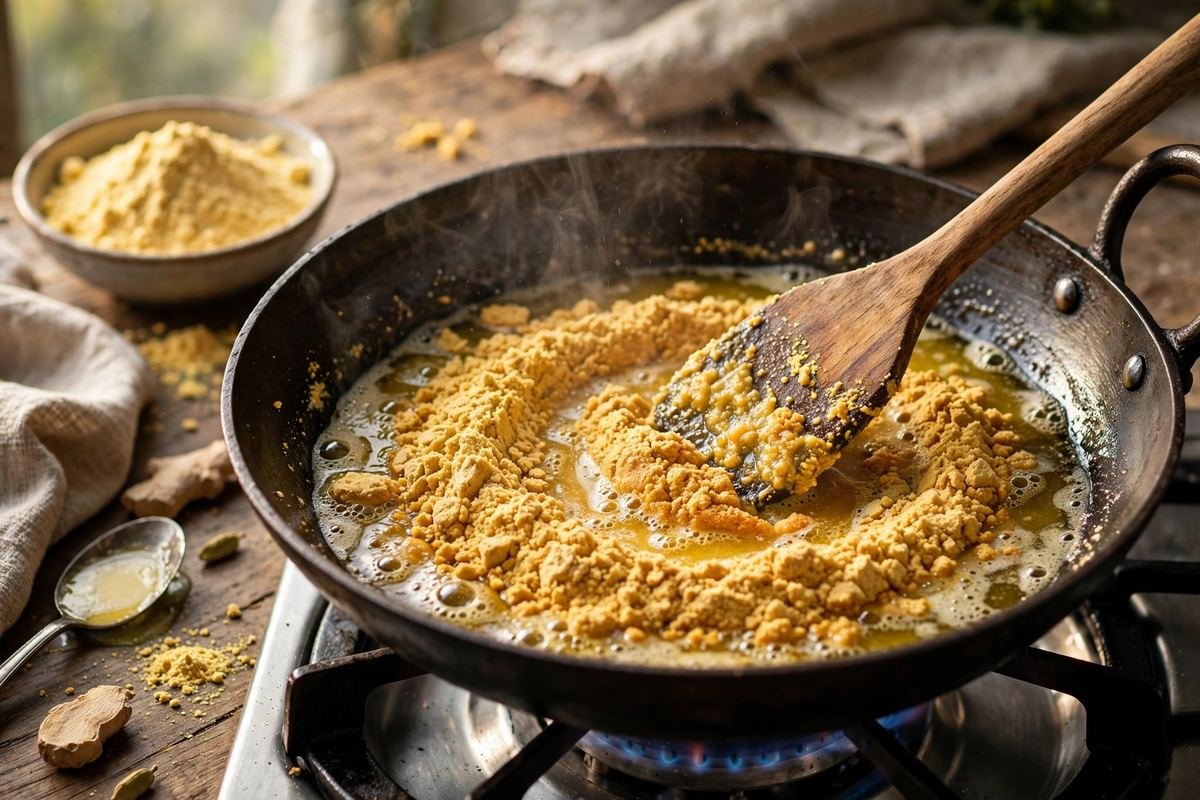
- Roast low and slow (25–35 minutes). Stir continuously with a flat spatula, scraping the bottom and corners of the kadhai, for 25–35 minutes. The transformation happens in stages: first the mixture loosens and turns fluid as the ghee melts fully in (5–8 minutes); then it darkens gradually from pale yellow to a deep golden, almost peanut-butter colour (15–25 minutes); finally, the ghee begins to glisten and separate slightly at the edges, and the unmistakable nutty, roasted aroma fills the kitchen — like baking shortbread. The besan should feel lighter and flow off the spatula in ribbons. If it smells sharp or acrid at any point, the heat is too high — lower it immediately.
- Cool completely — non-negotiable. Transfer the roasted besan to a large bowl or thali, spreading it out to cool faster. Let it cool to room temperature, about 30–40 minutes, stirring once or twice. It must be completely cool to the touch. Adding sugar to warm besan melts it, and melted sugar makes the mixture sticky, greasy, and impossible to shape into clean ladoos. Test by pressing the back of your hand to the mixture — no warmth should remain.
- Add sugar and flavour. Sprinkle the sifted powdered sugar, ground cardamom, and nutmeg (if using) over the cooled besan. Mix thoroughly with your hands or a spatula until the sugar is evenly distributed and the mixture looks like damp, golden crumbs. Fold in the melon seeds or chopped pistachios if using. Taste — the mixture should be sweet with a deep roasted nuttiness and a warm cardamom finish. Adjust sugar now if needed.
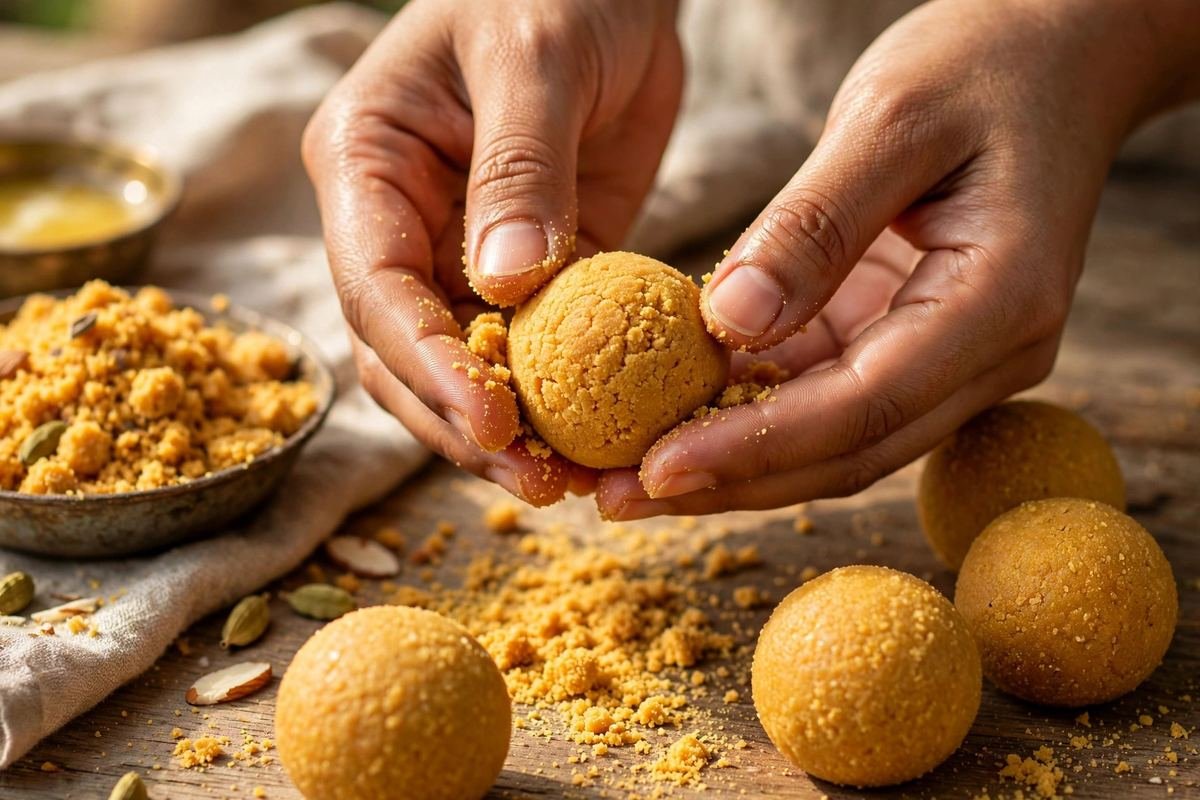
- Shape the ladoos. Take about 2 tablespoons of mixture (roughly 40g) and squeeze it firmly in your fist — the warmth and pressure of your hand melts the ghee just enough to bind it. Then roll between your palms in smooth circles, applying gentle, even pressure, until you have a compact, crack-free sphere about the size of a golf ball. If the mixture crumbles and refuses to hold, sprinkle in 1 teaspoon of melted ghee at a time and mix well. If cracks appear on the surface, the mixture is too dry — again, a touch more ghee fixes it.
- Garnish and set. Press a pistachio sliver or cashew half gently into the top of each ladoo while it is still soft. Arrange on a thali or tray and let them rest at room temperature for 1–2 hours. They will firm up as the ghee sets, developing that perfect texture — crisp enough to hold, soft enough to melt.
Tip: Read through the full post below for step-by-step photos, pro tips, variations and FAQs before you start cooking.
The Story Behind India’s Most Loved Ladoo
Ask any Indian which sweet defines Diwali, and besan ladoo will be near the top of every list. These humble golden spheres — made from nothing more than chickpea flour, ghee, sugar, and cardamom — have graced festive thalis, wedding favours, and temple prasad for centuries. Their beauty lies in their simplicity: there is nowhere to hide. With only four core ingredients, every ladoo is a testament to technique — the slow, patient roasting of besan in ghee that transforms a raw, beany flour into something nutty, fragrant, and deeply golden.
The word ladoo comes from the Sanskrit ladduka, meaning a small ball, and ball-shaped sweets have been part of Indian cuisine since ancient times — Ayurvedic texts mention ladoo-like preparations made with medicinal herbs. Besan ladoo as we know it today is a North Indian classic, and its magic lives entirely in the roast. Under-roast the besan and the ladoos taste raw and pasty; over-roast and they turn bitter and dark. The sweet spot is a 25–35 minute roast on low heat, when the flour darkens two shades, the ghee begins to release from the mixture, and the kitchen fills with an unmistakable nutty, almost cookie-like aroma. That aroma is your true north — experienced halwais judge the roast by smell as much as by sight.
This recipe gives you the traditional method with modern precision: the exact visual and aromatic cues for a perfect roast, the critical cooling step before adding sugar (hot besan melts sugar into a greasy paste instead of a crumbly, melt-in-mouth texture), and the hand technique for shaping smooth, crack-free ladoos. We use a mix of fine and coarse besan for the ideal texture — smooth enough to hold together, grainy enough to melt on the tongue. Make these for Diwali, for a housewarming, or simply because a rainy afternoon deserves something sweet, and you will understand why this four-ingredient wonder has never needed improving.
Why You’ll Love This Recipe
- Only 4 core ingredients — besan, ghee, sugar, cardamom — all pantry staples in an Indian kitchen.
- Foolproof roasting guide — exact colour, aroma, and texture cues so you nail the roast every time.
- Perfect texture — a fine-plus-coarse besan blend gives ladoos that hold their shape yet melt in the mouth.
- No special equipment — one kadhai, one spatula, and your hands.
- Festival-perfect — makes 20 ladoos, ideal for gifting in decorative boxes for Diwali.
- Long shelf life — keeps for 2–3 weeks at room temperature, making it the ultimate make-ahead sweet.
- Customisable — easy variations with coconut, chocolate, or dry fruits.
Key Ingredients Explained
Besan (500g, about 4 cups) is gram flour milled from chickpeas, and its grind matters enormously. Fine besan makes smooth, dense ladoos; coarse (mota) besan gives the classic slightly grainy, melt-in-mouth texture that traditionalists prize. This recipe uses a 3:1 blend — 375g fine besan to 125g coarse — for the best of both worlds: ladoos that bind beautifully but still crumble luxuriously on the tongue. Always sift the besan before roasting to break up lumps, and use fresh flour — besan older than 3–4 months can taste stale and bitter no matter how well you roast it.
Ghee (250g, about 1 cup plus 1 tablespoon) is both the cooking medium and a flavour. It carries the nutty aroma of the roast and gives ladoos their rich mouthfeel. Use good-quality ghee — homemade is ideal, or a trusted brand. The ratio here is roughly 1:2 ghee to besan by weight, which yields a moist, binding mixture; less ghee makes crumbly ladoos that refuse to hold shape, more makes them greasy. Resist the urge to substitute oil or butter — the flavour will not be right, and butter’s water content interferes with binding.
Powdered sugar (300g, about 2½ cups) must be powdered, not granulated — granulated sugar gives a gritty texture and does not dissolve into the mixture. Grind regular sugar in a mixer to a fine powder and sift it, or use store-bought icing sugar (without added starch if possible). The sugar is always added to cooled besan: hot besan melts the sugar, releasing moisture that turns the mixture sticky and greasy instead of crumbly. Green cardamom (8 pods, ground fresh) is the classic flavouring — add it with the sugar so its aroma stays bright. A pinch of nutmeg is a lovely optional addition.
Nuts for garnish (optional) — slivered pistachios, a cashew pressed into the top of each ladoo, or melon seeds (magaz) folded through the mixture — add crunch and a festive look. Keep any mix-ins to about 3–4 tablespoons so they do not interfere with binding.
Equipment You’ll Need
- Heavy-bottomed kadhai or wide pan — even heat is critical for the long roast
- Flat wooden spatula or silicone spatula — for constant stirring and scraping
- Fine-mesh sieve — for sifting besan and powdered sugar
- Large mixing bowl or thali — for cooling the roasted besan
- Mixer grinder — for powdering the sugar (if not using store-bought)
- Kitchen scale — ladoo ratios reward accuracy
- 375g fine besan (gram flour), about 3 cups, sifted
- 125g coarse besan (mota besan), about 1 cup, sifted
- 250g ghee (1 cup + 1 tablespoon), plus 1 extra tablespoon if needed
- 300g powdered sugar (2½ cups), sifted
- 8 green cardamom pods, seeds ground to a fine powder
- 1/4 teaspoon freshly grated nutmeg (optional)
- 3 tablespoons melon seeds (magaz) or finely chopped pistachios (optional)
- 20 pistachio slivers or cashew halves, for garnish (optional)
- Sift and prep. Sift the fine and coarse besan together into a large bowl, breaking up every lump — lumps that survive roasting become hard, raw-tasting specks in the finished ladoo. Powder the sugar in a mixer if needed and sift it as well. Grind the cardamom seeds to a fine powder. Have everything ready before you start, because the roast demands your full attention.
- Begin the roast. Melt the ghee in a heavy kadhai over low-medium heat until it is liquid and shimmering but not smoking. Add all the sifted besan and stir immediately to coat every grain with ghee. The mixture will look like wet sand. Lower the heat to low — this entire roast happens on low heat, and rushing it with higher heat is the single most common cause of bitter, burnt ladoos.
- Roast low and slow (25–35 minutes). Stir continuously with a flat spatula, scraping the bottom and corners of the kadhai, for 25–35 minutes. The transformation happens in stages: first the mixture loosens and turns fluid as the ghee melts fully in (5–8 minutes); then it darkens gradually from pale yellow to a deep golden, almost peanut-butter colour (15–25 minutes); finally, the ghee begins to glisten and separate slightly at the edges, and the unmistakable nutty, roasted aroma fills the kitchen — like baking shortbread. The besan should feel lighter and flow off the spatula in ribbons. If it smells sharp or acrid at any point, the heat is too high — lower it immediately.
- Cool completely — non-negotiable. Transfer the roasted besan to a large bowl or thali, spreading it out to cool faster. Let it cool to room temperature, about 30–40 minutes, stirring once or twice. It must be completely cool to the touch. Adding sugar to warm besan melts it, and melted sugar makes the mixture sticky, greasy, and impossible to shape into clean ladoos. Test by pressing the back of your hand to the mixture — no warmth should remain.
- Add sugar and flavour. Sprinkle the sifted powdered sugar, ground cardamom, and nutmeg (if using) over the cooled besan. Mix thoroughly with your hands or a spatula until the sugar is evenly distributed and the mixture looks like damp, golden crumbs. Fold in the melon seeds or chopped pistachios if using. Taste — the mixture should be sweet with a deep roasted nuttiness and a warm cardamom finish. Adjust sugar now if needed.
- Shape the ladoos. Take about 2 tablespoons of mixture (roughly 40g) and squeeze it firmly in your fist — the warmth and pressure of your hand melts the ghee just enough to bind it. Then roll between your palms in smooth circles, applying gentle, even pressure, until you have a compact, crack-free sphere about the size of a golf ball. If the mixture crumbles and refuses to hold, sprinkle in 1 teaspoon of melted ghee at a time and mix well. If cracks appear on the surface, the mixture is too dry — again, a touch more ghee fixes it.
- Garnish and set. Press a pistachio sliver or cashew half gently into the top of each ladoo while it is still soft. Arrange on a thali or tray and let them rest at room temperature for 1–2 hours. They will firm up as the ghee sets, developing that perfect texture — crisp enough to hold, soft enough to melt.
Pro Tips for Perfect Results
- Low heat, always. The entire roast happens on low. If your stove runs hot, use a flame diffuser or lift the kadhai off the burner periodically. Besan goes from perfectly roasted to bitter in under two minutes on high heat.
- Trust your nose. The aroma shift — from raw and beany to nutty and cookie-like — is the most reliable doneness signal, even more than colour. When the kitchen smells like a bakery, the roast is done.
- Stir the corners. Besan burns first in the corners and edges of the kadhai where the spatula misses. Scrape methodically, like folding, covering the whole pan surface every pass.
- Cool fully before sugar. This is the rule that makes or breaks ladoos. Warm besan plus sugar equals a greasy, sticky mess. Room temperature means room temperature — be patient.
- Sift twice. Sift the besan before roasting and the sugar before mixing. Lumps are the enemy of smooth ladoos.
- Fix dry mixture with ghee, not water. If ladoos crack or crumble, add melted ghee a teaspoon at a time. Water will make them soggy and spoil the shelf life.
- Size them evenly. Use a tablespoon or small scoop to portion the mixture so all ladoos are the same size — they look professional and set evenly.
Variations to Try
- Coconut besan ladoo: Replace 100g of the besan with 100g of desiccated coconut, added in the last 5 minutes of roasting. Tropical, fragrant, and slightly chewy.
- Chocolate besan ladoo: Add 3 tablespoons of cocoa powder with the sugar and a pinch of cinnamon. A modern fusion that children adore.
- Dry fruit ladoo: Fold in 1/2 cup of finely chopped dates, figs, almonds, and cashews with the sugar, and reduce the sugar to 200g. Richer and naturally sweet.
- Rava-besan ladoo: Replace the coarse besan with 125g of fine semolina (rava), roasted alongside. Gives a delightfully grainy, traditional texture.
- Kesar besan ladoo: Soak 15 saffron strands in 1 tablespoon of warm ghee and add with the sugar for a golden colour and luxurious aroma — the festive showpiece version.
Serving Suggestions
Serve besan ladoos at room temperature on a decorative thali, garnished with pistachio slivers and a few edible silver leaves for festive occasions. They are the classic Diwali gift — pack them in lined sweet boxes with a card, and they will outshine anything store-bought. At pujas and religious ceremonies, offer them as prasad; their long shelf life makes them ideal. For an elegant dessert plate, serve one ladoo alongside a small glass of chilled masala doodh (spiced milk) or a cup of masala chai — the warm spices echo the cardamom beautifully. Two ladoos per person is a generous serving; they are rich, and one is rarely enough but three is a commitment.
Storage and Reheating
Besan ladoos keep superbly at room temperature in an airtight container for 2–3 weeks — the ghee acts as a natural preservative. In hot, humid weather, refrigerate them for up to a month; bring to room temperature for 30 minutes before serving, as cold ghee makes them hard and waxy. They also freeze well for up to 3 months in a freezer-safe box with parchment between layers; thaw overnight in the fridge, then rest at room temperature. There is no reheating needed — but if refrigerated ladoos feel firm, 10 seconds in the microwave softens them perfectly. Never store them warm or in a damp container; moisture is the only thing that shortens their life.
Frequently Asked Questions
Why do my ladoos taste raw and pasty?
The besan was under-roasted. The roast must continue until the flour darkens two full shades to a deep golden colour and smells nutty and cookie-like — this takes a genuine 25–35 minutes on low heat. Pale besan means raw flavour, no matter how much ghee and sugar you add.
My ladoos won’t hold their shape and keep crumbling. Help!
The mixture is too dry — it needs more ghee. Add melted ghee one teaspoon at a time, mixing well after each addition, until the mixture holds when squeezed firmly in your fist. Also make sure you are squeezing hard before rolling; the pressure and warmth of your hands is what binds them.
Why did my ladoos turn out greasy and sticky instead of crumbly?
You added the sugar while the besan was still warm. The heat melted the sugar, releasing moisture and turning the mixture into a paste. Next time, cool the roasted besan completely to room temperature first — this single step is the difference between melt-in-mouth and mushy.
Can I use only fine besan if I can’t find coarse besan?
Yes — the ladoos will be smoother and slightly denser, still delicious. For a closer approximation of the classic texture, you can pulse 2–3 tablespoons of the fine besan mixture’s worth of roasted semolina (rava) in, or simply accept the smoother style, which many families prefer.
How do I fix ladoos that taste bitter?
Bitterness means the besan was over-roasted or roasted on too high a heat. Unfortunately this cannot be fixed — burnt besan stays bitter. The batch is best discarded and the roast redone on genuinely low heat with constant stirring. Watch the colour and trust your nose.
Can I reduce the ghee or sugar to make them healthier?
You can reduce the sugar to 250g without harming the texture, but cutting the ghee below about 200g will make ladoos that crumble and refuse to bind. For a lighter sweet in the same family, try dry-fruit ladoos bound with dates instead — but a true besan ladoo needs its ghee.
Besan ladoo is proof that greatness needs no grandeur — just flour, ghee, sugar, and the patience to roast slowly until the whole kitchen smells like celebration. Roll a batch, share them generously, and keep a few hidden for yourself. Every cook deserves a cook’s share.